How to compare and evaluate contract analysis software in 2026

TL;DR
This contract analysis software evaluation playbook helps in-house legal teams move past feature checklists and compare vendors on what drives results: scale, accuracy, speed, cost impact, and workflow integration. The biggest differentiator in any contract analysis software comparison is cross-contract analysis; the ability to surface risk and obligations across your entire repository. Whether you’re weighing standalone AI tools, CLM add-ons, or embedded platforms, this framework gives you a structured way to evaluate vendors and choose the best fit for your legal team.
Contract analysis software has rapidly evolved over the past decade to meet the growing demands placed upon modern in-house legal teams.
Early iterations of contract analysis tools focused on document summaries, keyword search, and basic clause extraction. They helped lawyers read contracts faster, but these tools were limited in power as they weren’t designed to understand contracts at scale.
Today, in-house legal teams are being asked questions that require portfolio-level insight, such as:
- Which contracts expose us to this risk?
- What contractual obligations are triggered by this event?
- Where do we need to act, and how quickly?
Contract review at a portfolio level is slow, expensive, and often incomplete. It requires counsel to trawl through documents one-by-one or outsource this work to external counsel at a great expense.
Thankfully, technology can service this need, with modern contract analysis tools designed to analyze a repository of contracts and provide insight into business obligations. The tricky part is choosing the right technology vendor for your team.
This playbook provides a practical framework to help in-house legal teams compare vendors based on what matters: speed, accuracy, scale, cost reduction, and risk mitigation.
Section 1: Define evaluation criteria before comparing vendors
The first step on your contracts analysis software journey is not to do with vendors, but rather your legal team. It’s critical to define what success looks like for the business and your team.
Ask your colleagues what they want out of new software and create a list of desired outcomes that you can then use as a checklist for vendor evaluation.
Key evaluation criteria
1. Scale
Can the solution analyze your entire contract repository?
This is essential for audits, compliance reviews, and enterprise-wide risk visibility.
2. Accuracy and traceability
Insights must be reliable and traceable. Outputs should always link back to the original contract language as evidence for audits and legal review.
Gartner notes that accuracy can exceed 90% in controlled scenarios, but often varies by contract type and complexity. Baring this is mind, it’s imperative that all data can be traced.
3. Speed to insight
How quickly can the system answer real business questions?
In practice, this means moving from “days or weeks” to “minutes or hours.”
4. Cost impact
Does the tool meaningfully reduce costly areas of legal work such as manual contract review, outside counsel spend or internal administrative tasks?
5. Workflow integration
Does the solution fit in with how your legal team already works and integrates with existing software? Or does it require exporting data, switching systems, and duplicating effort?
Section 2: Core contract analysis software features that matter
Not all features are equal. The most valuable ones are those that directly support legal decision-making.
According to Gartner, most organizations still prioritize single use cases (like extraction or review) when selecting tools. The real value, however, lies in combining capabilities, especially cross-contract analysis and risk visibility.
Feature evaluation table
| Feature | What to evaluate | Why it matters |
| AI clause extraction | Does it use contract-specific models or generic NLP? | Reduces manual review time and data entry whenever new contracts are added to the repository |
| Cross-contract analysis | Can it analyze obligations across the entire portfolio? | Enables audits, compliance, and risk reviews |
| Source verification | Are insights linked to original contract language? | Creates audit-ready outputs |
| Analysis grid | Are there filtering, sorting, and comparison tools? | Enables faster answers at scale |
| Bulk processing | Can it process large volumes quickly? | Critical during urgent events |
| Export & sharing | Can results be exported as structured data? | Improves collaboration with stakeholders and counsel |
| Integration | Is it embedded in a legal system or standalone? | Drives adoption and efficiency |
A key distinction here is cross-contract analysis, which is the ability to move beyond individual documents and understand obligations across a portfolio. This is where many tools fall short, and where in-house legal teams see the greatest value.
Section 3: Vendor comparison beyond feature lists
While contract analysis vendors may look similar on paper, their difference lies in how they integrate with existing software.
The vendor landscape is highly fragmented, with solutions ranging from point tools to capabilities like LawVu Lens.
Comparison criteria
| Criteria | LawVu Lens | Standalone AI tools | CLM add-ons |
| Cross-contract analysis | Yes | Limited | Partial |
| Embedded in legal operating system | Yes | No | Yes |
| Source verification | Yes | Varies | Varies |
| Contract-specific AI models | Yes | Often generic | Mixed |
| Reduces outside counsel dependency | High | Medium | Medium |
What this means in practice
- Standalone tools usually export contracts and work outside of your core legal software systems, which can create friction and limits user adoption.
- CLM add-ons can offer some integration but lack flexibility and be disruptive to legal workflows.
- LawVu Lens allow teams to analyze contracts and extract insights within their legal operating system.
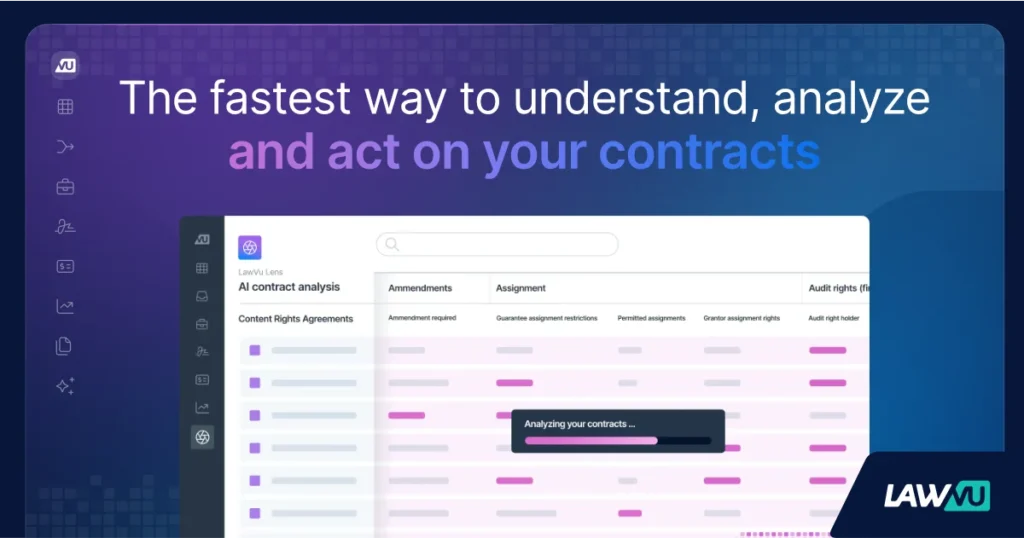
An example of an embedded operating solution is LawVu Lens, which is designed as a AI-powered contract analysis tool built directly within the legal operating system enabling teams to analyze obligations across their repository and act on them in context.
This embedded approach is particularly valuable when analysis needs to lead directly to remediation, reporting, or decision-making.
Continue your contract analysis evaluation
Explore the checklist to help you build your business case and make a confident decision.
Section 4: Future-proofing your decision
Contract analysis software is evolving quickly as AI and technology improve. The vendor you choose should have futureproofing built into its tool, with a guarantee it will improve over time, not become obsolete.
Questions to ask vendors
- How will contract coverage expand?
Focussing on additional contractual obligation categories and contract types.
- How does the AI improve over time?
Is the AI trained on legal-specific models? Can it be refined?
- Can the platform support ongoing contractual obligation monitoring?
Not just one-time analysis, but continuous visibility?
- How does it handle ambiguity?
Strong solutions flag uncertainty rather than making unsupported assumptions, ensuring legal oversight remains central.
The most effective tools should act as decision support systems, not replacements for legal judgment.
Making the right contract analysis software decision
The best contract analysis software should do much more than just helping you read contracts faster.
It should:
- Analyze contracts at scale
- Identify contractual obligations and risks quickly
- Reduce reliance on manual review
- Support better, faster legal decision-making
As in-house legal teams face increasing pressure to respond quickly and manage risk proactively, the ability to move from documents to data to insight to action is becoming essential.
Explore how LawVu Lens helps in-house legal teams
Analyze contracts at scale, surface critical contractual obligations, and respond to risk with speed and confidence. All directly within a unified legal operating system.