Adoption of these tools has accelerated significantly in the past couple of years, according to research from Gartner, with organizations exploring AI and generative AI contract review.
Today, most legal teams are still in an early stage of adoption, transitioning from manual review to scalable, data-driven analysis.

Gartner defines contract analysis software as “solutions that use AI techniques such as natural language processing, machine learning and generative AI to analyze in-progress or executed contracts to extract provisions and create structured, usable data”.
This data can then be analyzed by legal teams to highlight contractual obligations and deviations, subsequently assessing risk and recommending change.
Contract analysis software takes the time-intensive, manual task of individual contract review off lawyers' hands, making it far more efficient and saving legal teams considerable time.
How? Contract analysis software uses artificial intelligence (AI) to:
Modern tools do more than summarize documents. They turn contracts into structured, searchable data that can be analyzed across an entire contract portfolio.
This allows in-house legal teams to move from document-by-document review to portfolio-level insight.
Traditional contract review relies on lawyers reading contracts document-by-document, which is a laborious task. It is also designed for lawyers working in private practice, who have differing needs to in-house legal teams.
While this approach works for small volumes of documents, it becomes inefficient for businesses growing at scale. This leaves in-house legal teams with no choice but to send tranches of document review work to outside counsel. It also makes portfolio-level insight difficult, as lawyers need to cross-reference information between individual contracts.
The ramifications of an inefficient contract review process are high for legal teams. From slow audit and compliance processes, to high spend and reliance on counsel, and limited visibility into contractual risk.
Cross-contract analysis can analyze obligations and clauses across many contracts at once, made possible by legal technology.
It is not the same as document search or contract summaries. Rather, AI-powered software can search and cross-reference multiple documents simultaneously, producing insights and true portfolio-level analysis.
By harnessing cross-contract analysis, legal teams can ask a specific question and get answers across a whole repository of agreements, such as:
This level of insight is unparalleled for legal teams and provides a new level of clarity and risk management that is a game changer.
Contract analysis software follows a structured process:
Users can analyze insights across contracts
When evaluating what contract analysis software is best for your legal team, look for the following key capabilities:
Embedded workflows with existing legal software and other key business tools
If you’re building a business case for why your company should invest in contract analysis software, detailing common use cases for the tool can help.
Contract analysis software supports a wide range of legal use cases, including:
These instances all require fast and accurate insights across multiple contracts and often place counsel under immense pressure. In these situations, having contract analysis software to make the process more timely, efficient, and effective is invaluable.
There are numerous and substantial benefits for legal teams who use contract analysis software, these being:
Being able to communicate the benefits listed above strengthens your business case for contract analysis software by showing a clear potential return on investment.
Legal teams assessing contract analysis software options should have an evaluation checklist to ensure they are choosing the right tool for their team.
This list should be an antidote to the pain points regarding contract review for your legal team. While it will differ from team to team, there are some universal key points to be aware of.
These are:
For more detailed guidance on evaluating contract analysis software and vendors, read our article: buyer’s guide to best drafting and reviewing contract software.
Lawyers often have trepidation around the use of AI in day-to-day legal work, which can stem from a fear of being made redundant.
It is important to understand that contract analysis software is not designed to replace in-house lawyers; rather its sole purpose is to support legal professionals and reduce the burden of time-consuming, manual document review.
AI tools give in-house lawyers the ability to:
Legal judgment will always remain an essential human task. AI simply gives in-house lawyers information in record time, in a structured format they can easily work with, but they still are the ones responsible for assessing ambiguity, interpreting context, and making final decisions.
In-house lawyers go from data-retrievers to information assessors.
Modern contract analysis solutions like LawVu Lens are embedded into existing legal operating systems, which gives in-house lawyers the ability to analyze contractual obligations without switching tools.
LawVu Lens supports urgent requests, such as audits or incident response, and ongoing contract analysis.
The reduction of manual document review from a legal team’s daily workload enables them to focus on the strategic legal work which generates value for the business.
Ultimately, the best contract analysis software for your legal team should enable you to:
Before committing to a vendor, it’s crucial to determine if their tool will enable the outcomes listed above. Ask vendors for a demonstration and use cases to verify that their contract analysis software will work for your team.
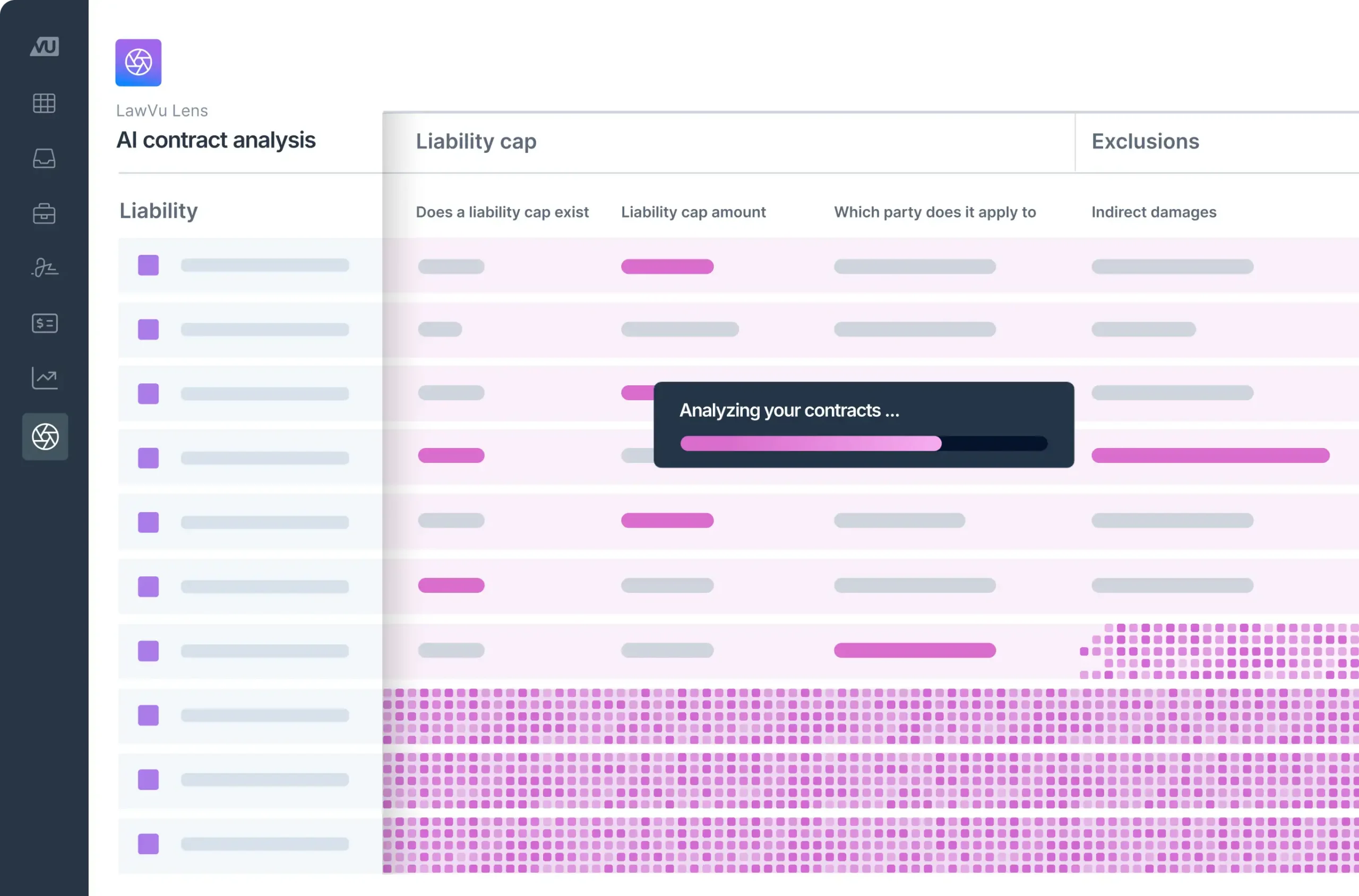
Explore what LawVu is developing to help in-house legal teams analyze contracts at scale and gain insight into their contractual obligations, without adding another disconnected AI tool.
Technology that uses AI to read, extract, and analyze contract data to help legal teams understand obligations, risks, and insights across contracts.
The ability to analyze clauses and obligations across multiple contracts at once, rather than reviewing documents individually.
The process of identifying, tracking, and managing contractual responsibilities such as notification requirements, compliance duties, and renewal conditions.
The identification of specific clauses within a contract, such as termination, liability, or confidentiality provisions.
The full set of contracts managed by an organization.
Contract information is converted into standardized fields such as contractual obligations, dates, and triggers, that can be filtered, compared, and reported on.
The ability to trace extracted insights back to the original contract language.
The use of artificial intelligence to automate the reading and interpretation of contracts.
A unified platform where legal teams manage contracts, matters, documents, and workflows in one place.
Contract analysis software is used to help legal teams understand contractual obligations, risks, and key terms across their contracts. It supports tasks such as audits, compliance reviews, and risk assessments.
AI contract analysis tools read contract text, identify clauses and contractual obligations, and convert them into structured data that can be analyzed across multiple agreements.
Cross-contract analysis allows legal teams to analyze clauses and contractual obligations across many contracts at once, helping them answer portfolio-level questions quickly.
Key benefits include structured datasets and faster legal insights, reduced manual review, lower external legal costs, and improved visibility into contractual risk.
Contract management focuses on storing and organizing contracts, while contract analysis focuses on understanding the content of contracts and extracting insights from them.
Legal teams should evaluate tools based on:
No. Contract analysis software supports legal teams by surfacing insights, but legal professionals are still responsible for interpretation and decision-making.
Most enterprise-grade tools are designed to operate within secure legal environments, often embedded within existing legal systems to protect sensitive contract data.