10 questions to ask before investing in contract analysis software
TL;DR
Before investing in contract analysis software, legal teams should ask the right questions, not just compare features. This article covers 10 of them, from problem definition and scale to transparency, pricing, and integration with your legal operating system. The core idea: the right tool turns unstructured contract language into structured, actionable insight, not just faster document summaries.
AI contract analysis software is quickly becoming a standard part of the in-house legal toolkit as they promise faster answers, better visibility, and reduced reliance on manual review.
Yet not all AI tools deliver the same kind of insight, and it’s important to know what they can do for your legal team. Many solutions focus on summarizing documents, extracting metadata, or enabling clause search, and while those capabilities are useful, they only go so far.
Legal teams are often trying to answer much bigger questions:
- What contractual obligations and subsequent risks exist across our contracts?
- Where are we exposed?
- What needs action?
Comprehensive, private AI tools that can compare a whole swathe of contracts can help answer these questions.
Contracts contain critical responsibilities and risks for the business, yet the challenge is that the obligations within them don’t exist as a single dataset. Rather they sit across hundreds or thousands of individual documents that need to be reviewed individually, often by external counsel. As such, portfolio level contract analysis is laborious and expensive.
Contract analysis software can change this, but it’s critical to ask the right questions before investing in new tools. The following guide will help you evaluate whether a solution will deliver meaningful insight, not just surface-level information.
1. What problem are we trying to solve with contract analysis software?
First, clarify the underlying needs of your legal team and your business stakeholders. These provide you with a checklist of what problems you want contract analysis tools to solve.
Common use cases for contract analysis software are:
- Regulatory or compliance reviews
- Audits and investigations
- Data breach response
- Liability exposure analysis
- Contract renewal and termination reviews
- Vendor or customer obligation checks
It’s important to distinguish between your need for a tool that simply finds contracts or helps you understand contractual obligations.
Metadata search tools are built to help you locate documents or clauses. Fewer tools are designed to extract contractual obligations and analyze risks across a portfolio.
If your goal is to understand risk, responsibilities, and exposure, you need more than metadata.
2 . Can the tool analyze contracts at scale – not just one document at a time?
Legal teams rarely need information from a single contract, rather they need insights gathered from a portfolio of them.
They need answers to questions such as:
- Which agreements contain change-of-control clauses?
- Which vendors require breach of notification within 48 hours?
- Which contracts lack certain compliance obligations?
True contract analysis software should support cross-contract analysis across entire repositories.
A capable solution should allow you to:
- Analyze hundreds or thousands of contracts at once
- Compare obligations across agreements
- View results in structured, filterable formats, with links to source
Without these capabilities, you’re still effectively reviewing contracts one by one, just with a different interface.
3. Does it extract real clause-level insight – or just summarize documents?
Some AI tools generate high-level summaries, which are helpful, but they’re not enough.
Legal teams need structured insight into specific contractual obligations, including:
- What the obligation is
- When it applies (trigger)
- What must be done (action)
- Any relevant constraints or timeframes
Advanced contract analysis software tools should also:
- Identify obligations and risks in contract language
- Categorize them (e.g., data protection, confidentiality)
- Extract key attributes such as triggers, timeframes, and actions
Gathering this structured data enables meaningful comparison and reporting across contracts, allowing for better decision-making.
4. How transparent and verifiable is the AI output?
Trust is crucial for a legal team using contract analysis AI software. If results identify that a contractual obligation exists, you need to be able to verify it quickly.
Ask:
- Can insights be traced back to the source of contract language?
- Are obligations and risks linked to the original clause?
- Can results be validated for audits or regulatory reviews?
Transparency is essential for defensible legal analysis. Without it, insights are difficult to rely on, especially in high-stakes scenarios.
5. Which contract types are supported today – and what’s on the roadmap?
AI models perform best when they’re trained to look across agreement types.
Common examples of these include:
- NDAs
- Master service agreements
- SaaS agreements
- Employment contracts
- Vendor agreements
When assessing software, ask vendors:
- Which contracts are supported today?
- How quickly will coverage expand?
You want to determine if the tool will meet both the current and future needs of your legal team.
6. How quickly can we get answers to urgent or unexpected questions?
Time is a luxury that most legal teams do not have. When business stakeholders have questions about situations such as data breaches, regulatory changes, or executive risk reviews – they want the answers fast.
The issue is that manual contract review can take weeks, putting in-house lawyer’s on the back foot. AI contract review should allow you to:
- Analyze large volumes of contracts quickly
- Identify relevant obligations in hours – not weeks
- Respond confidently under time pressure
This shift from a slow and reactive review to a team that can rapidly gather insight is invaluable to the business.
7. Will this reduce our reliance on external counsel?
Large-scale contract reviews are often outsourced to external counsel, which comes at a high cost and also causes a delay.
The right software solution should help you to:
- Perform initial analysis internally
- Prepare structured datasets for external counsel
- Reduce administrative review time
Instead of replacing external counsel, contract analysis software allows you to use them more effectively, focusing their time on high-value legal judgment, not data gathering.
8. Is it embedded in our legal operating system – or another standalone tool?
Standalone AI tools create new silos and friction within the legal team. Contracts may need to be exported, uploaded, or duplicated from tool to tool, which fragments data and slows adoption.
Solutions embedded within a unified legal operating system allow teams to analyze contracts where they are stored and managed, creating a clear advantage.
Benefits include:
- Contracts stay where they already live in a secure repository
- Analysis happens in context
- Results connect to broader legal workflows
This reduces operational overhead and risk and makes insights easier to act on.
9. How flexible is the pricing model as usage grows?
Contract analysis workloads vary. You might analyze a handful of contracts for one month, but hundreds the next, during an audit or investigation.
Baring this in mind, it’s smart to look for pricing models that align with usage.
Common models include:
- Annual license fees
- Usage-based pricing per document analyzed
- Bundled features within broader platforms
Look for flexibility. The cost should scale with usage, and be justified by time savings, reduced risk, and lower external legal spend.
10. Will this support long-term obligation and risk management – not just one-off reviews?
One-off analysis is valuable. But ongoing insight is more powerful, enabling legal to be a true strategic business partner.
The best tools support continuous contract intelligence, including:
- Ongoing contractual obligation and risk monitoring
- Portfolio-level reporting and insights
- Renewal and termination tracking
- Regulatory compliance reporting
These capabilities help legal teams move from reactive contract review to proactive risk management.
The right tool doesn’t just analyze – it transforms legal work
Choosing the right contract analysis software requires careful evaluation. It’s not just a technology decision, rather it’s a capability decision.
The right solution should help your team:
- Analyze contracts at scale
- Surface contractual obligations and risks across your portfolio
- Answer complex questions quickly
- Reduce manual review and external legal spend
Most importantly, it should give you clear visibility into the commitments that shape business risk and opportunity.
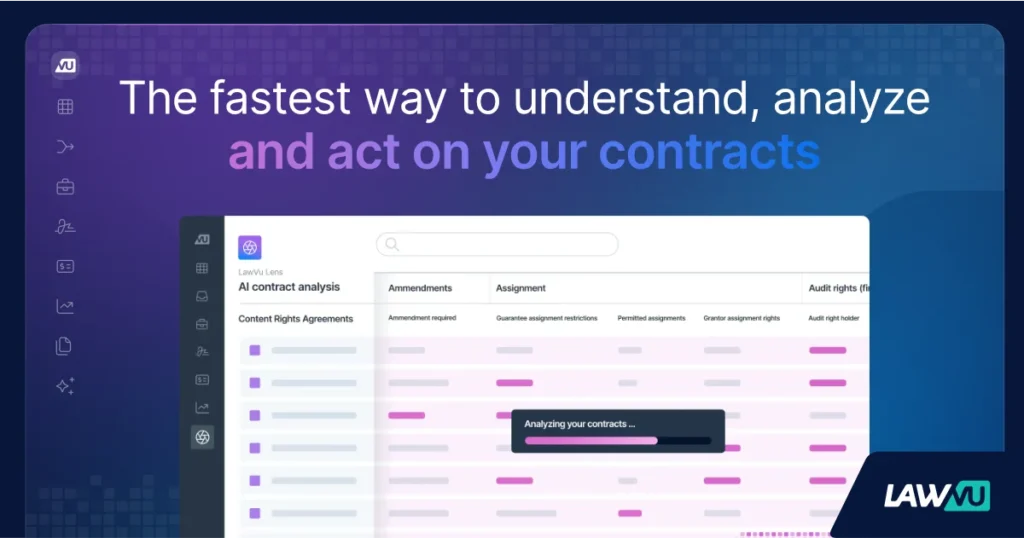
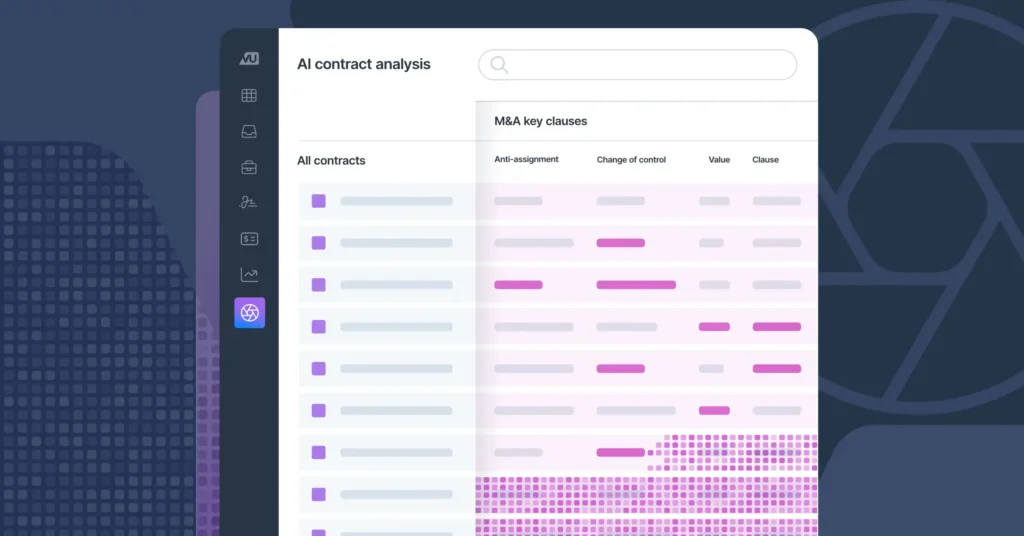
LawVu Lens is designed with these principles in mind. It enables in-house teams to analyze obligations across their contract portfolio, turning unstructured contract language into structured, comparable data.
By surfacing obligations and risks, linking them back to source clauses, and enabling analysis across thousands of contracts, it helps legal teams answer complex questions quickly and act with confidence.
Explore real-world contract analysis use cases:
Make your final decision with confidence
See how contract analysis software performs against your evaluation checklist; using real contracts, real questions, and real outcomes.