The best contract analysis software | 2026
TL;DR
This guide breaks down what “best-in-class” contract analysis software actually delivers; portfolio-level obligation analysis, fast insight, clause-level accuracy, and traceable outputs. It compares three vendor types (legal operating system-embedded, standalone AI assistants, and CLM add-ons), covers pricing and ROI calculation, and ends with buyer tips: start with high-risk use cases, test output quality against manual review.
Traditionally, contract analysis has been one of the most laborious and time-consuming aspects of in-house legal work. And in the context of audits, regulatory changes, and internal business investigations, corporate counsel have relied heavily on manual document review or outsourcing work to external counsel (at considerable expense).
The advent of legal technology is finally changing this, giving legal teams back time and providing greater accuracy. Modern AI contract analysis tools can quickly identify legal obligations, risks, and opportunities across entire contract portfolios, while removing the barrier of manual review.
The market for contract analysis software is flooded with options, so it’s important to understand what “best-in-class” contract analysis software looks like today, how different solutions compare, and what in-house teams should prioritize when evaluating vendors.
This guide is designed to give you that information.
What is contract analysis software and why does it matter?
Contract analysis software harnesses AI to read, structure, and analyze executed contracts at scale. It can be tailored to both law firms and in-house legal teams, and removes the barrier of manual contract review, by searching a portfolio of documents in mere minutes, converting them into structured, searchable data.
Legal teams can analyze large volumes of agreements to understand:
- Compliance with new regulations
- Data protection and confidentiality risks
- Vendor and customer commitments
- Renewal and termination terms
- Liability exposure
The goal of these tools is simple; to help legal teams answer complex questions across their portfolio of contracts quickly and accurately.
Traditionally contract review has been a time-intensive task, where in-house lawyers scour documents one-by-one, or outsource the work to external law firms. It’s an area of in-house legal work that is prone to human error, causes bottlenecks, and comes at a high cost (especially when outside counsel is involved).
New software is a game changer for in-house teams. It can eliminate bottlenecks by enabling analysis across hundreds or thousands of contracts simultaneously.
Section 1: What makes the best contract analysis software?
It could be easy to assume that the best contract analysis software is the most technologically sophisticated, but this is not the case.
Tangible outcomes for legal teams are the real barometer of a great contract analysis tool. Legal teams should evaluate solutions based on their ability to quickly deliver practical, reliable insights across their contract portfolio.
Key attributes include:
1. Portfolio-level obligation analysis
The ability to identify and analyze the business’s obligations across all contracts, not just within individual documents.
2. Speed to insight at scale
Answers should be available in minutes or hours, not days or weeks, even across large datasets.
3. Clause-level accuracy
Extracted data must reflect the nuance of legal language, not just keyword matching.
4. Traceable and verifiable outputs
Legal teams need to validate results. The best tools link extracted data back to source clauses. Where contractual obligations or answers are missing or unclear, they should be flagged for legal review rather than interpreted.
5. Cost savings vs manual review
A strong solution should meaningfully reduce reliance on outside counsel and internal review time.
6. Embedded workflows
Insights should live where legal teams already work, not in disconnected tools.
Ultimately, the best solutions help legal teams move from reactive data gathering and document review to proactive contract intelligence.
Section 2: Must-have features to look for
When shopping around for contract analysis software, look for these core capabilities that should be considered non-negotiable.
1. AI-powered obligation extraction
The system should identify contractual obligations from clause language, not just extract basic metadata.
Leading tools go further by structuring contractual obligations and risks into components such as triggers, actions, and constraints.
2. Cross-contract analysis
The ability to analyze obligations and determine risks across entire repositories is critical as it enables teams to answer questions like:
- Which contracts require breach notification within 72 hours?
- Which vendors have termination-for-convenience clauses?
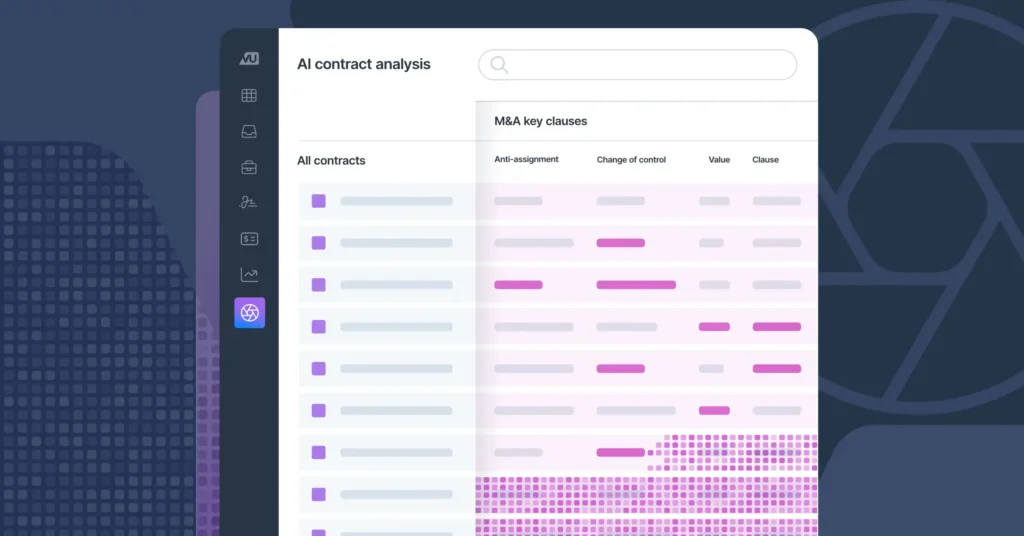
3. Analysis grids
To get the best use of the insights that a contract analysis tool derives, you need structured outputs that are presented in a grid or table format, as this allows users to filter, sort, and compare data. This is efficiency is essential when working across hundreds or thousands of contracts.
4. Source-linked verification
Every extracted contractual obligation should link back to the original contract clause. This ensures transparency, reduces risk, and gives legal teams confidence in the accuracy of their data.
5. Bulk processing
The tool you choose should be able to process large document sets quickly, enabling rapid response to audits, risk events, or executive requests.
6. Structured outputs
Insights should be exportable for different formats such as reports, remediation workflows, and collaboration with stakeholders or outside counsel.
6. Embedded workflow integration
The most effective contract analysis tools should be embedded within a unified legal operating system or contract management systems. People want to work with systems that talk to each other, as it creates once source of truth for the legal team and makes adoption easier.
Section 3: Comparison of contract analysis software categories
Not all contract analysis tools are built the same. There are three distinct types: Contract analysis tools embedded within a legal operating system, standalone AI assistants, and CLM add-on analysis tools.
Understanding the different categories helps clarify trade-offs.
| Category | Strengths | Limitations |
| Legal operating system-embedded contract analysis | Connected data, seamless workflows, faster adoption | Requires existing legal operating system investment |
| Standalone AI assistants | Flexible, easy to test and deploy | Data silos, limited integration with legal processes |
| CLM add-on analysis tools | Convenient for existing CLM users | Often limited in depth, configurability, or cross-contract insight |
Solutions embedded in legal operating systems are often preferred by legal teams because they connect contract data with broader legal workflows. This turns said data into actionable information.
Compare contract analysis software with real-world context
Evaluating vendors goes beyond feature lists. See how different contract analysis solutions compare across capabilities, workflows, and outcomes – and what best-in-class looks like in practice.
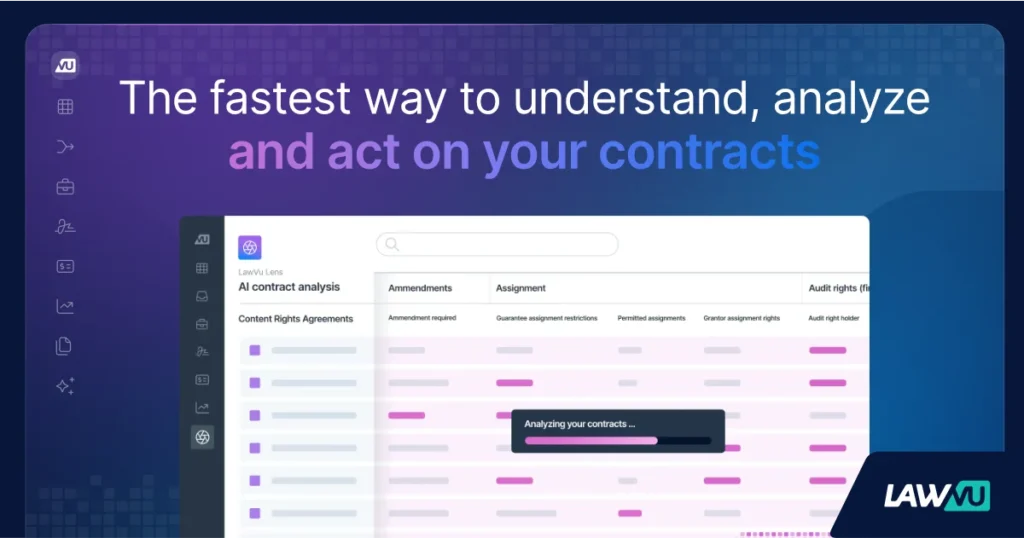
LawVu Lens is an example of a modern, legal operating system-embedded contract analysis solution. Powered by AI and built directly into the LawVu legal operating system, LawVu Lens, it is designed to help in-house teams understand obligations and risk across their contract portfolio.
Key characteristics of LawVu Lens include:
- Cross-contract obligation analysis
Lens surfaces obligations across entire contract repositories, enabling portfolio-level insight.
- Structured contract intelligence
Contracts are transformed into structured data, making them searchable, comparable, and actionable.
- Support for both reactive and proactive use cases
Teams can respond quickly to audits, data breaches, or regulatory changes, while also supporting ongoing reporting and risk management.
- Reduced reliance on manual review and outside counsel
By generating structured datasets, Lens helps legal teams work more efficiently and reduce external spend.
- Embedded within a LegalOS
Insights are delivered within the same system where legal teams manage their work, improving usability and adoption.
LawVu Lens reflects a shift toward continuous, portfolio-level contract intelligence rather than laborious one-off document review.
Section 5: How to evaluate ROI
Business stakeholders will expect to see Return on Investment (ROI) when investing in new legal software, so it helps to build a business case of potential cost savings.
Compare the cost of legal software against existing costs such as:
- Outside counsel spend
Legal teams frequently outsource contract analysis to external counsel due to time constraints.
- Internal time savings
Faster answers reduce legal bottlenecks and improve responsiveness.
- Risk reduction
Better visibility into obligations helps avoid compliance gaps and exposure.
- Business enablement
Legal can support faster decision-making across the organization.
A strong solution should demonstrate measurable improvements across all four areas.
Section 6: Buyer tips – how to choose the right solution
For legal teams actively evaluating vendors, the following approach can help ensure a successful decision.
1. Start with high-risk use cases
Focus on areas where contract visibility is most critical, such as:
- Data protection
- Regulatory compliance
- Liability exposure
2. Test output quality
Compare AI-generated outputs against manual review to assess:
- Accuracy
- Completeness
- Legal usability
3. Validate speed and scale
Ensure the solution can handle large contract volumes without performance issues.
4. Ensure traceability
Every insight should be backed by source-linked evidence.
5. Assess vendor roadmap
Look for solutions that:
- Expand obligation categories over time
- Allow configuration for specific business needs
- Continue improving accuracy and usability
The best contract analysis software for your legal team should factor in much more than pure AI capability. It should improve business and workflow outcomes, enabling teams to:
- Answer complex questions about obligations quickly
- Analyze contracts across their entire portfolio, not just one at a time
- Reduce manual review and outside counsel spend
- Operate within existing legal workflows
As contract portfolios grow and regulatory pressures on businesses increase, these capabilities are essential, not just optional.
Evaluate contract analysis software with confidence
Move beyond feature lists and see how contract analysis performs across real-world scenarios. Explore how LawVu Lens helps legal teams analyze obligations at scale, validate outputs, and make faster, more informed decisions.