
The gap nobody’s talking about
Legal tech has never been more crowded and never made bigger promises.
Every vendor now claims AI. Every product demo looks impressive. And yet, in-house legal teams keep telling us the same thing: nothing’s actually changed.
Requests still arrive through six different channels. Contracts still bounce between email, Word, and a signature tool that doesn’t talk to anything else. Spend still lives in a spreadsheet nobody fully trusts. And when the general counsel gets asked what legal is actually working on right now, the answer takes a week to pull together.
This isn’t a failure of effort. Legal teams have bought good tools. Plenty of them. That’s the problem.
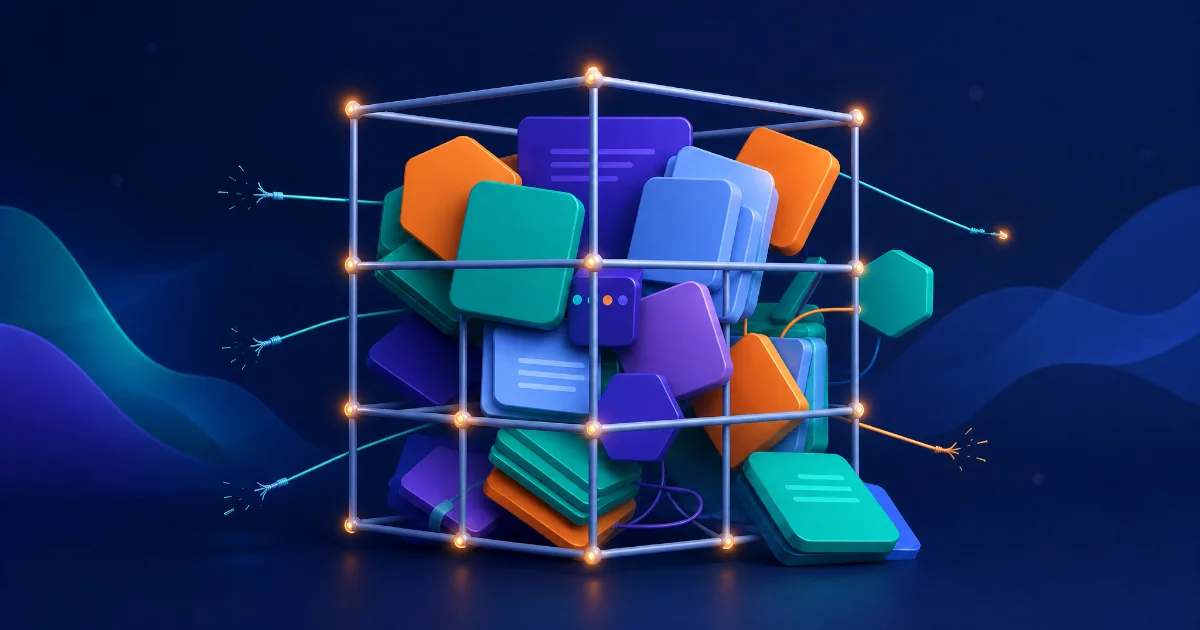
Every tool was chosen to fix one thing. A contract tool for contracts. An intake form for requests. A billing platform for outside counsel spend. Each one works, in isolation. None of them were built to work together.
So, the department that’s supposed to give the business clarity is, itself, running on fragments.
AI was supposed to fix this. Instead, it’s making the gap harder to ignore, because AI built on top of fragments only ever sees fragments.
The problem was never the tools legal bought. It’s what was missing underneath them: a foundation.
That foundation has a name: a legal operating system. Here’s what that means, and why it’s the difference between legal tech that adds features and legal tech that changes how the function runs.
This isn’t a category most legal departments have adopted yet – which is exactly why it’s worth getting ahead of. You’ve heard this comparison before – what CRM did for sales, what ERP did for finance. Legal is the last major function still waiting for its version of that shift, and the wait is starting to show.
What is a legal operating system?
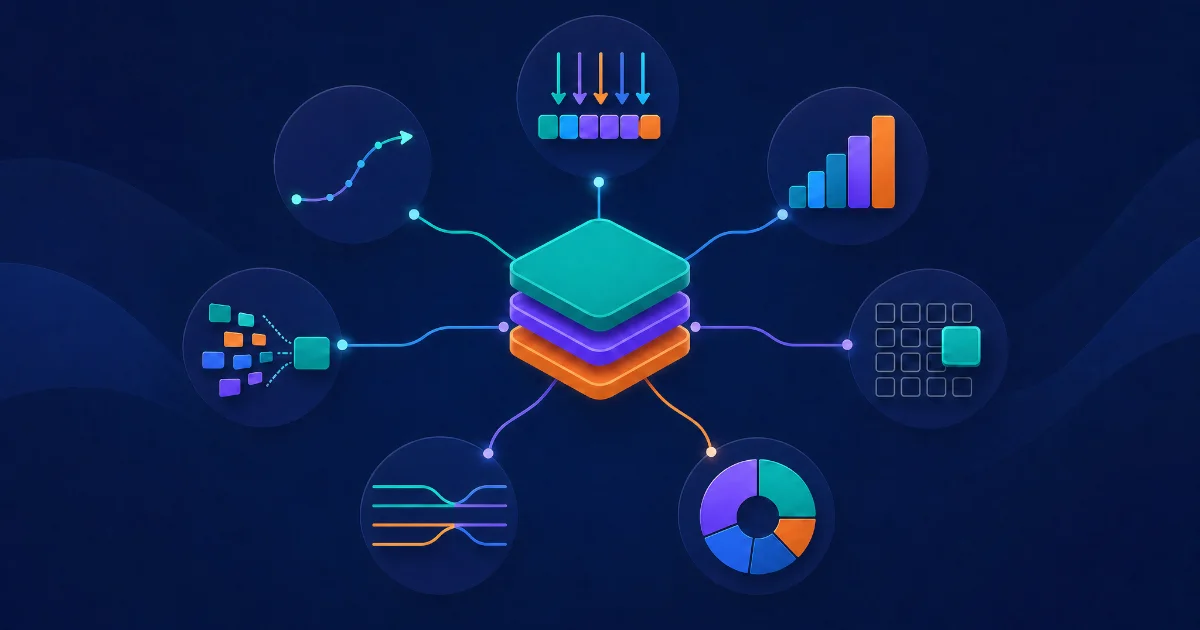
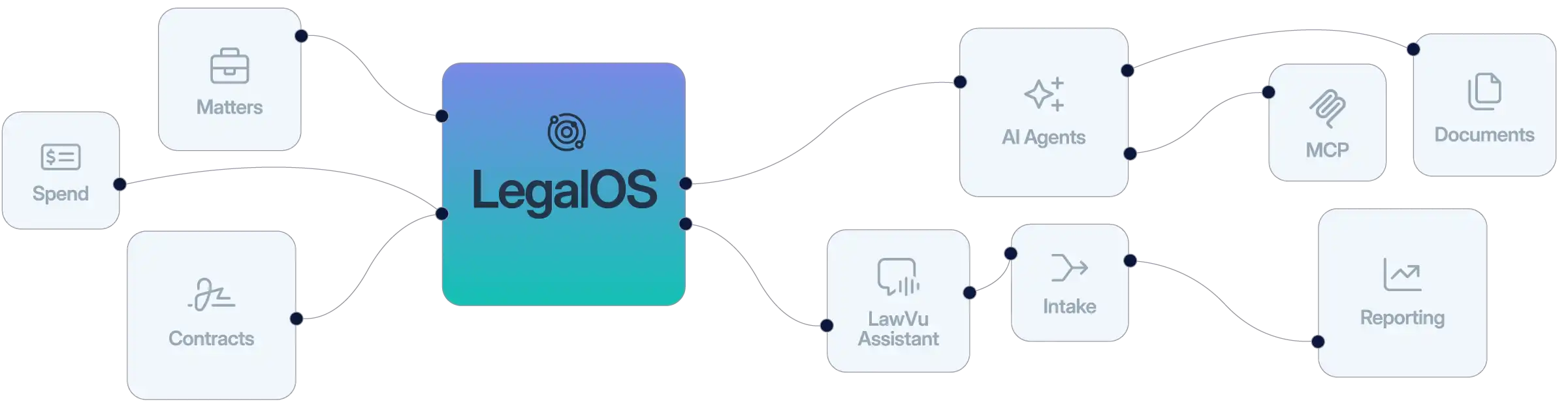
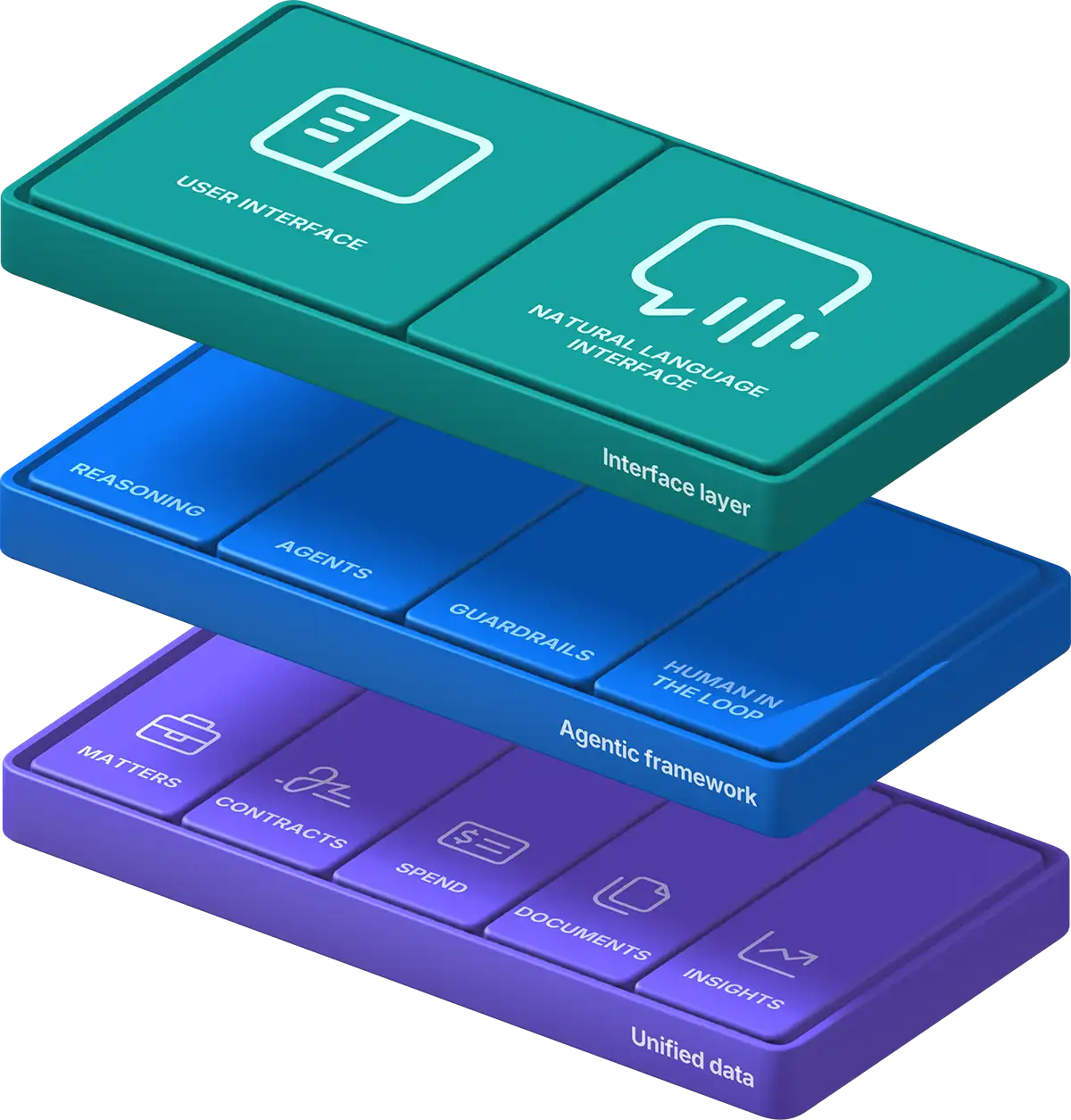
A legal operating system – what LawVu calls LegalOS – connects legal intake, matter management, contract lifecycle management, spend management, documents knowledge, reporting, and AI into a single operational foundation. Every workflow shares the same data. A contract isn’t just a document – it’s linked to the matter it came from, the spend it’s tied to, and the risk it carries. A request isn’t just a ticket; it’s the start of a trail that runs all the way through to resolution and reporting.
It's not a bigger contract tool, an AI assistant bolted onto an existing stack, or a rebrand of "legal workspace." It's the same category shift CRM brought to sales and ERP brought to finance: one shared system of record that makes an entire function visible and governable, not just faster in pieces.
Legal has never had that. Until now.
The difference between a feature and a foundation
A point solution makes one workflow faster. That’s real value, and it’s why legal teams have bought so many of them over the years.
But speed inside a silo doesn’t add up to a connected function. Faster contracts don’t help if legal still can’t answer how much work the team is carrying, where outside counsel spend is heading, or which matters are quietly becoming a problem.
An operating system doesn’t just make one thing faster. It makes the whole function visible from the start.
Why connected beats clever
Plenty of legal tech is clever: AI drafting assistants, smart intake forms, automated invoice review. Every one of these is a genuine improvement over doing the same task by hand.
But clever and connected aren’t the same thing. A clever feature living inside its own silo still leaves you managing five different logins, five data sets, and five versions of the truth.
Connected beats clever because connected compounds. Every workflow that shares the same foundation makes every other workflow better: better reporting, because the data’s already there; better AI, because it can see across the whole function; better governance, because there’s one framework instead of five.
What “purpose-built for in-house” means
Not every “connected platform” is actually built for in-house legal. Plenty of enterprise software connects functions in theory and still forces legal teams to bend their process to fit somebody else’s workflow.
A legal operating system is purpose-built for the way in-house legal operates: how requests come in, how matters get worked, how contracts move through negotiation, how spend gets managed against outside counsel, and how all of it gets reported back to a business that doesn’t speak legal.
That distinction shows up fastest in the details a generic platform gets wrong: matter types that don’t map to how your team triages risk, approval chains built for procurement instead of legal sign-off, reporting fields that mean something to finance but nothing to a general counsel trying to explain workload. Purpose-built isn’t a marketing line. It’s the difference between a platform you configure around your team, and a platform that quietly configures your team around it.
That’s the category. Now here’s what needs to be delivered.
The four things every in-house legal team needs
Tools change. Vendors come and go. AI will look different again in two years.
What doesn’t change is the job. Every in-house legal team, regardless of size, industry, or tech stack, needs the same four things:
Total visibility.
Most legal teams already have some visibility. They know, roughly, what’s on their plate. What they don’t have is total visibility: a single, real-time view across every matter, every contract, every dollar of spend, without pulling three reports and reconciling them by hand.
Fewer surprises are a positive side effect. Total visibility is the actual goal – you can’t manage, staff, or defend a function you can’t see in full.
Mechanically, this comes from one thing: every workflow writing to the same record. When intake, matters, contracts, and spend all sit in one system, the dashboard updates itself and pulls the right metrics across all legal work automatically – instead of waiting on someone to compile it. Tracking performance stops being a guessing game and showcasing legal’s value gets a lot easier.
Foresight.
Control is reactive. It tells you when something has already gone wrong: an overdue renewal, a budget overrun, a matter that’s stalled. Foresight tells you before it happens.
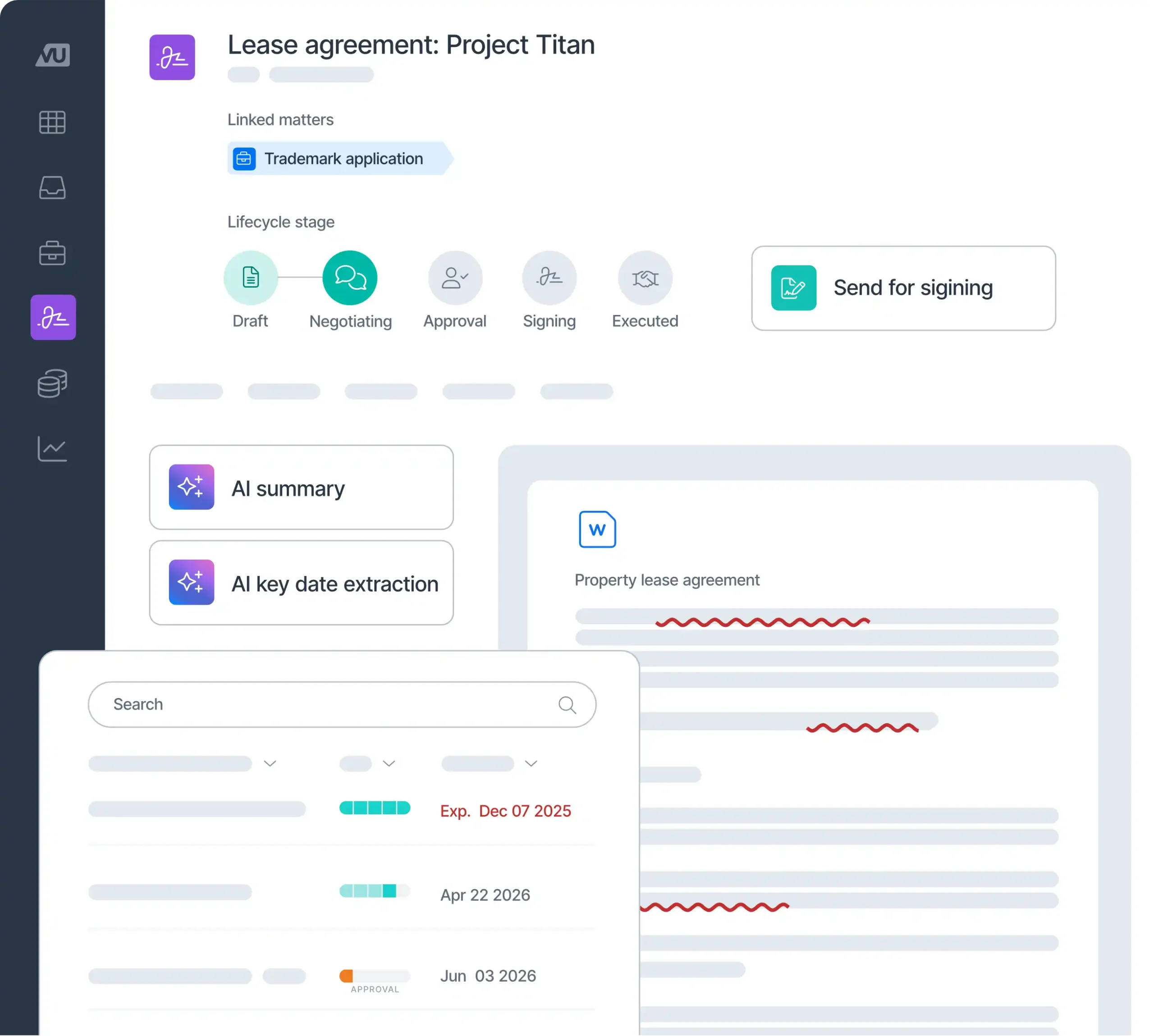
A connected operating system surfaces obligations, renewal dates, and risk patterns across the entire portfolio, not because someone remembered to flag them, but because the data was always there to see. That’s foresight: catching the problem while it’s still small.
This works because obligations and deadlines are extracted and tracked automatically at the contract level, then rolled up across the whole portfolio, instead of living inside individual documents nobody’s re-reading until renewal week.
An intelligent foundation.
Every vendor has an AI feature now. Almost none of them have an intelligent foundation.
The difference is context. A clever feature answers the question you asked, using whatever data it happens to have access to. An intelligent foundation understands the whole function, because it’s built on top of connected matters, contracts, spend, and document knowledge, not bolted alongside them.
That’s what turns AI from a party trick into something legal teams can rely on.
In practice, that means the same AI layer that drafts a contract can also check it against your playbook, flag that it touches a matter already over budget, and log the whole exchange for audit, because drafting, playbooks, matters, and spend all live in the same place it’s reading from.
A way to get ahead.
Most legal tech is built to help you keep up: process the intake faster, turn the contract around quicker, close the invoice sooner. Useful, but it’s still a treadmill.
A legal operating system is built to help legal get ahead – to move from a reactive service provider to strategic partner with the business, which consults with legal before decisions get made, not after. That shift doesn’t come from working faster inside a fragmented system. It comes from operating on the same kind of strategic infrastructure sales and finance have had for years.
Concretely: when reporting is real-time instead of reconstructed, legal can walk into a planning meeting with next quarter’s risk and workload already mapped, instead of explaining what happened last quarter after the fact.
These four things aren’t separate initiatives. They come from the same source: a connected foundation where every workflow feeds the others.
Visibility feeds foresight. Foresight feeds a more intelligent AI layer. And all of it, together, is what gets legal ahead of the business instead of behind it.
Why AI as an engine changes everything
In-house legal leaders don’t need convincing that AI matters. That conversation is over. AI for in-house legal isn’t the future of legal operations – it’s already the present.
The conversation that isn’t over is what kind of AI actually works.
The problem with AI wrappers
Most “AI-powered” legal tools are wrappers: a chat interface sitting on top of the same disconnected system that existed before. Ask it a question, and it answers using whatever slice of data it can reach, usually just the one application it lives in.
That’s not nothing. But it’s also not what people mean when they say AI is going to change legal operations. A wrapper can summarize a contract. It can’t tell you the same clause you’re negotiating today created a dispute in a different matter last year, because it has no way of seeing that matter.
You can usually spot a wrapper in the first five minutes of a demo. It answers the question you typed, and nothing more. It can’t tell you what it doesn’t already have open in front of it, because it was never given a way to look further. Ask it something that spans two systems, a contract and the matter it belongs to, or spend and the deadline driving it, and the answer quietly falls apart.
AI wrappers make individual tasks faster. But they make it harder for legal to work smarter as a team.
What AI as the engine, not the feature, delivers
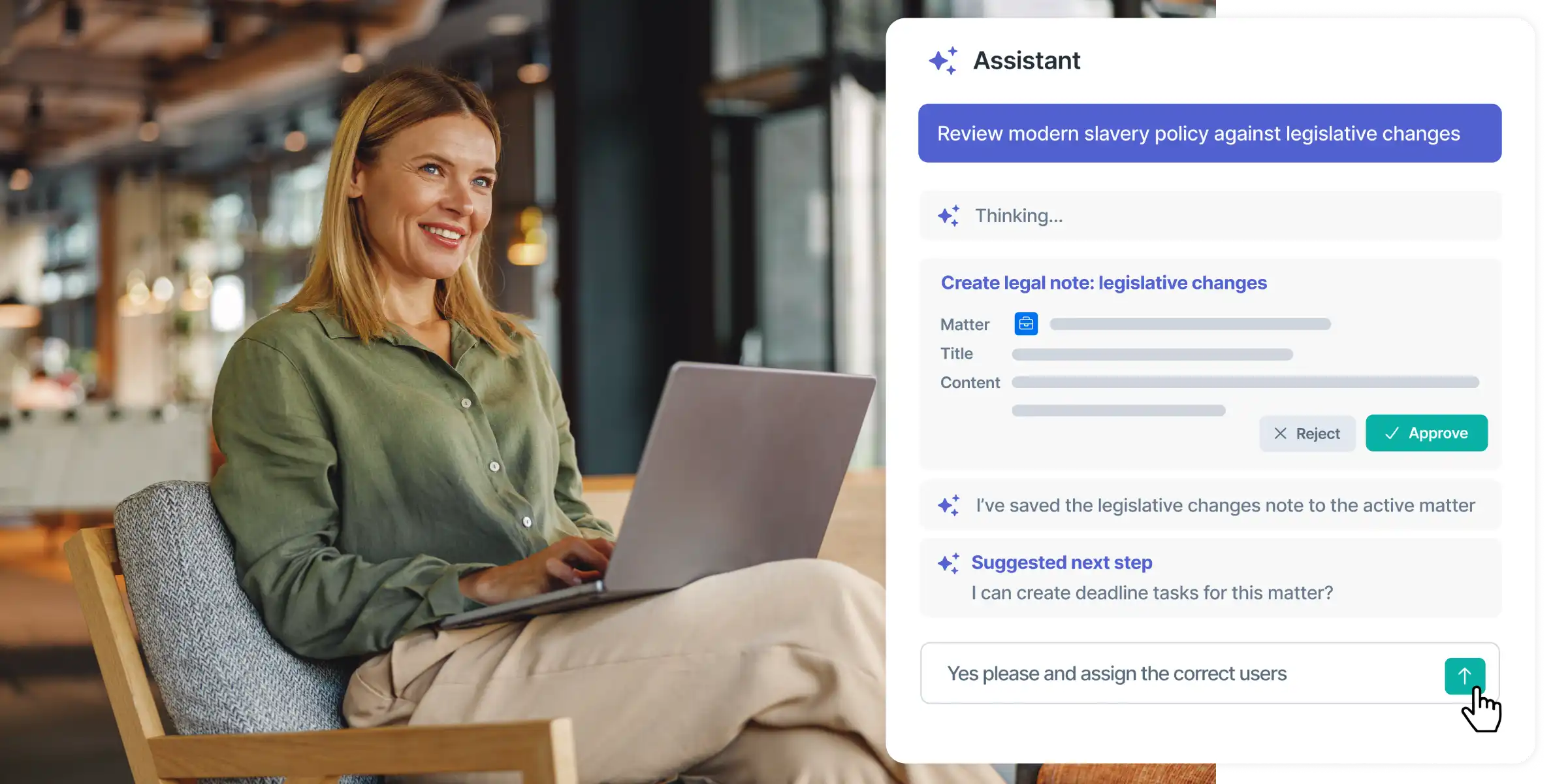
Inside a legal operating system, AI isn’t a feature sitting on top of the platform. It’s the engine running through it.
That means AI can see a request the moment it comes in and route it before a human even looks at it. It means AI can flag that a contract renewal, a matter deadline, and a budget threshold are all converging on the same week, because it has access to all three. It means AI can draft, review, and summarize with the context of your team’s own playbooks and precedent, not a generic model’s best guess.
A feature answers questions. An engine acts – permission-aware, auditable, with a human in the loop where it matters.
A decade of in-house data as the foundation
Here’s the part most AI vendors can’t offer – context that comes from years of real in-house legal work.
An operating system built specifically for in-house legal accumulates exactly the kind of data that makes AI genuinely useful: how requests get triaged, how contracts get negotiated, where risk tends to hide. That’s a different starting point than a chatbot with no memory of your function.
This is why the infrastructure question matters more than the AI question. The AI is only ever as good as what it’s connected to. Build it into the engine, and it can suggest a workflow or pull up related contract clauses. Bolt it on as a feature, and it stays exactly as smart as the day it launched.
That compounding effect is the part that’s easy to miss in a demo but impossible to miss a year in. A wrapper is the same tool on day 400 that it was on day one. An engine built into a connected foundation can draw on real intake patterns, negotiation history, and risk signals to make the next answer more relevant than the last. Not because it is "learning" in the abstract, but because it is operating inside the system where legal work actually happens.
What this looks like in practice
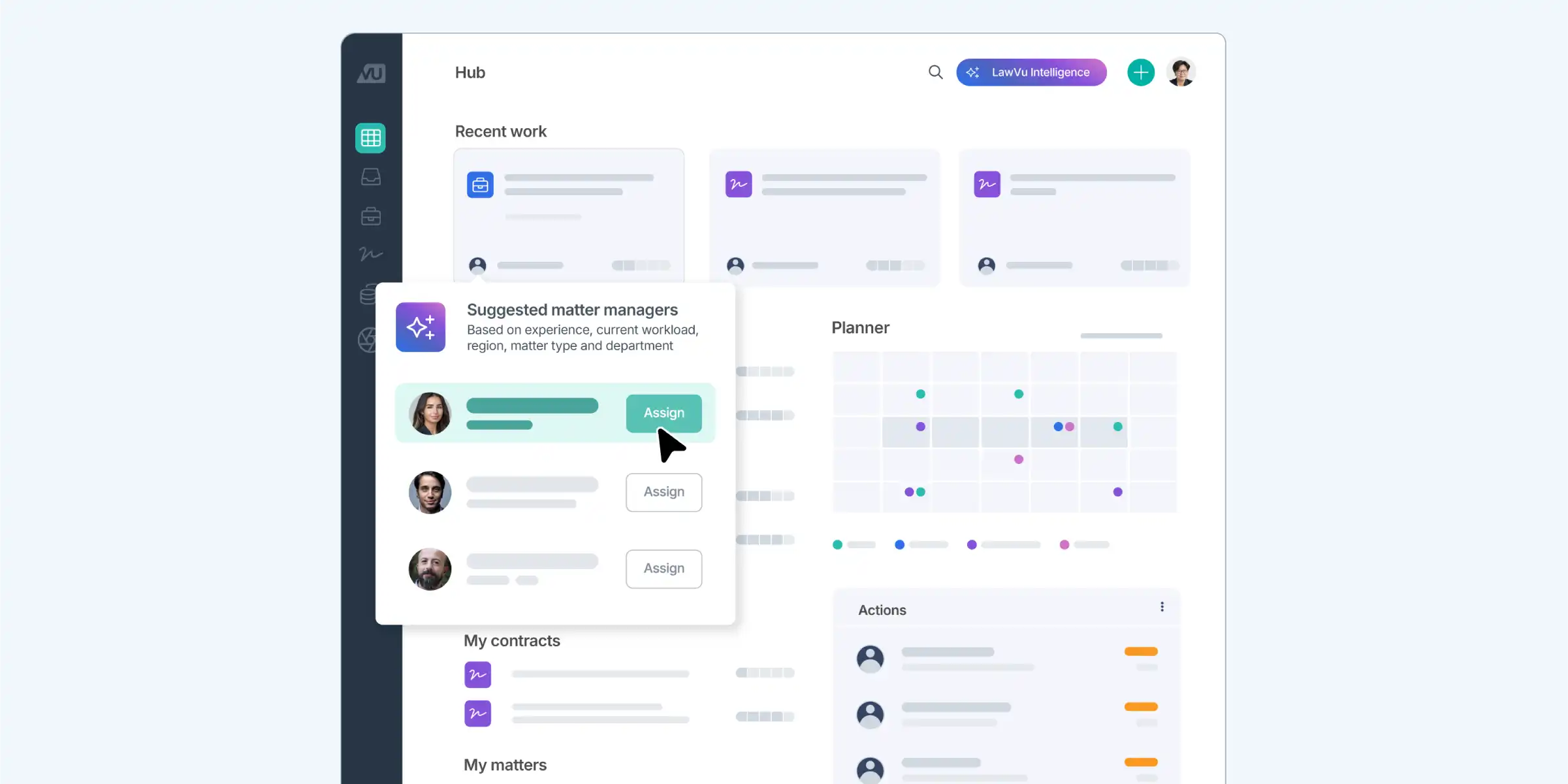
Here’s what a connected operating system changes:
A request comes in from sales – not through email, not through a Slack message that gets lost by Thursday, but through a guided intake flow that already knows which template applies and routes it to the right person automatically. No triage meeting required.
A contract stalls in review.
Instead of someone remembering to chase it, the system flags that it’s been sitting three days past your team’s usual turnaround, because it can see every other contract timeline and knows this one is an outlier.
An outside counsel invoice comes in over budget.
The system catches it against the matter it’s tied to, not just the vendor rate card, because spend and matters live in the same place. No more discovering the overage at quarter close.
The general counsel gets asked, with no notice, what legal is working on this quarter.
Instead of pulling three people off their jobs to assemble a report, the answer is already there, because visibility isn’t a project – it’s the default.
A renewal deadline, a matter that’s quietly gone over budget, and a policy change affecting a dozen live contracts all land in the same week. The system surfaces all three together, because it was watching all three at once. Nobody has to notice the pattern manually – the pattern was already visible.
A new hire joins legal ops mid-way through the quarter.
Instead of a week spent learning where things live across five systems and whose inbox holds the missing context, there’s one system to learn, one place every record already lives.
None of these moments are dramatic. That’s exactly the point. A legal operating system doesn’t announce itself with a big transformation moment. It just quietly removes the version of the day where legal is always one step behind, chasing information instead of acting on it.
Add those moments up over a quarter, and the change stops being quiet. Meetings that used to open with “let me pull that together” open with an answer instead. Budget conversations happen before the overage, not after. The general counsel walks into the executive meeting with the same real-time view of legal’s work that the CFO has of finances. That’s not a feature list. That’s what a foundation looks like once it’s running underneath the work.
Where this leaves your existing tools
None of this requires ripping out everything you’ve already bought. Most legal teams that move to a connected operating system don’t start from zero; they start from the same fragmented stack described at the top of this guide and consolidate onto the foundation over time.
Some point solutions get retired, because the operating system now does that job natively. Others stay in place and connect in, because they’re genuinely best-in-class at one thing, and there’s no reason to replace them. The test isn’t “does everything live in one tool.” It’s “does everything live on one foundation, whether or not every tool sits inside it.” That’s the practical version of “connected beats clever”: it’s not about fewer logins for their own sake; it’s about one shared record everything else can plug into.
More than just a pretty interface
AI for in-house legal only earns its place inside a foundation like this. None of this is a nicer dashboard.
It would be easy to sell a legal operating system on looks: a cleaner interface, a friendlier intake form, a slicker AI chat window. Plenty of vendors do exactly that, and plenty of legal teams have been burned buying it.
But an interface is what you see. An operating system is what’s underneath it – the connected foundation that makes total visibility, real foresight, a genuinely intelligent AI layer, and an actual path to getting ahead all possible at the same time, instead of five separate promises from five separate tools.
That’s the case this guide has been making. Not a better-looking version of the same fragmented stack, but the infrastructure legal has been missing while every other major business function already had it.
Legal has earned its seat at the strategic table. What it’s been missing is the operating system to hold that seat, not just occupy it.
That’s what LawVu’s legal operating system is built to be. So yes: more than just a pretty interface.
LegalOS readiness assessment
Now that you understand what a legal operating system is, use this checklist to assess if your team is ready for one.
Check the following boxes based on where you are today:
Total visibility.
Foresight.
An intelligent foundation.
A way to get ahead.
Your score
0 to 2 checked.
If you score 5 or below
You’re ready to start building your business case for a legal operating system.