AI inside LegalOS: Seven use cases for general counsel
TL;DR
Connected AI changes what general counsel do, not just how fast they draft – it triages incoming work, preps board reporting, and surfaces risk across an entire portfolio automatically. None of it works without connected data first. The edge going forward comes from the operating system behind the AI, not the AI features themselves.
Ask most people what AI has changed about legal work, and the conversation goes straight to contract drafting. A clause gets suggested. A first draft appears in seconds. The story ends there.
That story is incomplete. The general counsel furthest along with AI are not using it to draft faster. They are using it to see further, ahead of a request before it lands on their desk, across a portfolio of matters before a board meeting, through months of spend data before a renewal conversation.
The opportunity was never really about speed. It is about a different way of running a legal function altogether, one where AI for general counsel means something closer to judgment support than typing assistance, and where the strongest legal AI use cases rarely start with a document at all.
Portfolio analysis makes the point concretely. Run AI across a legacy contract set – or one just inherited through acquisition, and it surfaces what’s been sitting there unnoticed: uncapped indemnities, mismatched governing law, exposure nobody has revisited in years. The same lens turns a due diligence review from weeks into hours.
Two kinds of AI, and only one that scales
Most legal AI still lives inside a single document or a single application. It can summarize a contract you hand it or answer a question about the file you have open. That is useful, but it is also limited: the AI only knows what you show it. For a long time, that was simply what AI in legal operations meant: a faster way to handle one task at a time.
Connected AI works differently. Because it sits across every matter, contract, request, and invoice a legal team touches, it can draw on the full shape of the department’s work, not just the page in front of it. That only works, though, if the underlying data has been brought together into a single source of truth, in the first place, rather than living across scattered systems.
| Isolated AI | Connected AI |
| Answers questions about one document | Understands work across contracts, matters, requests, and spend |
| Works within one application | Works across legal operations |
| Limited context | Rich operational context |
| Individual productivity | Organizational intelligence |
Keep that distinction in mind, because it explains why the same underlying technology produces very different outcomes depending on where it sits.
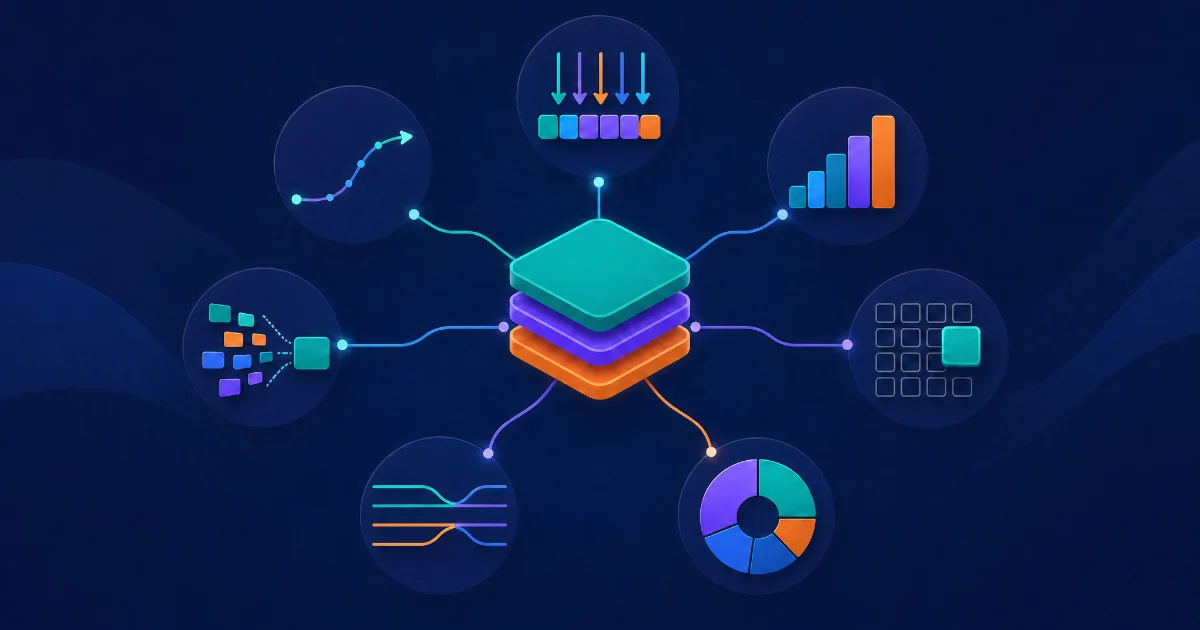
What follows are seven legal AI use cases playing out right now, each one grounded in connected legal data rather than point solutions working in isolation:
1. Prioritizing legal requests (intake)
Legal requests (intake) rarely arrive well formed. They land as a two-line email or a vague ticket, missing the context that would let legal triage it properly. Connected AI reads each request against the full record of past matters, so it can flag urgency, likely business impact, and what information is still missing before anyone on the team has opened the file.
Legal stops guessing at priority and starts working from it, which is a small shift in sequence with an outsized effect on how the week runs.
2. Preparing for executive meetings
The same logic changes how a GC walks into a board meeting. Rather than pulling together workload figures, contract status, and outside counsel activity by hand the night before, AI assembles that picture continuously across the legal operating system.
Preparation becomes a five-minute review of what the system already knows, not an evening spent chasing colleagues for updates.
Not just fewer surprises. Total visibility.
3. Ending the single point of failure
Legal work has a long memory problem, and general counsel usually are that memory themselves. The reasoning behind a past exception, the clause negotiated with a particular supplier, the precedent set two years ago: none of it lives in a system, it lives in the GC’s head. Which means every contract manager, business stakeholder, and new lawyer joining the team eventually asks the same person the same kind of question.
That’s not a search problem. It’s a continuity and consistency problem. When one person is the record, the business only moves as fast as that person is available, and precedent walks out the door the moment they take leave or move on. Two contract managers asking about similar exceptions six months apart may get two different answers, because the “system” is memory, not a record.
Connected data changes what the GC does in that exchange. When matters, contracts, and correspondence sit in one place, prior advice and precedent become something the business can retrieve directly, rather than something only the GC can supply on request. The GC stops being the person everyone must go through and becomes the person who set the rules the system now applies consistently, without being asked each time.
It’s worth noting that this is largely the work of extractive rather than generative AI, a distinction worth understanding since the two solve very different problems. One retrieves what already exists. The other creates something new. Institutional knowledge is a retrieval problem first, which is exactly why it’s one of the more immediately solvable ones.
4. Identifying operational bottlenecks
Zoom out from any single matter, and the same connected record makes it possible to see the department’s operations as a whole. AI embedded across the full workload can spot the patterns a busy GC rarely has time to chase down: which approval stage keeps stalling, which team is quietly overloaded, where a recurring bottleneck is costing the business time.
None of that depends on someone going looking for it. It depends on the work already being connected – intake, matters, contracts, and spend in one system rather than scattered across owners and systems. That’s the foundation a legal operating system provides.
Want to understand the foundation behind connected AI?
AI is only as effective as the operating model that supports it. Learn how a legal operating system connects legal work, data, and intelligence to create the context AI needs to deliver meaningful outcomes. Read: What is a legal operating system?
5. What connected AI looks like in practice
AES Corporation offers a clear picture. Rather than bolting AI onto contract work as a separate tool, the team drafts in LawVu Draft – part of LegalOS, working off the same data as everything else on the platform. It generates first-pass language, flags clauses that fall outside the norm, and checks new agreements against precedents already sitting there.
Adoption tells its own story: AI use within the team rose from 30 percent to 80 percent in a single year.
As Raquel Rodriguez, Associate General Counsel at AES, put it, the team now works from what amounts to “a shared brain of legal drafting knowledge”, rather than each lawyer starting from a blank page.
That is the shift connected AI creates. Not a faster spreadsheet or a cleaner dashboard, but drafting and review work generated from context the system already holds, rather than assembled by a lawyer starting from nothing.
6. Seeing the whole portfolio at once
Instead of answering one contract at a time, AI can read the whole portfolio at once: which obligations are approaching, which clauses carry unusual risk, which agreements need attention this quarter. It is the kind of contract visibility most legal teams have never had, simply because the information was never in one place to summarize.
A standalone tool can only read what you upload to it. Embedded AI is already sitting on the full repository, which is where the efficiencies come from.
7. Supporting outside counsel management
The same logic applies to outside counsel. AI can identify spending trends, recurring work types, and vendor performance across every firm a legal team engages, turning outside counsel management from an annual review into an ongoing conversation.
That same visibility works at the invoice level too. Rather than reviewing charges line by line after the fact, AI can flag discrepancies as invoices arrive, checking each one against agreed billing guidelines and timekeeper rates in real time and surfacing anything that falls outside them before payment goes out.
But spend is only one line of a much bigger report.
The same connected system that catches a billing discrepancy is also holding matter status, workload, and risk data, which means outside counsel spend never has to be reported on its own.
It sits inside the same view general counsel already use to talk to the board about everything else legal is doing, so a conversation about firm performance can move in the same breath to caseload, to risk exposure, to where the function’s time is actually going. That is the shift. Spend stops being a report of its own and becomes one more input into a single picture of legal’s work.
Planning legal resourcing around business strategy
The strongest use case, though, is the quietest one. Instead of reacting to whatever lands on the desk next, AI lets legal leaders look at demand, workload, and resourcing over time, and plan around where the business is genuinely heading.
This is the shift from legal as a response function to legal as a source of foresight, and it is squarely a leadership capability rather than a technical one. It is also where enterprise legal AI earns its name: the value compounds only once it is reasoning across the whole department, not assisting with one task at a time.
The future belongs to connected AI, not AI features
None of this points toward autonomous legal departments or lawyers replaced by software. What it points toward is less administrative drag and more time spent on the advice only a lawyer can give.
As adoption matures, that shift depends less on which AI legal technology a team buys and more on whether the data behind it is connected in the first place, a distinction worth sitting with before evaluating any AI for in-house legal technology, generative or otherwise.
It’s also the difference between a legal function that scales with the business and one that scales its headcount alongside it, since a connected model lets AI absorb growing volume without every extra matter, contract, or invoice needing another person to handle it. Getting there also means preparing the team itself for a genuinely different way of working, and using that technology responsibly once it is in place.
The competitive advantage of the next few years will not come from having the most AI features. It will come from having the most connected operating model behind them.
If any of these scenarios sound like where your own legal function is headed, it is worth understanding what a legal operating system is and how it creates the conditions AI needs to be genuinely useful.
You can also see how it comes together inside LawVu’s LegalOS, or book a walkthrough with the team.