The in-house legal operating system buyer’s guide: How to evaluate, compare, and choose the right platform
 Michaelle Noble

TL;DR
Selecting legal technology is no longer about choosing the best individual tool. It’s about choosing the platform that will support how your legal department operates today and evolves tomorrow.
A legal operating system connects intake, matters, contracts, spend, documents, reporting, and AI on a shared foundation. This buyer’s guide explains what to look for, how to compare vendors, and which questions to ask so you can make a confident, future-ready investment.
Legal has earned influence. Now it needs the operating system to scale it.
The expectations placed on in-house legal teams have changed dramatically.
Today’s legal departments are expected to accelerate commercial activity, provide strategic guidance, manage growing regulatory complexity, and help the business operate with confidence. Executive teams increasingly rely on legal not just to reduce risk, but to influence decisions, support growth, and enable innovation.
While legal’s role has evolved, many teams still work across a collection of disconnected applications purchased over time to solve individual problems.
Contract management lives in one system, matter management in another, invoices in a third, while reporting depends on spreadsheets and manual data collection. And new AI tools promise greater productivity but often operate without access to the complete picture of legal work.
The result isn’t simply inefficiency. It’s an operating model that makes it difficult for legal to scale its influence across the business.
That’s why an increasing number of organizations are rethinking how they invest in legal technology. Rather than adding another point solution, they’re looking for a platform that connects legal work, information, and intelligence into a single operating model.
This is where the legal operating system comes in.
Like CRM transformed sales and ERP transformed finance, a legal operating system provides the infrastructure that allows legal to operate as a connected business function – bringing together people, processes, data, and AI to support every deal, every decision, and every team.
What is a legal operating system?
A legal operating system is a unified platform designed to manage the full spectrum of in-house legal work. Instead of treating contracts, matters, legal requests, outside counsel, and reporting as separate activities, it connects them through shared workflows and a common data foundation.
Core capabilities typically include:
- Legal intake and self-service
- Matter management
- Contract lifecycle management
- Legal spend management
- Document management
- Reporting and analytics
- AI-powered workflows and automation
The distinction between a legal operating system and a traditional legal technology stack is important.
Point solutions are designed to optimize individual workflows. A legal operating system is designed to optimize how the legal function operates as a whole. Because every workflow shares the same operational foundation, information flows more easily across the department, reporting becomes more meaningful, and AI can operate with richer context and stronger governance.
For legal leaders, this creates an opportunity to move beyond managing individual processes toward building a connected operating model that scales with the business.
Understand the legal operating system model
Before evaluating vendors, it’s important to understand what defines a legal operating system and why leading legal teams are moving beyond disconnected point solutions.
Explore the framework, core capabilities, and operating principles behind LegalOS.
How legal technology has evolved
Over the past two decades, legal technology has evolved through three distinct stages.
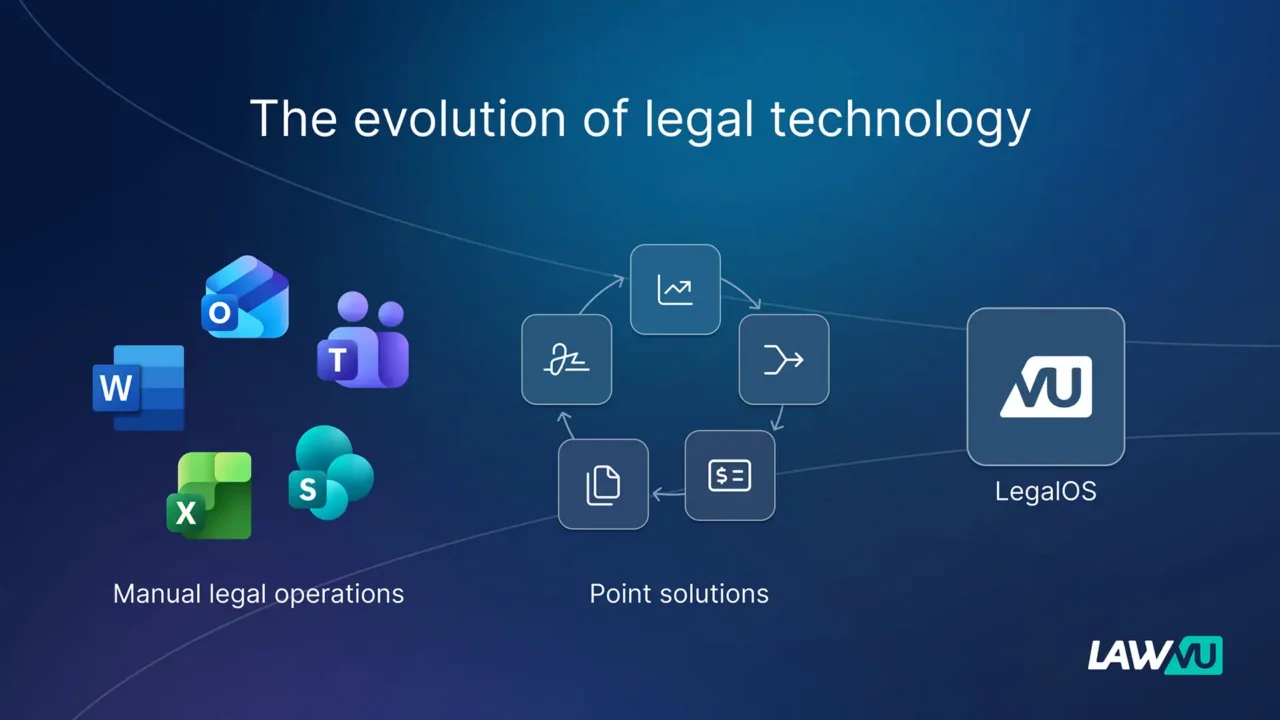
Generation 1: Manual legal operations
Legal work is managed primarily through manual processes and disconnected tools.
- Email-based requests and communication
- Spreadsheets for tracking matters and workloads
- Shared drives for storing documents and knowledge
- Limited visibility into legal work
- Heavy reliance on individual team members
Generation 2: Point-solution legal technology
Organizations begin adopting specialized software to improve specific workflows.
- Contract lifecycle management
- Matter management platforms
- E-billing and spend management solutions
- Workflow improvements within individual functions
- Growing dependence on integrations between systems
Generation 3: Legal operating systems
Modern legal teams are increasingly moving toward connected platforms that unify legal operations.
- Connected legal platform
- Unified workflows across the department
- Shared operational data
- Embedded AI across legal processes
- Centralized reporting, governance, and insights
- A scalable operating model for the future of legal
The shift from point solutions to a legal operating system isn’t simply a technology upgrade. It’s a change in how legal operates, collaborates, and delivers value to the business.
Why point solutions are reaching their limits
Point solutions have played an important role in the evolution of legal technology. Many organizations have successfully improved contracting, matter management, or spend control by implementing specialized software.
The challenge isn’t that these tools fail to deliver value. It’s that, over time, they often create an increasingly fragmented operating environment.
As legal departments grow, disconnected systems make it more difficult to answer fundamental questions about workload, risk, business demand, and performance. Information becomes duplicated across applications, reporting requires manual effort, and users are forced to navigate multiple systems to complete a single workflow.
This fragmentation becomes even more significant as organizations adopt AI. Intelligent automation depends on connected, high-quality data. When contracts, matters, spend, and documents exist in separate systems, AI often lacks the context needed to deliver meaningful results.
The table below highlights the differences between a collection of point solutions and a connected legal operating system.
| Common challenge | Business impact |
|---|---|
| Duplicate data across systems | Reduced data quality and trust |
| Multiple user experiences | Lower adoption rates |
| Manual workflow handoffs | Slower turnaround times |
| Complex integrations | Increased IT dependency |
| Fragmented reporting | Limited operational visibility |
| Siloed AI capabilities | Reduced AI effectiveness |
| Multiple vendors | Greater administrative burden |
For many organizations, the decision is no longer about replacing one application with another. It’s about creating a technology foundation that enables legal to operate as a connected, data-driven business function.
The legal operating system evaluation framework
Before evaluating vendors, buyers should establish a clear evaluation framework.
Many legal technology evaluations become feature comparisons. While functionality is important, focusing exclusively on feature checklists often leads to short-term decisions that create long-term complexity.
The most successful evaluations typically focus on five questions:
- Does the platform support our operating model?
- Can it scale with future requirements?
- Does it create a foundation for AI?
- Does it improve visibility across legal work?
- Will it reduce complexity rather than add to it?
These questions should guide every stage of the evaluation process.
Capability 1: Intake and demand management
The way legal work enters the organization has a significant impact on everything that follows.
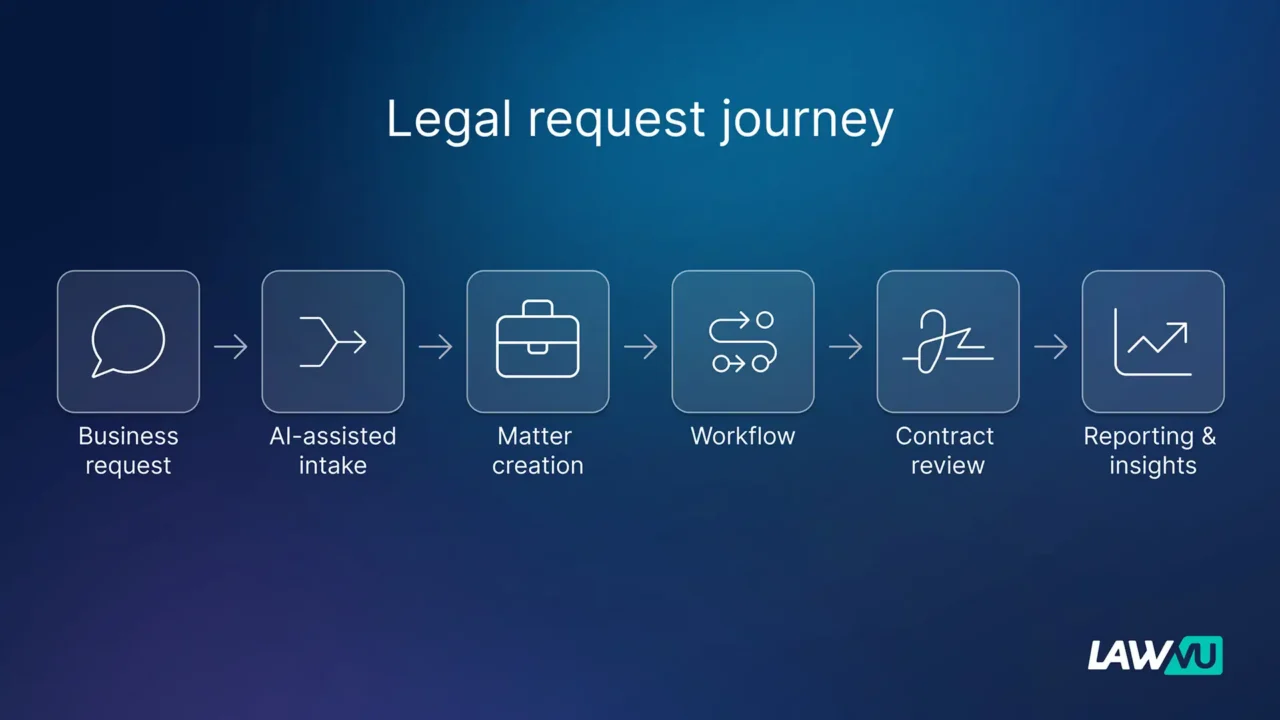
Unfortunately, many legal departments still receive requests through a combination of email, direct messages, hallway conversations, spreadsheets, and shared inboxes. This makes prioritization difficult and often results in incomplete information, inconsistent processes, and delayed responses.
Modern legal operating systems address this challenge by creating a centralized legal front door.
The strongest platforms provide:
- Guided intake workflows
- Business self-service
- Automated routing
- Request prioritization
- Status visibility
- AI-assisted triage
Increasingly, legal operating systems are using AI to improve how work enters the legal function. Rather than requiring business users to complete lengthy forms or understand legal processes, AI-powered intake experiences can capture requests conversationally, gather missing information automatically, and generate structured legal records behind the scenes. This helps reduce administrative effort while ensuring legal receives complete, actionable information from the start.
For buyers, this represents an important shift. The goal is no longer to simply create a better intake form. The goal is to create a scalable front door for legal that improves responsiveness across every team while maintaining governance and consistency.
Rather than forcing business users to understand legal processes, the platform helps guide them toward the appropriate path.
This has two benefits. First, it improves the experience for business users. Second, it reduces the administrative burden on legal teams by ensuring requests arrive with the information required to take action.
As AI capabilities mature, intake is becoming one of the most valuable opportunities for automation because it shapes demand before legal resources are consumed.
Capability 2: Matter management
Matter management remains the operational backbone of legal.
Every legal department needs visibility into what work exists, who owns it, what stage it is in, and how resources are being allocated.
Unfortunately, many matter management implementations focus primarily on record keeping rather than work orchestration. Buyers should look for platforms that support:
| Capability | Why it matters |
|---|---|
| Configurable workflows | Match legal processes without custom development |
| Task management | Ensure accountability and execution |
| Workload visibility | Improve resource planning |
| Collaboration tools | Reduce reliance on email |
| Reporting | Measure performance and outcomes |
| Workflow automation | Reduce administrative effort |
The best matter management systems do more than track work. They help move work forward.
Increasingly, AI is becoming part of that equation through intelligent task creation, matter suggestions, workload balancing, and conversational workflow execution.
Capability 3: Contract lifecycle management
Contracts are where legal and the business intersect most frequently. They represent revenue opportunities, commercial relationships, regulatory obligations, and organizational risk – all within a single workflow.
For many legal departments, however, contract management remains highly manual. Documents move between email, Word, shared drives, and approval tools, making it difficult to maintain consistency, track obligations, or understand where agreements are stalled.
A modern legal operating system should connect the entire contract lifecycle, from the initial request through drafting, negotiation, approval, execution, and ongoing management.
Core capabilities should include:
- Contract requests
- AI-assisted drafting
- Review and negotiation workflows
- Approval automation
- Electronic signature integrations
- Renewal and obligation tracking
- Portfolio reporting
Beyond workflow management, buyers should evaluate how vendors approach contract intelligence.
Questions worth asking include:
- Can the platform automatically extract key terms and metadata?
- Does it identify obligations, risks, and renewal dates?
- Can AI assist with drafting and reviewing agreements?
- Are playbooks and clause libraries embedded into the drafting process?
- Can insights be surfaced across the entire contract portfolio?
The strongest solutions don’t simply help legal process contracts faster. They help legal improve quality, consistency, and governance throughout the contracting process.
Increasingly, AI is becoming an integral part of that experience. Rather than replacing legal judgment, AI can help generate first drafts, identify deviations from preferred language, summarize negotiations, and surface potential risks for review.
For buyers, the key question isn’t whether AI is included. It’s whether AI works within governed legal workflows to help legal teams move faster while maintaining quality and control.
Capability 4: Spend management
Outside counsel remains one of the largest controllable expenses for many legal departments, making spend management a critical component of any legal operating system.
Historically, spend management has been treated as a separate discipline, supported by standalone e-billing platforms or finance processes. That separation often limits visibility into how external spend connects to matters, workloads, and business priorities.
Modern legal operating systems bring spend management into the broader operational picture, allowing legal leaders to understand not only what they are spending, but why.
When evaluating vendors, look for capabilities such as:
- E-billing
- Budget management
- Invoice review
- Outside counsel management
- Billing guideline enforcement
- Spend reporting
The greatest value comes when financial data is connected to operational data. Linking matters, budgets, vendors, and outcomes provides a clearer picture of legal’s performance and helps identify opportunities to improve resource allocation.
Capability 5: Reporting and operational intelligence
One of the most common frustrations among legal leaders is the amount of time required to answer relatively simple operational questions.
How much work is legal handling?
Which business units generate the highest demand?
Where are matters getting delayed?
How much are we spending with outside counsel?
Which contracts create the greatest organizational risk?
The issue is rarely a lack of data. More often, the data exists across multiple disconnected systems that were never designed to work together.
A legal operating system addresses this challenge by creating a shared reporting layer across intake, matters, contracts, spend, and documents. Instead of manually assembling reports, legal leaders gain access to real-time operational insights that support better planning and decision-making.
Look for reporting capabilities that include:
- Executive dashboards
- Custom reporting
- Matter and workload analytics
- Contract performance metrics
- Spend reporting
- Risk and compliance insights
Good reporting explains what happened.
Great reporting helps legal understand why it happened – and what should happen next.
This is where connected intelligence becomes particularly valuable. When every legal workflow contributes to the same operational foundation, patterns begin to emerge that would otherwise remain hidden. Legal leaders can identify resource constraints, anticipate business demand, monitor contract risk, and make more informed decisions based on connected information rather than isolated reports.
As legal continues to become a more strategic business function, operational intelligence will become just as important as operational efficiency.
Capability 6: Evaluating AI capabilities
AI has quickly become one of the most important considerations in legal technology evaluations.
Yet it’s also one of the easiest areas to evaluate incorrectly.
Nearly every vendor now promotes AI-powered capabilities, making it difficult for buyers to distinguish between isolated features and meaningful operational innovation.
Rather than asking, “Does the platform have AI?” buyers should evaluate how AI supports legal work across the entire operating model.
Consider four questions during every evaluation.
Does AI have meaningful context?
AI is most valuable when it can access connected legal data rather than information from a single workflow.
A platform that understands matters, contracts, spend, documents, and legal knowledge will consistently produce better insights than one operating within isolated applications.
Does AI help execute work?
The next generation of legal AI is moving beyond answering questions.
Increasingly, AI can help create matters, summarize documents, retrieve information, update records, recommend next steps, and initiate workflows – all while remaining within governed legal processes.
Embedded AI assistants are becoming particularly valuable because they allow legal professionals to interact with the platform conversationally rather than navigating multiple screens and menus.
Is governance built into AI?
Legal teams need confidence that AI operates within appropriate guardrails.
Look for capabilities such as:
- Permission-aware responses
- Audit trails
- Human review before execution
- Administrative controls
- Enterprise-grade security
Governance should be a foundational requirement rather than an afterthought.
Is AI embedded into everyday work?
The most valuable AI doesn’t require users to adopt another application.
Instead, it becomes part of the workflows legal teams already use – supporting intake, matter management, contract review, spend analysis, reporting, and knowledge retrieval from within the platform itself.
As AI continues to mature, buyers should focus less on individual features and more on whether the platform provides a connected foundation that allows AI to improve every stage of legal operations.
The legal operating system implementation playbook
Learn how to assess readiness, build a rollout plan, and successfully implement a legal operating system.
Legal operating system vs point solutions
Throughout this guide, we’ve explored why legal departments are increasingly moving away from disconnected applications and toward connected operating models.
The shift isn’t about replacing every tool with a single application. It’s about reducing operational complexity while creating a stronger foundation for reporting, governance, and AI.
The comparison below highlights the differences buyers should consider during the evaluation process.
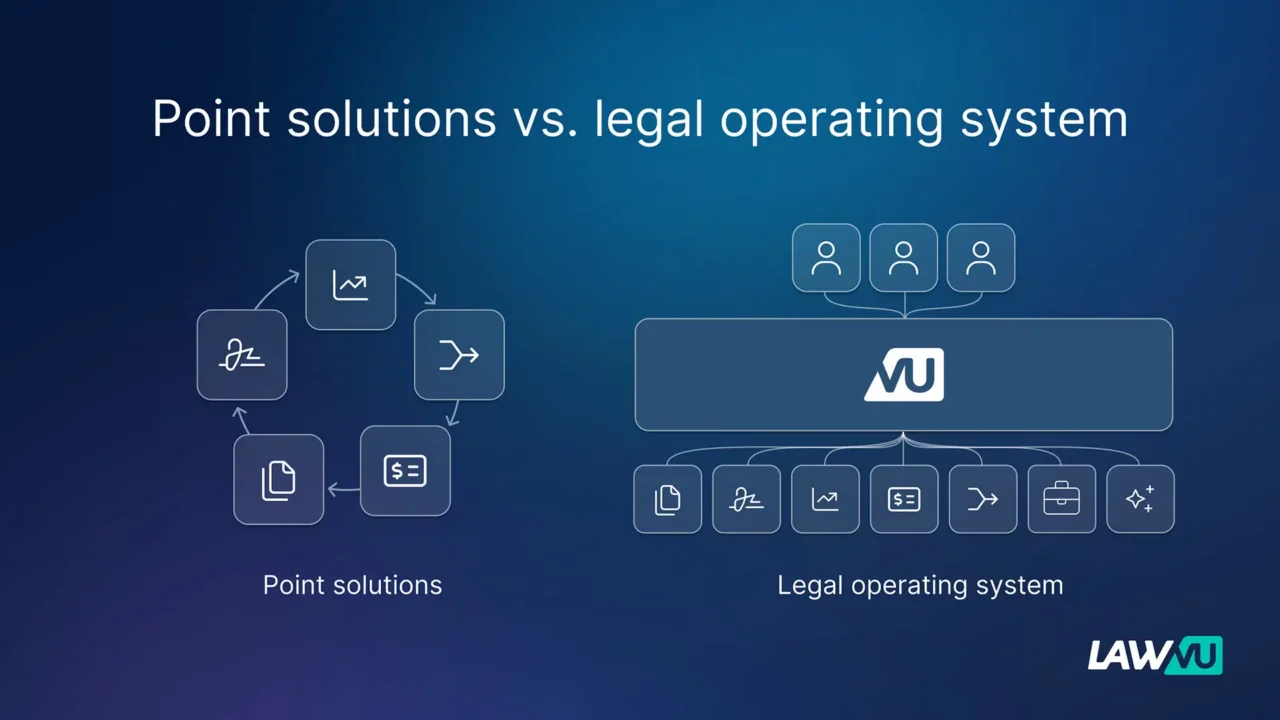
| Evaluation criteria | Point solutions | Legal operating system |
|---|---|---|
| User experience | Fragmented | Unified |
| Reporting | Distributed | Centralized |
| AI context | Limited | Connected |
| Governance | Multiple controls | Single framework |
| Vendor management | Multiple relationships | Strategic partnership |
| Scalability | Increasing complexity | Connected growth |
| Total cost of ownership | Higher over time | Lower operational burden |
While every organization’s requirements are different, the broader trend across legal operations is clear. Buyers are increasingly prioritizing connected platforms that reduce complexity, improve visibility, and create a stronger foundation for future automation and AI initiatives.
Features-to-benefits comparison
During vendor evaluations, it’s easy to become focused on feature lists. However, buyers should ultimately evaluate business outcomes rather than individual functionality.
The table below translates common platform capabilities into the operational value they deliver.
| Feature | Business benefit |
|---|---|
| AI intake | Reduces manual triage and improves service delivery |
| Matter management | Improves visibility, accountability, and resource planning |
| Contract automation | Accelerates business velocity and contract turnaround times |
| Contract intelligence | Surfaces obligations, risk, and opportunities across the portfolio |
| Spend management | Improves financial control and outside counsel oversight |
| Reporting | Demonstrates legal’s value through measurable outcomes |
| Workflow automation | Reduces administrative burden and repetitive work |
| Unified platform | Eliminates vendor sprawl and operational complexity |
| Connected AI | Delivers better context, stronger governance, and more useful results |
Understanding pricing models
Once vendors have been shortlisted, pricing becomes an important consideration. However, buyers should avoid making decisions based solely on annual subscription costs.
Different vendors use different commercial models.
| Pricing model | Advantages | Considerations |
|---|---|---|
| User-based | Predictable | Costs rise with growth |
| Module-based | Flexible | Can increase complexity |
| Platform-based | Simplifies procurement | Verify included capabilities |
| Enterprise pricing | Tailored to requirements | Requires detailed review |
| Usage-based AI | Aligns cost to value | Can become unpredictable |
When comparing proposals, look beyond annual license fees. Consider implementation costs, integrations, user adoption, administration, ongoing support, and future scalability.
The hidden costs buyers often miss
Technology investments are often evaluated based on software pricing alone, yet license fees typically represent only one part of the total investment.
During evaluations, consider the broader operational costs associated with each platform, including:
- Implementation: Time, services, and internal resources required to deploy the platform.
- Integrations: Ongoing maintenance of connections between multiple systems.
- Administration: Configuration, permissions, workflow management, and reporting.
- User adoption: Training, change management, and ongoing support.
- Vendor management: Procurement, renewals, security reviews, and supplier relationships.
- Future AI investments: Whether additional AI products will be required as your strategy evolves.
For many legal departments, the greatest return comes not from selecting the least expensive software, but from reducing complexity and creating a connected operating model that can scale with the business.
Legal operating system evaluation scorecard
By the time most legal technology evaluations reach the final stages, stakeholders have reviewed demonstrations, compared capabilities, spoken with references, and received commercial proposals. Yet this is often where the buying process becomes most subjective.
Legal may prioritize usability and workflows. Legal operations may focus on reporting and configurability. IT evaluates integrations, security, and governance. Procurement looks at pricing, while executives want confidence that the investment will support long-term business goals.
A structured evaluation scorecard helps align those perspectives around a common set of criteria. The weighting below provides a practical starting point for most organizations. You can adjust the percentages to reflect your own priorities, but using a consistent framework makes vendor comparisons more objective and helps ensure decisions are based on strategic fit rather than individual product demonstrations.
| Criteria | Weight |
|---|---|
| Functional fit | 25% |
| User experience | 15% |
| AI strategy | 15% |
| Reporting & analytics | 10% |
| Integration capabilities | 10% |
| Security & governance | 10% |
| Vendor partnership | 5% |
| Total cost of ownership | 10% |
As part of your evaluation, score each vendor against every category, apply the weighting, and calculate a total score. While the highest score shouldn’t automatically determine the winner, this approach helps ensure the final decision reflects your long-term operating model rather than isolated strengths or weaknesses.
Common mistakes buyers make
Selecting a legal operating system is a long-term investment, and many of the most expensive mistakes happen before implementation even begins.
Below are some of the most common pitfalls legal departments encounter during the evaluation process.
Choosing features instead of outcomes
It’s easy to compare feature lists, but buyers should focus on the business outcomes those features enable. The right platform should improve visibility, streamline collaboration, and support better decision-making – not simply add more functionality.
Solving today’s problems without considering tomorrow’s needs
Legal technology decisions often remain in place for many years. Consider how the platform will support future growth, new business requirements, and advances in AI rather than optimizing solely for today’s workflows.
Evaluating AI without evaluating governance
AI capabilities should be assessed alongside the controls that govern them. Look for permission-aware responses, auditability, administrative oversight, and security rather than focusing only on speed or automation.
Underestimating operational complexity
A collection of best-of-breed applications may appear attractive during procurement but become increasingly difficult to manage over time. Consider the long-term impact of integrations, reporting, administration, and vendor management when evaluating total cost of ownership.
Treating implementation as the finish line
Technology alone doesn’t transform legal operations. Successful implementations combine platform capabilities with process improvements, change management, and user adoption to deliver lasting business value.
Avoiding these common mistakes helps ensure your investment supports not only the legal department’s current needs but also its long-term strategic direction.
Customer perspective
Technology evaluations often focus on capabilities, but the ultimate measure of success is how those capabilities improve day-to-day legal operations.
As Andrew Hay, Head of Operations, Legal and Secretariat at Co-op, explains:
“Everyone in the legal team is using LawVu now. Before LawVu, there was a significant risk around documentation – it was scattered throughout emails. I now have a much more robust record of what’s happening, and LawVu has reduced our exposure for not having complete matters.”
Andrew Hay, Head of Operations, Legal and Secretariat at Co-op
For many legal teams, the value of a legal operating system extends beyond individual workflows. It creates a single source of truth for legal work, improves visibility across the department, and provides the operational foundation needed to support future growth.
The future belongs to legal operating systems
Legal has never been more important to business success.
Organizations increasingly rely on legal to accelerate growth, manage risk, guide strategic decisions, and enable innovation. Meeting those expectations requires more than talented people and individual software tools. It requires an operating model that allows legal to work as a connected, data-driven function.
That is why the legal operating system is emerging as the next evolution of legal technology.
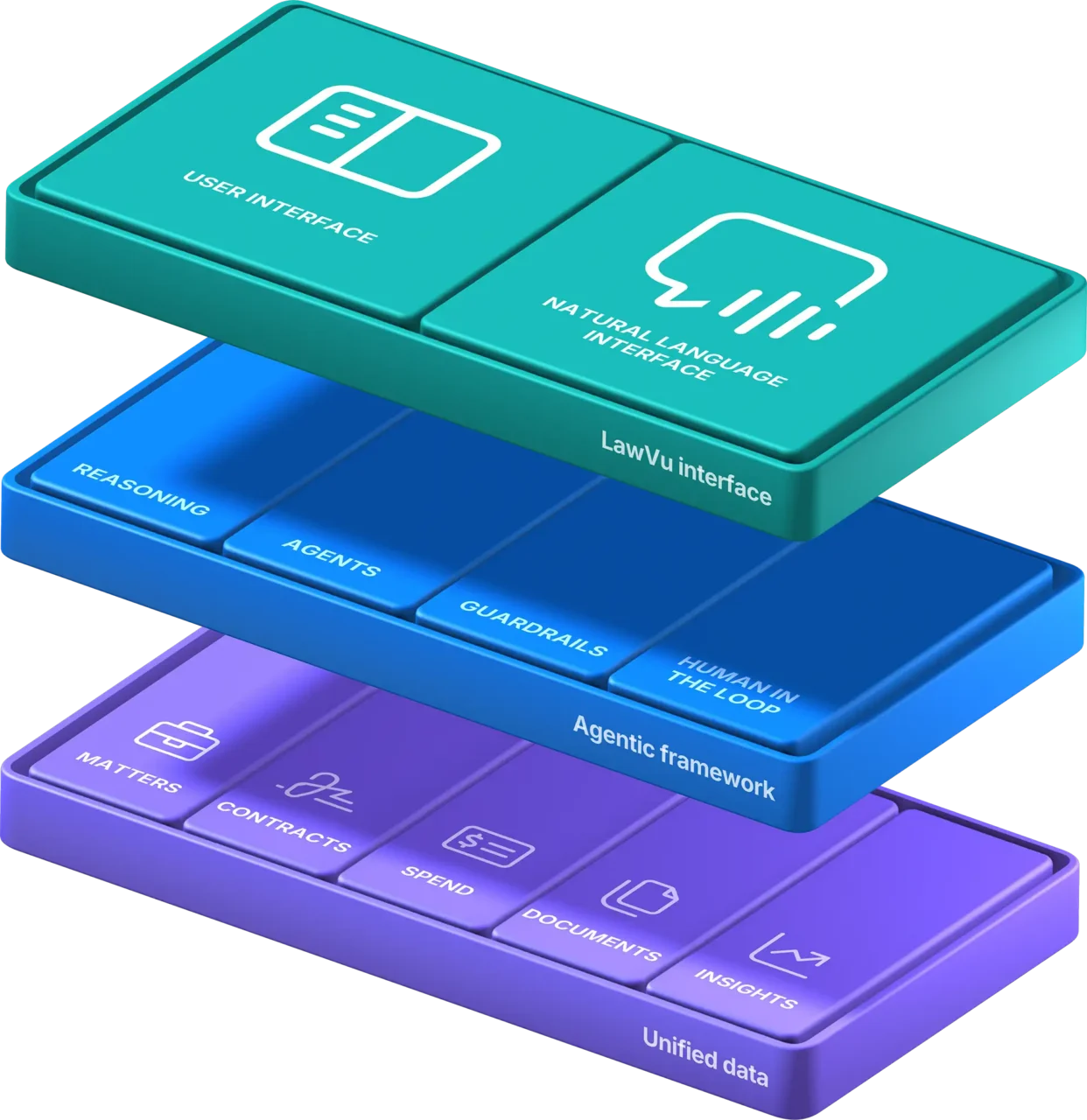
Rather than treating intake, matters, contracts, spend, reporting, and AI as separate initiatives, a legal operating system connects them through a shared operational foundation. Information flows more freely, reporting becomes more meaningful, and AI gains the context needed to deliver measurable business value.
The result is more than operational efficiency. It is greater visibility. Better decision-making. Stronger governance. And ultimately, greater influence across the business.
As legal departments continue their transformation from reactive support functions to strategic business partners, the organizations that invest in connected operating models will be better positioned to scale their impact across every deal, every decision, and every team.
A legal operating system isn’t simply another technology investment. It’s the foundation for how modern legal teams operate.
Ready for the next step?
Now that you understand how to evaluate legal operating systems, the next question is how do you build a successful strategy and secure organizational support.
Continue your evaluation journey
Discover how to quantify ROI, align stakeholders, and secure executive buy-in for a legal operating system investment.
The in-house legal operating system buyer’s guide
How to evaluate, compare, and choose the right platform.