Legal operating system playbook: How in-house teams can consolidate their tech stack and eliminate tool sprawl
 Michaelle Noble

Most legal departments don’t intentionally create fragmented technology environments. Tool sprawl happens gradually as new software is introduced to solve individual challenges.
This playbook isn’t about choosing the right platform – that decision is covered in our Legal operating system buyer’s guide. Instead, it’s about what comes next.
Whether you’re replacing disconnected tools or building a long-term legal technology strategy, this guide provides a practical roadmap for consolidating your technology stack, redesigning workflows, managing change, and building a legal operating model that scales with the business.
Technology isn’t the problem – fragmentation is
Few legal departments set out to build a fragmented technology stack.
Most arrive there through years of sensible decisions.
A contract lifecycle management platform is introduced to improve contracting. Matter management software is implemented to improve visibility. E-billing helps control outside counsel spend. A separate intake tool manages requests. Reporting evolves in spreadsheets. AI solutions are layered on as new opportunities emerge.
Each investment solves an immediate challenge.
Collectively, however, they can create an operating environment that is increasingly difficult to manage.
Lawyers move between multiple systems to complete a single workflow. Information is duplicated across applications. Reporting requires manual effort. Business users struggle to understand where work sits. AI tools operate without the full context of legal’s work.
The problem isn’t the technology itself. The problem is fragmentation.
As legal becomes a more strategic function, fragmented technology limits visibility, slows decision-making, increases administrative effort, and makes it harder to deliver a consistent experience across the business.
Consolidation isn’t simply about reducing software.
It’s about creating an operating model that allows legal to work as one connected function.
Why tool sprawl happens
Tool sprawl rarely occurs because legal teams make poor purchasing decisions.
It happens because legal departments evolve.
New regulations create new requirements. Businesses grow through acquisition. Individual teams purchase specialized software to solve immediate operational challenges. Over time, those independent decisions create an increasingly complex technology landscape.
Common signs include:
- Multiple applications supporting similar workflows
- Duplicate information across systems
- Manual handoffs between teams
- Inconsistent reporting
- Growing integration requirements
- Increasing software administration
- Multiple AI tools with disconnected data sources
Many legal leaders recognize these symptoms long before they decide to consolidate technology.
The challenge is knowing where to begin. Fortunately, successful consolidation projects don’t start with technology. They start with understanding how legal should operate.
Step 1: Audit your legal technology landscape
Before changing anything, build a complete picture of your current legal technology environment.
The objective isn’t simply to create an application inventory. It’s to understand how legal work moves through your department today.
Document every application currently supporting legal work, including:
- Primary business purpose
- Users and administrators
- Annual cost
- Connected integrations
- Data ownership
- Manual processes
- Known pain points
Don’t forget the unofficial systems that often support legal operations, including spreadsheets, shared drives, email inboxes, collaboration tools, and locally managed databases.
Many organizations discover that critical legal processes depend just as heavily on these informal tools as they do on enterprise software.
Questions to ask
- Which systems contain the same information?
- Which workflows require users to switch between applications?
- Which reports require manual effort?
- Where are lawyers performing administrative work instead of legal work?
This exercise establishes the baseline for every decision that follows.
Step 2: Identify your biggest sources of operational friction
Once you’ve mapped your technology landscape, shift your attention from systems to workflows.
Rather than asking which applications should be replaced, ask where work becomes unnecessarily difficult.
For example:
- Where do requests get delayed?
- Which processes require duplicate data entry?
- Where do approvals stall?
- Which teams struggle to access legal information?
- Which activities rely on email rather than structured workflows?
These friction points often reveal the greatest opportunities for improvement.
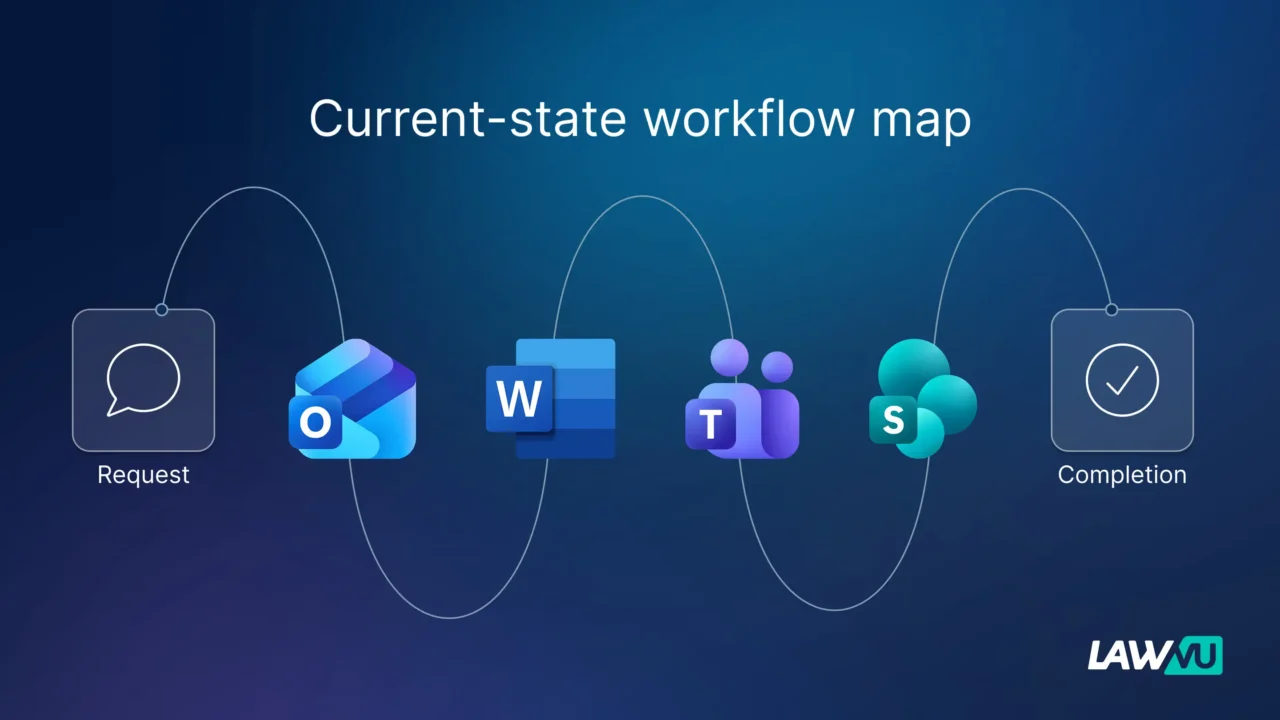
One useful exercise is to follow a single legal request – from the moment it enters the department through completion.
Document every application, approval, manual update, and handoff required along the way.
Many organizations discover that a seemingly straightforward contract request touches five or more systems before it is complete.
That’s not a technology problem. It’s an operating model problem.
Why operating model matters more than technology
Technology consolidation often fails because organizations focus on replacing software rather than redesigning how legal operates.
Installing a new platform without changing workflows simply recreates old processes in a different application.
Successful transformations begin with a different question:
“How should legal operate if we were designing the function today?”
Instead of thinking about products, think about outcomes.
- How should legal requests enter the department?
- How should matters be managed?
- Where should contracts live?
- How should information be shared?
- What insights should executives receive?
- Where should AI assist legal professionals?
Once those questions are answered, technology becomes an enabler rather than the starting point.
A legal operating system supports that vision by connecting legal work around a shared operational foundation instead of a collection of individual tools.
Learn the principles behind a legal operating system
Before redesigning your operating model, it’s helpful to understand what defines a legal operating system and why connected platforms are becoming the foundation for modern in-house legal teams.
Step 3: Design your future operating model
Once you’ve identified where friction exists, resist the temptation to start replacing software immediately.
Successful legal transformations don’t begin with technology – they begin with designing how legal should operate in the future.
This is one of the biggest differences between a technology implementation and an operating model transformation.
Instead of asking, “Which application should we replace?”, ask:
- How should work enter the legal department?
- How should legal prioritize requests?
- What information should be visible to everyone?
- Which activities should be automated?
- What data should leaders use to make decisions?
- Where can AI create meaningful value without sacrificing governance?
By answering these questions first, technology becomes the platform that enables your operating model rather than the force that defines it.
A future-state operating model should be built around a few core principles:
- One front door for legal requests
- One source of truth for legal work
- Connected workflows across matters, contracts, and spend
- Shared reporting and operational insights
- AI embedded throughout the legal workflow – not operating alongside it
This shift is what transforms legal from a collection of individual processes into a connected business function.
Before and after consolidation
One of the easiest ways to visualize the impact of consolidation is to compare how legal work operates before and after implementing a legal operating system.
The objective isn’t simply to reduce the number of applications. It’s to reduce friction, improve visibility, and create a better experience for both legal and the business.
| Before consolidation | After implementing a LegalOS |
| Multiple logins across different applications | One connected platform for legal work |
| Email-based legal requests | Structured intake and self-service |
| Duplicate information stored in multiple systems | Shared operational data across workflows |
| Manual handoffs between applications | Connected end-to-end workflows |
| Reporting built in spreadsheets | Real-time dashboards and operational insights |
| Separate AI tools with limited context | AI operating across connected legal data |
| Multiple vendors and integrations | Simplified technology ecosystem |
While every organization has different requirements, the direction of travel is the same: fewer disconnected systems, more connected workflows, and greater operational visibility.
Step 4: Build a phased implementation roadmap
One of the biggest risks in any transformation program is trying to change everything at once.
Legal technology consolidation should be approached as a phased journey, with each stage building confidence and delivering measurable value before expanding further.
Phase 1: Assess and align (Days 1–30)
The first month should focus on understanding your current environment and building organizational alignment.
Key activities include:
- Complete your technology audit
- Document legal workflows
- Identify duplicate capabilities
- Define governance and project ownership
- Establish success metrics
- Prioritize quick wins
At this stage, avoid making technology decisions before understanding how legal work should be done.
Phase 2: Configure and pilot (Days 31–90)
With the operating model defined, begin configuring your legal operating system around the workflows you’ve designed.
Focus on:
- Configuring priority workflows
- Migrating high-value data
- Integrating core business systems
- Testing with a pilot business unit
- Gathering user feedback
- Refining processes before wider rollout
A successful pilot creates momentum and allows teams to improve the experience before expanding across the organization.
Phase 3: Expand and optimize (Days 90–180)
Once the foundation is in place, begin scaling the operating model across the legal department.
Priorities typically include:
- Expanding to additional legal teams
- Retiring legacy applications
- Introducing AI-enabled workflows
- Building executive dashboards
- Measuring adoption
- Identifying further automation opportunities
Remember that implementation isn’t the finish line. It’s the beginning of continuous operational improvement.
Governance: Build for long-term success
Technology projects often receive significant attention during implementation but much less after launch.
Without clear governance, even the best platforms can become difficult to manage over time.
Establish ownership early by defining responsibility for:
| Area | Recommended owner |
| Platform administration | Legal Operations |
| Workflow design | Legal Operations + Legal Leadership |
| User access and permissions | Legal Operations / IT |
| AI governance | Legal + IT + Security |
| Reporting and dashboards | Legal Operations |
| Ongoing platform improvements | Cross-functional governance group |
Governance should not slow innovation – it should create consistency while allowing the platform to evolve alongside the business.
Step 5: Drive adoption – not just deployment
Technology only creates value when people use it.
One of the most common reasons transformation initiatives fail isn’t poor software. It’s insufficient adoption.
Successful legal teams treat adoption as an ongoing business initiative rather than a launch event.
Consider building an adoption plan that includes:
Executive sponsorship
Visible support from legal leadership reinforces the strategic importance of the initiative and helps drive organizational alignment.
Change champions
Identify influential users across legal and the business who can provide feedback, encourage adoption, and support colleagues during the transition.
Training by role
Avoid one-size-fits-all training. Tailor learning experiences for lawyers, legal operations, business users, and administrators.
Continuous communication
Celebrate milestones, share success stories, and regularly communicate how the new operating model is improving legal service delivery.
Measure adoption
Track metrics such as:
- Active users
- Intake adoption
- Workflow completion rates
- Reduction in email requests
- Business satisfaction
- Time saved through automation
Adoption should be measured with the same discipline as implementation.
Ultimately, the success of a legal operating system isn’t measured by whether it was deployed. It’s measured by whether it changes how legal works.
Implementation checklist
Before moving into full deployment, confirm that you’ve completed the following:
- Technology landscape audited
- Future operating model documented
- Governance established
- Success metrics defined
- Pilot team identified
- Training plan developed
- Executive sponsor confirmed
- Business communication plan created
- Legacy system retirement plan agreed
Treat this checklist as a readiness assessment rather than a project milestone. The more preparation completed before rollout, the smoother the transformation will be.
Measuring ROI after implementation
Once a legal operating system has been implemented, success should be measured by the outcomes it enables – not simply whether the project was delivered on time or on budget.
While reducing software costs is often one benefit of consolidation, the most significant return on investment typically comes from improving how legal operates.
A connected operating model enables legal to spend less time managing administrative work and more time supporting strategic business priorities. It also gives leadership greater visibility into performance, demand, and risk, creating opportunities for continuous improvement.
When evaluating ROI, consider measuring value across four key areas.
| Area | Expected outcome |
| Operational efficiency | Fewer manual processes, reduced administrative effort, faster workflows |
| Business experience | Improved responsiveness, greater transparency, self-service capabilities |
| Strategic visibility | Real-time reporting, better workload management, data-driven decision-making |
| Future readiness | Connected data foundation for AI, automation, and continuous innovation |
The goal is not simply to operate more efficiently. It’s to create additional capacity, improve business partnership, and position legal to scale alongside the organization.
KPIs to measure success
Rather than focusing exclusively on technology metrics, build a scorecard with KPIs that demonstrate improvements in legal operations and business outcomes.
Consider tracking metrics such as:
| Operational KPI | Why it matters |
| Matter turnaround time | Measures service delivery improvements |
| Contract cycle time | Demonstrates business velocity |
| Legal request response time | Indicates improvements in intake and prioritization |
| Report preparation time | Measures administrative efficiency |
| Active platform adoption | Tracks organizational engagement |
| Outside counsel spend | Measures financial control |
| Business satisfaction | Reflects improvements in the client experience |
| Workflow automation rate | Demonstrates operational maturity |
These metrics should be reviewed regularly and shared with leadership to demonstrate how the operating model continues to create value over time.
The legal operations maturity journey
Technology consolidation is not the destination – it’s a milestone in legal’s broader transformation.
| Stage | Characteristics |
| Reactive | Email, spreadsheets, manual processes, limited visibility |
| Organized | Point solutions supporting individual workflows |
| Connected | Legal operating system with shared workflows and data |
| Intelligent | AI embedded across connected legal operations |
As organizations mature, their legal operating model typically progresses through four stages.
Each stage builds on the previous one.
Organizations rarely move directly from fragmented technology to AI-powered operations. Instead, they establish a connected operational foundation first, allowing automation and intelligence to scale with confidence.
Common implementation challenges and how to overcome them
Every transformation initiative encounters obstacles. Anticipating them early makes them significantly easier to manage.
| Challenge | Recomended approach |
| Resistance to change | Involve users early, communicate the “why,” and celebrate early wins. |
| Data migration complexity | Prioritize high-value data first and establish clear governance before migration. |
| Legacy system dependencies | Map integrations early and retire applications in phases rather than all at once. |
| Competing business priorities | Deliver value through incremental milestones instead of a “big bang” rollout. |
| Inconsistent adoption | Invest in training, change champions, and ongoing communication. |
| AI uncertainty | Introduce AI gradually within governed workflows and measure outcomes before expanding use cases. |
No implementation will be perfect.
Successful organizations don’t eliminate every challenge – they build the governance, processes, and culture needed to adapt as their operating model evolves.
Three principles for long-term success
As your legal operating system matures, three principles should guide future decisions.
Keep simplifying
Every new workflow, integration, or automation should reduce complexity rather than add to it. Resist the temptation to recreate disconnected processes within a new platform.
Continue improving
Implementation is the starting point, not the finish line. Regularly review workflows, user feedback, and operational metrics to identify opportunities for refinement.
Build for what’s next
AI, automation, and new business requirements will continue to evolve. A connected operating model gives legal the flexibility to adopt new capabilities without rebuilding its technology foundation.
Organizations that continually optimize their operating model – not just their software – will be best positioned to support future growth.
Bringing it all together
Technology consolidation is often discussed as a software initiative.
It’s a business transformation initiative.
Replacing disconnected applications with a legal operating system is only one part of the journey. The real opportunity lies in redesigning how legal work enters the department, how information flows across teams, how decisions are made, and how legal delivers value to the business.
When implemented thoughtfully, a legal operating system becomes more than a technology platform.
It becomes the operational foundation that connects legal work, people, data, and intelligence across the entire function.
That foundation enables legal to move beyond managing requests and begin operating as a truly strategic business partner.
What’s next?
Whether you’re just beginning your transformation or preparing to secure executive support, the following resources will help you continue your LegalOS journey.
Understand the operating model
What is a legal operating system?
Learn the principles behind LegalOS, the capabilities that define it, and why connected operating models are becoming the future of in-house legal.
Compare platforms with confidence
The in-house legal operating system buyer’s guide
Use our buyer’s guide to compare vendors, evaluate AI capabilities, understand pricing models, and build an objective shortlist.
Build your business case
Building the business case for a legal operating system
Learn how to quantify ROI, align stakeholders, and secure executive buy-in for your LegalOS transformation.