How to improve legal team visibility in 2026
 Marija Barbarich
TL;DR
Legal team visibility means having a real-time view of every matter, contract, and pound of spend, without needing to compile a report on request. Yet only 1 in 5 business leaders consider their legal department highly effective at supporting business objectives. The gap isn’t a performance problem; it’s a visibility problem: legal work that’s genuinely happening but not fully visible to the business. Closing it requires a single connected view of legal’s work, not another reporting layer built on top of disconnected systems.
For general counsel and legal operations leaders, the absence of visibility is one of the most consistent reasons why legal’s contribution to the business is underestimated; not because the work is lacking, but because it is not seen.
The world sees the outcome; legal sees what produced it
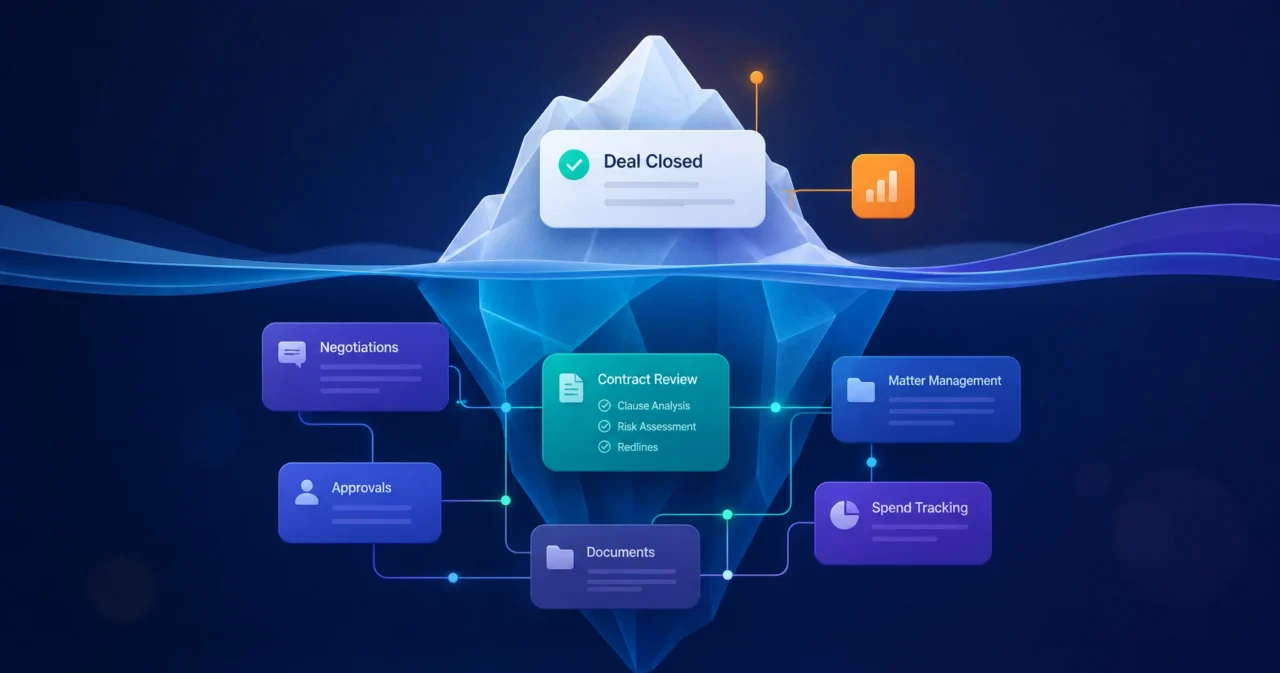
Any significant commercial outcome, a deal closing, a deadline being met, a regulatory filing landing on time, is the visible result of work legal completed well before the outcome became apparent: terms negotiated, clauses reviewed, approvals secured, documents executed. The business typically sees only the final step.
The preceding work, often where the majority of the effort is involved, remains invisible unless someone specifically asks about it.
This pattern holds under any fixed external deadline, including one governed by an industry-wide date such as a transfer window closing.
The visible outcome, a signing confirmed, arrives only after a sequence of legal work that nobody outside the function observed as it happened.
The measurable cost of the visibility gap
Thomson Reuters’ 2026 State of the Corporate Law Department Report found that 86% of general counsel consider their legal department a significant contributor to organisational objectives, while only 17% of C-suite executives agree, and 42% say legal contributes little or not at all.
Separately, IDC research also revealed that only 1 in 5 business leaders consider their legal department highly effective at supporting business objectives.
This is not a perception problem specific to one organisation. It is a structural pattern across the profession.
However, the consequence extends beyond reputation. The same IDC research found that 70% of business leaders admit to circumventing the legal department when they cannot see where a request or matter stands, and 75% of legal teams are already aware this is happening.
When visibility is absent, the business does not wait for it. It routes around the function that would otherwise provide it, which increases risk rather than reducing it.
Why visibility breaks down: absence of a connected legal operating system

Legal teams are not withholding visibility deliberately.
In most cases, the information exists but cannot be easily assembled. IDC’s research found that only 41% of legal teams have access to genuinely comprehensive data about their own operations, while 53% report having access to data that is too difficult to compile because it is spread across disparate systems.
This is the structural gap that a legal operating system, or LegalOS, is designed to close.
Rather than adding a further reporting tool to an already fragmented technology stack, a LegalOS connects intake, matters, contracts, and spend into a single system, so that visibility is a property of how the work is recorded, not a task performed afterward.
What improves legal team visibility in practice
Improving visibility is not primarily a reporting exercise. It requires the underlying data to be connected before it can be seen clearly.
- Consolidate matters, contracts, and spend into one connected system. Visibility cannot be assembled from systems that do not share data. A connected foundation is the precondition, not an optional enhancement.
- Make status available without a request. Any stakeholder should be able to see where a matter or contract stands without asking legal directly. This removes the specific behaviour, informal circumvention, that arises when visibility is absent.
- Report continuously rather than periodically. When reporting draws on live data, executive updates become a review of information the system already holds, rather than a separate exercise assembled under time pressure.
- Track outcomes, not only tasks. Communicating “we handled twelve contracts” is a task-focused statement. Communicating “we protected two revenue-generating agreements from unfavourable terms” ties the same work to a business outcome, which is what visibility is ultimately for.
The fourth point reflects a broader distinction in how legal departments communicate their value:
| Level | Description | Example |
| Task Listing | Lists legal work types without context | “M&A, litigation, compliance” |
| Task + Operational | Adds how the work is done | “Reduce litigation and become more efficient” |
| Service Orientation | Adds who the work is for | “Support the business on new opportunities” |
| Strategic Alignment | Connects work to organisational goals | “Ensure priorities align with business strategy” |
| Outcome-Focused | Ties work to business outcomes | “Enable the business to meet its goals without delay” |
Most legal reporting sits at the first or second level. Visibility, in the sense that closes the gap with the C-suite, requires reaching the fourth or fifth.
Visible by design, not by request
The gap between how legal perceives its own contribution and how the business perceives it is not resolved by legal working harder or reporting more frequently within the current structure.
The gap closes when visibility becomes a property of the system legal’s work runs on, available at any time, to any stakeholder, without a request being required. That is a different objective from producing fewer surprises. It is the objective of making legal’s work legible to the business as a matter of course.
See how a connected legal operating system makes this kind of visibility in practice, not just in principle, in the LegalOS guide.
Lean more about the legal operating system, or LegalOS, here.