How to improve contract turnaround time for in-house legal teams
 Marija Barbarich
TL;DR
Contract turnaround time is the total time between a contract entering review and reaching full execution. The real bottleneck is rarely negotiation but the final stage: reconciling versions and securing signature once terms are already agreed. Inefficient legal processes cost the average organisation up to £105 million annually in delayed or lost revenue, much of it tied to this stage. Fixing it means consolidating the contract process into one connected system, not adding another point solution.
What is contract turnaround time?
Contract turnaround time is the total time between a contract entering legal review and reaching full execution.
For general counsel and legal operations leaders, improving contract turnaround time requires removing the manual handoffs between negotiation, drafting, approval, and signature, rather than asking the legal team to move faster through each stage individually. That distinction matters, because most attempts to fix turnaround time target the wrong point in the process.
A common pattern: agreement without execution
Commercial terms are agreed. Legal completes its review, issues redlines, and signs off. The only outstanding step is signature. Yet the contract continues to circulate because the parties cannot agree which version is current, untracked edits have crept in, or the approved draft has not reached the person responsible for signing.
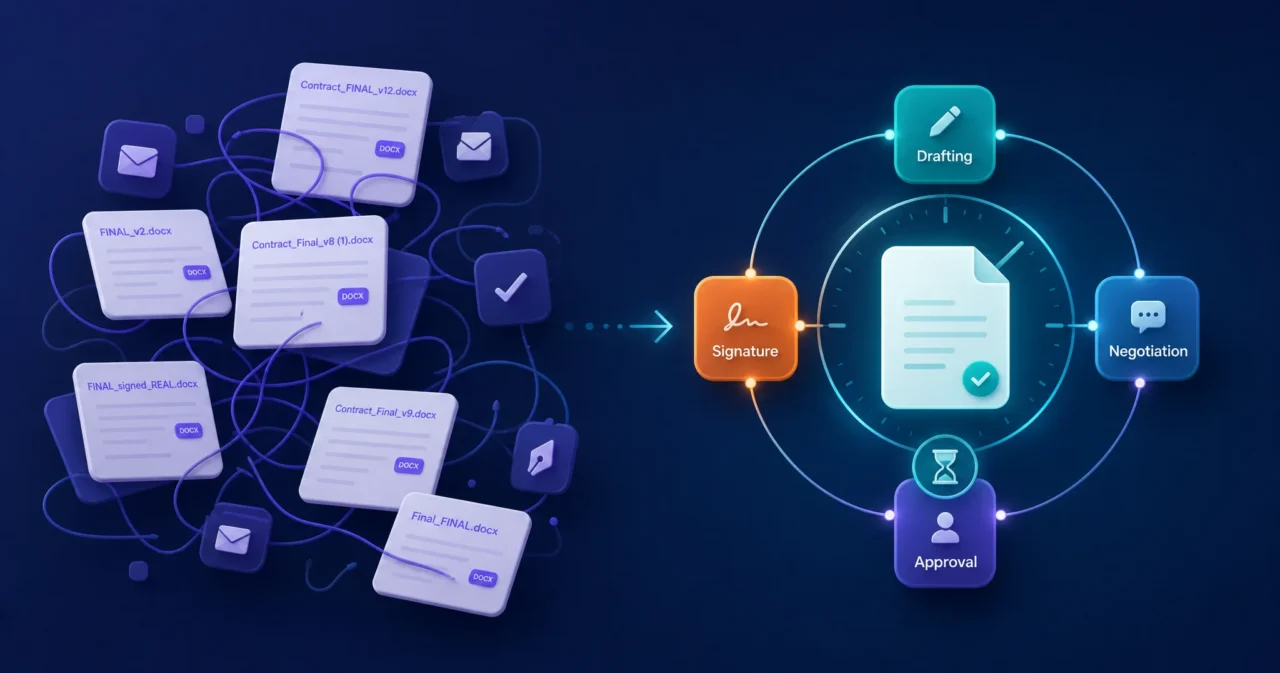
Most legal teams will recognise a variation of this pattern, often marked by a file name such as Legal_v12_FINAL.docx: the version that exists because the one before it, also labelled final, was not.
Organisations operating under fixed external deadlines, such as those governing transfer windows, experience the same dynamic: the transfer is agreed, and it’s been announced well before it is legally complete.
The cost of delayed execution
This gap between commercial agreement and executed contract is what contract turnaround time measures.
According to IDC, of over 350 in-house legal counsel and business leaders, inefficient legal processes caused an average of 11% of revenue to be delayed or lost in the past 12 months, equivalent to as much as approximately £105 million annually for the organisations surveyed. A meaningful share of that figure is attributable to contracts that are functionally agreed but not yet executed.
A useful diagnostic for any legal function is to review contracts currently awaiting signature and identify how many are, in substance, already agreed; in most organisations, this figure is higher than internal reporting would suggest, because status is tracked informally, if at all, once negotiation has concluded.
The underlying cause: absence of a connected legal operating system
When asked why contracts take longer than expected, most legal teams point to capacity constraints. While that explanation is often accurate, it’s rarely the whole story.
The more consistent cause is structural: a single contract typically moves through email for negotiation, a word processor for drafting, a separate platform for e-signature, and informal tracking, if any, for status.
These systems do not communicate with one another. Each handoff creates another point where a contract can stall, be duplicated, or split into two versions that no longer match.
| Stage | Where it typically stalls | Why |
| Negotiation | Email threads, tracked separately from the draft | Redlines and the document diverge, requiring manual reconciliation |
| Drafting | Word attachments passed between parties | Version control depends on a file name, not a system of record |
| Approval | Informal routing between individuals | No automatic trigger once review is complete |
| Signature | A separate e-signature platform | Requires a manual handoff from wherever the “final” version currently sits |
This is consistent with IDC’s findings from the legal function’s own perspective: legal professionals report spending an average of 1.6 hours per day drafting or reviewing low-risk, routine contracts, a meaningful proportion of which reflects version reconciliation rather than substantive legal review. Confirming that a given attachment matches an earlier set of agreed redlines is not legal judgment. It is the operational cost of a fragmented process, applied to every contract that passes through it.
This is the structural gap that a legal operating system, or LegalOS, is designed to close.
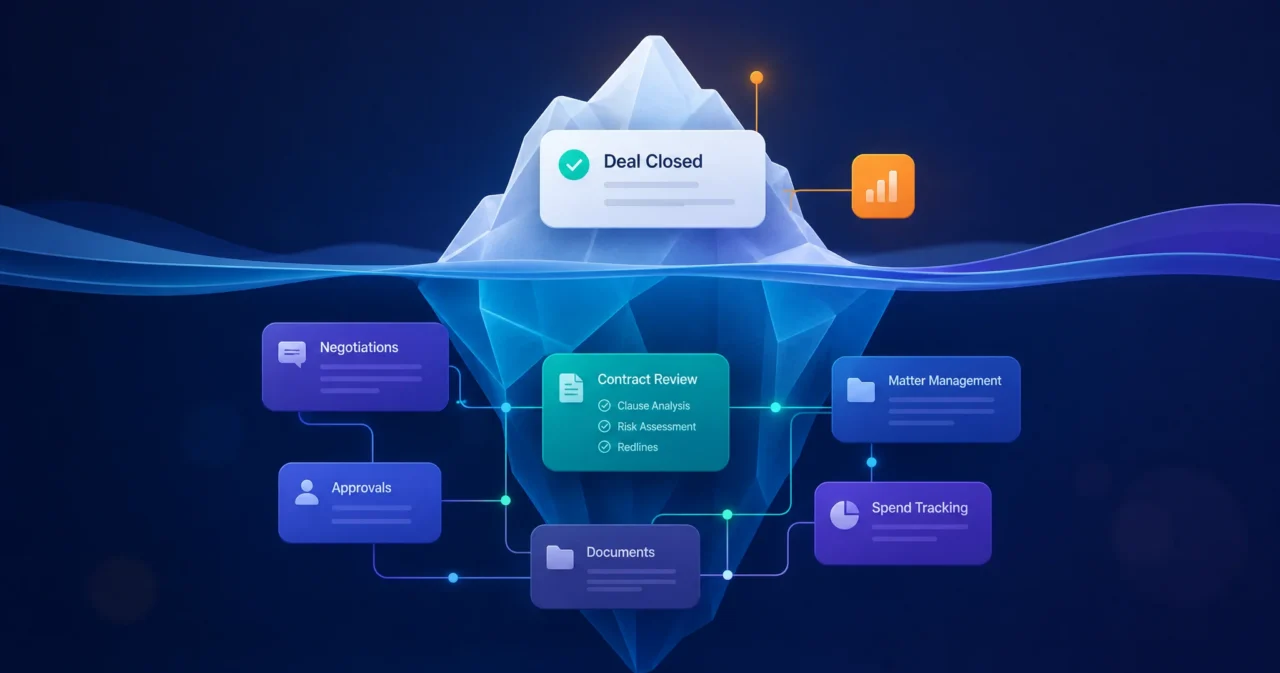
Rather than introducing a further point solution alongside the ones already in place, a LegalOS gives contracts, matters, intake and spend, and the communications around them, a single connected foundation, so fragmentation is removed rather than managed around.
What reduces contract turnaround time in practice?
Reducing turnaround time is not primarily a matter of accelerating each stage of review. It requires removing the structural conditions that allow version ambiguity to occur, which is the specific function a LegalOS is built to perform:
- Consolidate negotiation and drafting into a single system. When redlines are exchanged within a single connected document rather than as separate attachments, there is no ambiguity about which version is current, because only one exists.
- Automate routing for approval and signature. A contract that has cleared review should proceed to signature without requiring a team member to initiate the next step manually. Automated contract routing removes the dependency on an individual remembering to act.
- Extend self-service to low-risk, routine agreements. Not every contract requires individual legal review. Standard NDAs, routine renewals, and pre-approved templates can be released to the business within parameters legal defines once, rather than reviewed case by case.
- Maintain visible status for every contract in progress. The status of a given contract should be available on request, rather than requiring legal to be asked directly. When status is recorded in a shared system, oversight replaces manual follow-up.
None of these measures require additional legal headcount. They require a LegalOS: one connected foundation in place of the separate systems a contract must currently pass through before execution.
Why this extends beyond legal’s own workload
The effects of a slow contract process are not confined to the legal function. IDC’s research found that 61% of legal teams identify improved contract lifecycle management as a leading source of cost savings following the adoption of unified legal technology, and 59% of business leaders, those awaiting contracts rather than those drafting them, report faster approval cycles as the most significant productivity improvement from legal technology adoption.
Contract turnaround time is, in this respect, a measure of business velocity that happens to sit within the legal function. It merits the same rigour in measurement that other operational metrics receive.
One connected home, not four
A LegalOS brings drafting and review, negotiation, approval, and signature into a single environment, so that a contract has one authoritative record rather than several, and the term “final” carries a consistent meaning across the organisation.
Contract turnaround time does not improve because a team works harder. It improves when the interval between commercial agreement and execution ceases to be the point at which process fragmentation causes the most damage.
The appropriate response is not more diligent version tracking. It is a process architecture in which only one version exists to track.
Ready to see how a connected contract process works in practice?
LawVu LegalOS brings drafting, approval, and signature into a single environment, so that contract status and version are never in question.