Why matter management is the foundation for legal AI
 Michaelle Noble

Artificial intelligence is rapidly changing the way legal work gets done. As legal teams evaluate AI adoption opportunities, many are discovering that successful legal AI initiatives depend on a strong operational foundation. This is where matter management and AI become closely connected.
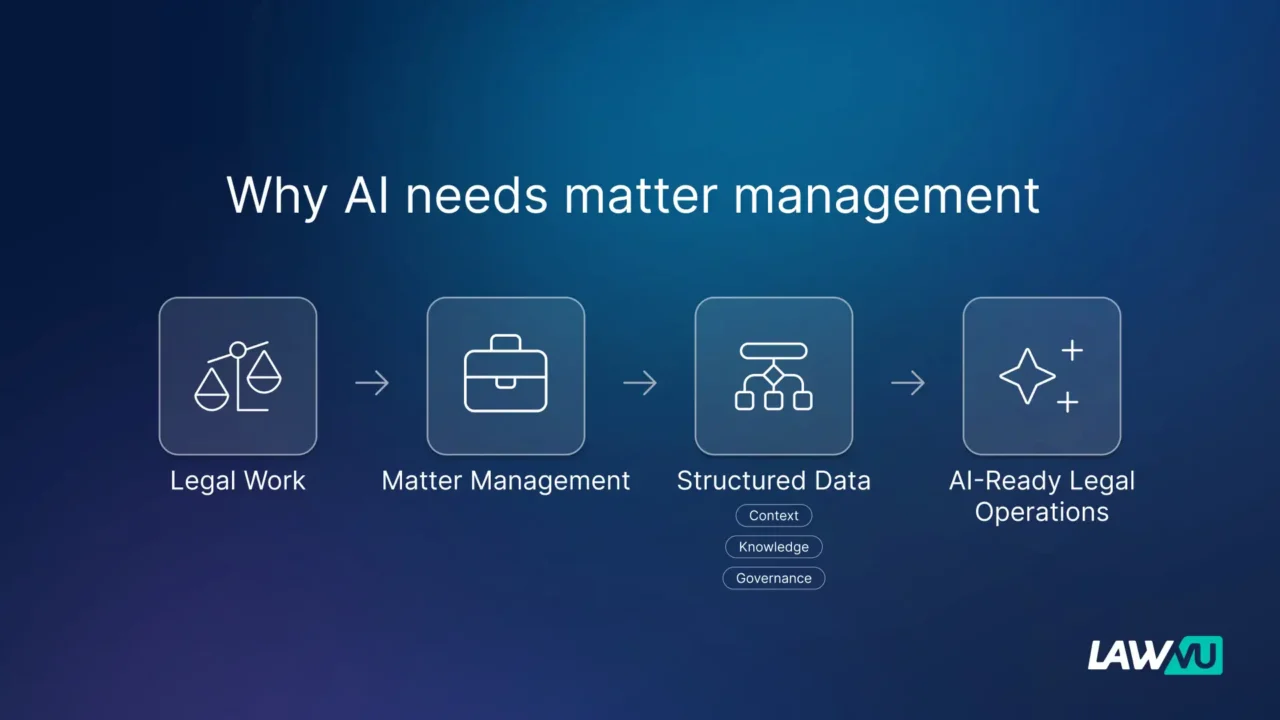
For organizations researching what matter management is, the answer increasingly extends beyond tracking legal work. Modern matter management provides the structure, context, governance, and institutional knowledge that AI systems use to deliver more reliable and relevant outcomes. Whether a legal department is using a dedicated matter management system, a broader legal operations platform, or in-house legal matter management software, the quality of the underlying data will directly impact AI effectiveness.
This is why matter management is increasingly viewed as a foundational capability for organizations looking to build AI-ready legal operations.
The AI challenge facing legal teams
Most legal departments have accumulated information across multiple systems over time.
Contracts may live in one repository. Matter details may be stored in spreadsheets. Communications are often buried in email. Knowledge exists in shared drives, chat platforms, and the minds of experienced legal professionals.
While humans can often navigate this complexity, AI struggles when information is fragmented.
Common challenges include:
- Inconsistent data
- Duplicate information
- Limited context
- Siloed knowledge
- Unstructured workflows
- Incomplete records
Many organizations begin exploring legal AI without realizing that AI effectiveness depends heavily on the quality of legal data, workflows, and operational processes already in place.
As a result, organizations often find that AI cannot deliver on its promise without first addressing the operational foundations that support legal work.
Why AI needs context, not just content
Many discussions about AI focus on access to documents.
But legal work is about more than documents.
A contract is connected to negotiations, approvals, stakeholders, business objectives, legal guidance, and historical decisions. A litigation matter includes communications, filings, deadlines, outside counsel activity, and risk assessments.
Without this context, AI may be able to summarize information, but it cannot fully understand it.
Matter management provides that context by organizing legal work around a structured matter record.
Each matter becomes a connected source of information that includes:
- Documents
- Communications
- Tasks
- Approvals
- Decisions
- Stakeholders
- Historical activity
This structure helps AI generate more accurate insights and deliver more meaningful support to legal teams.
Matter management creates AI-ready data
One of the biggest challenges in legal AI adoption is data quality.
AI-ready legal operations require structured, reliable, and accessible information that AI systems can understand and act upon. This is where a modern matter management system becomes increasingly valuable.
Matter management helps address this challenge by creating standardized processes for capturing legal work.
Benefits include:
- Consistent matter classification
- Structured metadata
- Centralized records
- Standardized workflows
- Improved governance
Over time, these practices create cleaner, more reliable data that AI systems can use more effectively.
Organizations that invest in strong in-house matter management practices are often better positioned to benefit from AI because they have already established consistent workflows, governance standards, and data structures.
Customer perspective
“As our business grew, we needed a more scalable way to manage legal work and preserve institutional knowledge. Centralizing matters created a stronger operational foundation for the team.” — Cockroach Labs
AI intake starts with matter management
One of the fastest-growing applications of AI in legal operations is intake.
Historically, legal requests arrived through email, chat messages, phone calls, and informal conversations. Legal professionals often spent significant time gathering information before work could even begin.
AI-powered intake is becoming one of the fastest-growing use cases for AI in legal operations.
Modern legal teams can use AI-powered intake to capture requests in natural language, gather missing information, answer routine questions, and route work automatically.
However, these capabilities depend on a structured framework behind the scenes.
Matter management provides the categories, workflows, matter types, and governance rules that allow AI intake to function effectively.
Without that foundation, organizations may struggle to realize the full value of AI-powered intake because requests can remain inconsistent and difficult to route effectively.
Many organizations evaluating legal matter management software are increasingly looking beyond traditional matter tracking capabilities and assessing how well platforms support AI-enabled intake, self-service, and workflow automation.
AI triage requires operational structure
After intake comes triage.
Legal teams must evaluate requests, assess risk, determine priority, and assign work appropriately.
As AI-powered legal operations mature, many organizations are using AI to support intake, triage, prioritization, and workload management.
AI can help identify matter types, highlight potential risk indicators, recommend workflows, and suggest routing paths.
But again, this depends on having historical matter data and standardized processes available for analysis.
Matter management provides the operational structure that can significantly improve the effectiveness of AI-assisted triage.
The more consistent the underlying matter data, the more effective these AI capabilities become.
Why legal AI initiatives fail
Many legal teams invest in AI tools before addressing the underlying operational challenges that affect legal data quality and accessibility.
Common obstacles include:
- Disconnected systems
- Inconsistent matter data
- Limited knowledge management
- Poor search capabilities
- Unstructured workflows
Without addressing these issues, legal AI often struggles to deliver reliable outcomes.
This is one reason why organizations investing in legal matter management software are increasingly prioritizing platforms that provide centralized information, strong governance, and operational visibility in addition to AI capabilities.
Matter management helps solve these challenges by creating the structure, governance, and context that AI requires.
Organizational knowledge is the missing ingredient
Many legal departments focus on documents when evaluating AI readiness.
Yet one of the most valuable assets for AI is organizational knowledge.
Every completed matter contains information that can help future legal work:
- Negotiation strategies
- Prior legal guidance
- Risk assessments
- Regulatory interpretations
- Internal precedent
Without matter management, much of this knowledge remains inaccessible.
Matter management transforms legal work into a searchable knowledge asset that AI can help surface, analyze, and apply.
Matter management, LegalOS, and governed AI
As legal departments mature, the conversation moves beyond individual AI tools.
The goal is not simply to add AI to existing processes. It is to create an environment where AI can operate effectively, securely, and within appropriate governance frameworks.
This is where LegalOS becomes important.
A LegalOS connects matter management, contracts, intake, reporting, knowledge, workflows, and AI within a single operational environment.
Matter management serves as a foundational layer by creating the structured information and context that AI relies on. Whether organizations are using standalone in-house legal matter management software or a broader LegalOS approach, the principle remains the same: AI performs best when it operates on trusted, connected legal data.
Together, matter management and LegalOS help legal teams move from isolated AI use cases toward a more connected and scalable approach to legal operations.
Importantly, context alone is not enough. AI also requires governance, permissions, auditability, and oversight. A trusted system of record helps ensure AI can access the right information while maintaining the controls legal departments need to manage risk.
What AI-ready legal teams do differently
Organizations that are successfully preparing for AI adoption tend to share several characteristics:
They centralize legal work
Information is captured within a common system rather than spread across disconnected tools.
They standardize processes
Legal work follows consistent workflows that create reliable data.
They prioritize knowledge management
Institutional knowledge is retained and made searchable.
They invest in governance
Data quality, permissions, and security are treated as strategic priorities.
They view AI as an operational capability
Rather than treating AI as a standalone initiative, they focus on building the foundations that support long-term success.
The future of legal AI starts with matter management
AI has the potential to transform legal operations, but technology alone is not enough.
The legal teams that gain the greatest value from AI will be those that establish strong operational foundations first.
Matter management provides the structure, context, governance, and knowledge that AI depends on. It creates the conditions for more effective intake, smarter triage, stronger reporting, better search, and more reliable automation.
As legal departments continue to evolve, matter management will increasingly serve as the bridge between traditional legal operations and the next generation of AI-powered legal work.