Matter management metrics: What high-performing legal teams track
 Michaelle Noble

Legal departments are under increasing pressure to do more than manage legal work. They are expected to demonstrate value, allocate resources effectively, improve service delivery, and support business objectives.
To do that, legal leaders need visibility. This is where matter management metrics become essential.
Modern matter management provides more than a way to organize legal work. It creates the data foundation that allows legal departments to understand demand, measure performance, identify trends, and make better decisions.
The challenge isn’t a lack of data. Most legal teams already have access to significant amounts of information. The challenge is knowing which metrics matter and how to use them effectively.
Why matter management metrics matter
Historically, many legal departments relied on anecdotal information to understand workload and performance.
Questions such as:
- How busy is the team?
- Where is work coming from?
- What types of matters consume the most time?
- Are service levels improving?
- Do we have enough resources?
Are often difficult to answer with confidence.
Matter management changes this by creating visibility into legal work throughout its lifecycle.
When matters are tracked consistently, legal leaders gain access to meaningful data that supports operational improvement, resource planning, and strategic decision-making.
The difference between activity metrics and performance metrics
Not all metrics provide the same value.
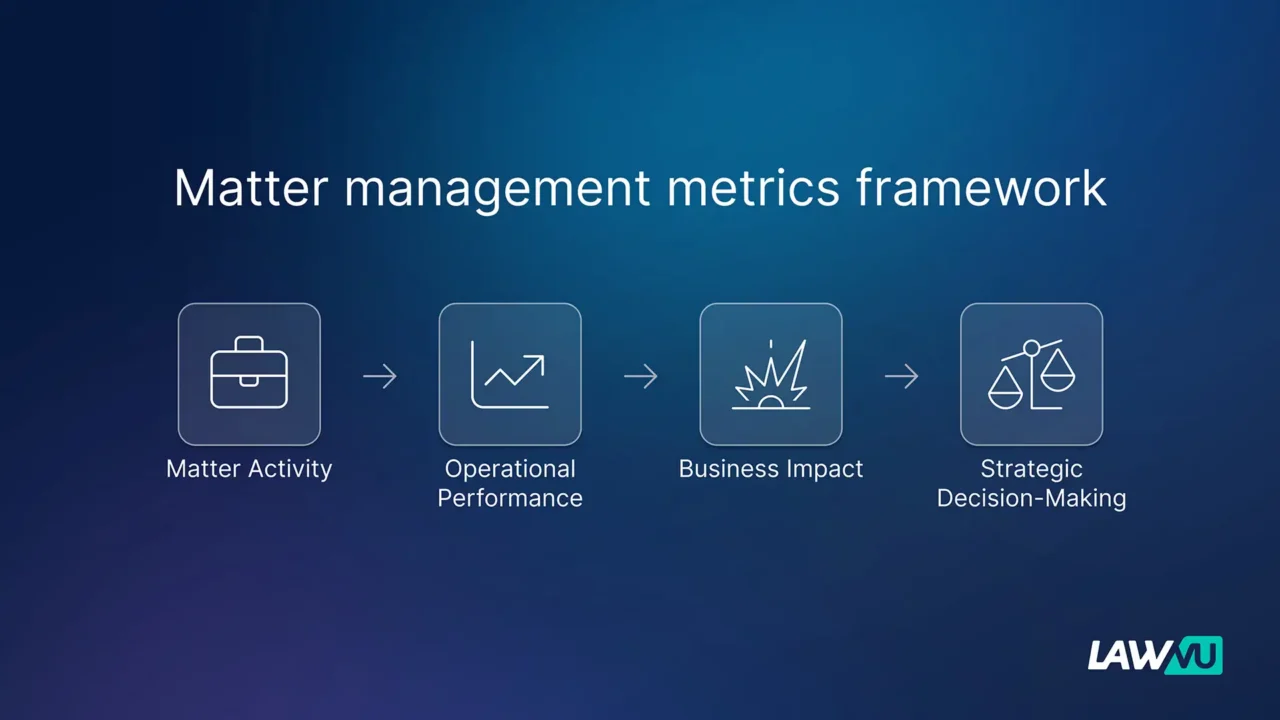
Many legal teams focus heavily on activity metrics, such as the number of matters opened or closed.
While these measurements are useful, they only tell part of the story.
Many mature legal operations teams balance activity metrics with performance metrics that help answer questions such as:
- How quickly is work being completed?
- Where are bottlenecks occurring?
- Which areas create the most demand?
- How effectively are resources being allocated?
- How is legal supporting business objectives?
The most effective reporting programs combine both perspectives.
Metric #1: Matter volume
Matter volume is one of the most fundamental metrics legal teams should track.
This metric helps legal leaders understand overall demand and identify trends over time.
Questions matter volume can answer include:
- How much work is legal handling?
- Is demand increasing or decreasing?
- Which business units generate the most requests?
- What matter types are most common?
Tracking matter volume creates a baseline for understanding legal workload and future resource requirements.
Metric #2: Matter type distribution
Not all legal work requires the same level of effort or expertise.
Tracking matters by category helps legal departments understand where time and resources are being spent.
Common categories include:
- Contract review
- Employment matters
- Litigation
- Compliance
- Intellectual property
- Corporate governance
- Regulatory matters
Over time, this data can reveal opportunities for automation, self-service, process improvement, and staffing optimization.
Metric #3: Matter cycle time
Matter cycle time measures how long it takes to complete legal work from intake to closure.
This is often one of the most valuable performance metrics available to legal leaders.
Monitoring cycle time helps teams:
- Identify bottlenecks
- Improve responsiveness
- Set realistic expectations
- Measure operational improvements
Rather than focusing solely on volume, cycle time helps organizations understand how efficiently legal work moves through the department.
Metric #4: Intake and response times
The business often evaluates legal based on responsiveness.
How quickly does legal acknowledge requests?
How long does it take to provide an initial response?
Tracking intake and response metrics helps legal teams improve stakeholder experiences and identify opportunities to streamline workflows.
As AI-powered intake and triage become more common, these metrics are becoming increasingly important indicators of operational performance.
Some legal teams also track how requests enter the department, including portal submissions, email requests, self-service interactions, and AI-assisted intake channels. These metrics can help identify opportunities to improve adoption, reduce administrative effort, and better manage legal demand.
Metric #5: Workload distribution
One of the most common challenges in legal departments is uneven workload allocation.
Some team members become overloaded while others have available capacity.
Matter management data can help leaders understand:
- Workload by individual
- Workload by team
- Workload by matter type
- Resource utilization trends
This visibility supports better staffing decisions and helps reduce burnout.
Metric #6: Matter status and backlog
Understanding the status of active matters is critical for effective legal operations.
Tracking matters by status helps leaders answer questions such as:
- How much work is currently in progress?
- Where are matters getting stuck?
- Is backlog increasing or decreasing?
- Which workflows require attention?
Without visibility into active work, legal departments often struggle to prioritize effectively.
Metric #7: Outside counsel usage
For organizations that regularly engage external law firms, outside counsel metrics can provide valuable insights.
Common metrics include:
- Matters assigned to outside counsel
- Outside counsel spend by matter type
- Law firm utilization
- Budget versus actual spend
These measurements help legal departments evaluate legal spend and make more informed sourcing decisions.
Metric #8: Knowledge reuse
One of the most overlooked metrics in legal operations is knowledge utilization.
More mature legal operations teams may track:
- Template usage
- Precedent usage
- Self-service adoption
- Knowledge article engagement
While these metrics are less common than workload or cycle-time reporting, they can provide valuable insights into efficiency and knowledge-sharing practices.
Beyond efficiency gains, knowledge metrics help legal teams understand whether valuable institutional knowledge is being captured and reused. Over time, this can help transform completed legal work into a strategic asset that supports future decisions, onboarding, and AI readiness.
Metric #9: Business demand trends
Legal demand rarely remains static.
Tracking trends over time helps legal leaders anticipate future needs and support strategic planning.
For example:
- Which business units generate the most requests?
- Are compliance matters increasing?
- Is contract volume growing?
- Which areas create recurring demand?
Understanding demand patterns helps legal teams move from reactive work management to proactive planning.
Metric #10: Value and impact indicators
While legal value can be difficult to measure directly, operational indicators can help demonstrate how legal supports broader business objectives.
Examples include:
- Reduction in cycle times
- Increased self-service adoption
- Faster contract turnaround
- Improved stakeholder satisfaction
- Reduced outside counsel dependency
- Better workload visibility
When combined with operational metrics, these indicators help legal leaders communicate the broader impact of legal work.
The role of matter management software in reporting
Accurate reporting depends on accurate data.
This is one reason why many organizations invest in modern legal matter management software and matter management systems.
When legal work is managed consistently on a centralized platform, teams gain access to more reliable reporting, greater visibility, and better decision-making.
For organizations evaluating in-house legal matter management software, reporting and analytics should be considered core capabilities rather than optional features. More importantly, reporting is only one outcome. For many organizations, a matter management system becomes the foundation of a legal system of record, creating a trusted source of information that supports reporting, knowledge management, operational visibility, and AI adoption.
- 7 essential features of effective legal matter management software
- Matter management evaluation playbook: How to compare software and vendors
Customer perspective
“Before LawVu, we didn’t have a single view of our legal work. By bringing matters and contracts together in one platform, we gained the visibility we needed to prioritize work, improve reporting, and better support the business.”
— Northern Tool + Equipment
Reporting is only the beginning
High-performing legal teams don’t use reporting solely to understand what happened. They use data to improve the delivery of legal services.
As legal operations mature, reporting becomes part of a broader operating model that connects matters, contracts, intake, knowledge, workflows, and AI. This is where LegalOS comes into play.
By bringing legal work together in a connected operational environment, LegalOS helps legal teams move beyond reporting to continuous improvement, strategic planning, and data-driven decision-making.
From reporting to legal operations maturity
The most mature legal departments don’t measure metrics simply to create reports.
They use data to improve decision-making.
Matter management metrics help legal leaders understand demand, optimize resources, identify opportunities for improvement, and demonstrate value to the business.
As legal operations continue to evolve, the ability to measure and manage performance will become increasingly important.
The goal isn’t to collect more data. It’s to generate better insights.
And for high-performing legal teams, matter management provides the foundation for those insights.
The future of legal operations is measurable
The legal departments that perform best in the future will not necessarily be those with the largest teams or budgets. They will be those with the strongest visibility into their work.
Metrics help legal leaders understand demand, improve service delivery, allocate resources more effectively, and demonstrate value to the business.
The future of legal operations will increasingly rely on connected data, trusted systems of record, and AI-powered insights. But none of those capabilities are possible without a strong foundation.
For many legal departments, that foundation begins with matter management.