Reducing legal friction: 6 features LawVu customers use to reduce legal friction
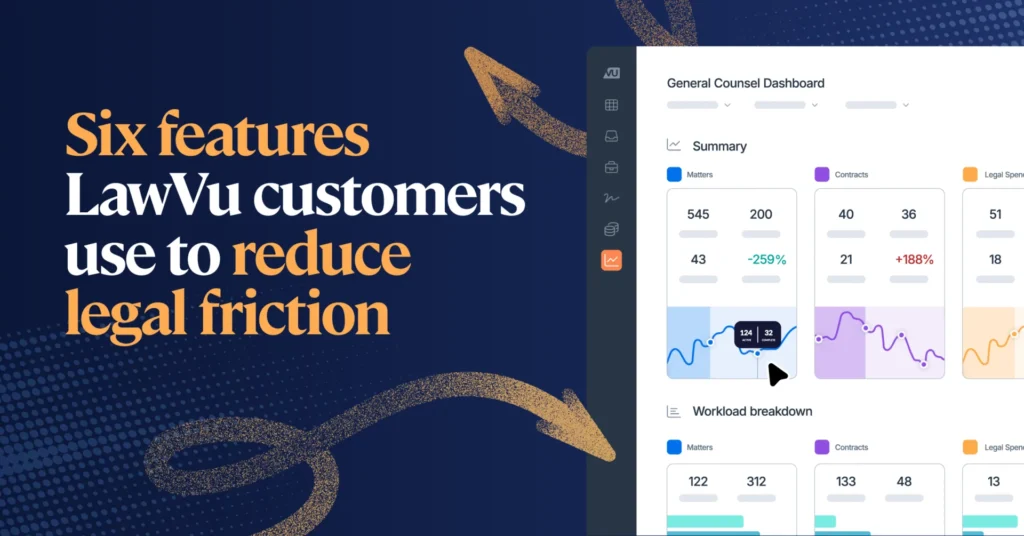
TL;DR
Legal friction slows business momentum, increases operational risk, and consumes valuable legal team capacity. A legal operating system like LawVu LegalOS reduces friction by connecting intake, matters, contracts, spend, documents, and AI workflows in one unified platform.
Instead of relying on disconnected tools and manual processes, in-house legal teams can streamline work, improve visibility, automate repetitive tasks, and deliver a faster, more transparent legal experience across the business.
How a legal operating system reduces legal friction for your business
Every business function has an operating system. Sales runs on a CRM. Finance runs on an ERP. HR runs on an HCM.
For years, legal has been the exception.
Many in-house legal teams still manage work across email, spreadsheets, shared drives, chat messages, and disconnected software. The result is legal friction: operational inefficiency caused by fragmented workflows, manual processes, and disconnected data.
When legal work slows down, the impact spreads across the business:
- Revenue opportunities stall
- Procurement cycles slow
- Risk surfaces too late
- Outside counsel spend increases
- Legal teams become overloaded with administrative work
According to IDC research, inefficient legal processes contribute to significant productivity loss and rising operational costs across organizations.
The problem is no longer a lack of legal technology. It’s a lack of connected operational infrastructure. In-house legal teams don’t need another disconnected tool.
They need a legal operating system.
What is a legal operating system?
A legal operating system is a connected platform where legal workflows, operational data, and AI capabilities work together in one environment.
LawVu LegalOS connects intake, matters, contracts, spend, documents, reporting, and AI workflows into a unified system designed specifically for in-house legal teams.
Instead of stitching together separate applications, LegalOS creates a single operational foundation where:
- Legal requests enter through one front door
- Workflows move seamlessly across teams
- Contracts, matters, and spend data stay connected
- AI operates with richer legal context
- Legal leaders gain visibility across the entire function
Point solutions improve isolated workflows. A legal operating system improves how the legal function operates as a whole.
By replacing fragmented processes with connected infrastructure, legal teams can reduce operational overhead, improve responsiveness, and scale more effectively.
1. Reduce intake and workflow friction
One of the biggest sources of legal friction is intake chaos.
Requests arrive through Slack, Teams, email, spreadsheets, and informal conversations. Legal teams spend valuable time clarifying requests, routing work manually, and chasing missing information.
LawVu LegalOS creates one intelligent front door for legal work.
With AI-powered intake, business users can submit requests using plain language through the tools they already use, while legal teams can standardize triage, surface risk earlier, and route work more efficiently.
LegalOS also connects matter management, collaboration, approvals, and reporting into a single operational workflow. Instead of coordinating work across disconnected systems, legal teams gain:
- Better visibility across matters and approvals
- More consistent workflows
- Reduced administrative coordination
- Faster stakeholder communication
- More time for strategic legal work
This creates a faster, more transparent legal experience across the business. Take the example of Sizzling Platter, where the introduction of LawVu LegalOS is saving the team 10-15 hours per week, allowing that time to be spent on higher-value work. https://lawvu.com/customer-story/sizzling-platter/
2. Reduce contract friction with connected AI
Contracts remain one of the largest sources of operational friction for legal teams.
Drafting, reviewing, approving, and tracking agreements often involves disconnected systems, manual handoffs, and limited visibility into risk and obligations.
LawVu LegalOS approaches contract lifecycle management as part of a connected operational system rather than a standalone repository.
LawVu Draft enables legal teams to draft, review, and negotiate agreements directly within Microsoft Word using AI-powered playbooks, clause libraries, and contract intelligence. Because contracts remain connected to approvals, matters, documents, and reporting workflows, legal teams gain greater visibility across the entire contract lifecycle.
Connected AI capabilities also help legal teams:
- Surface obligations faster
- Identify risk exposure earlier
- Improve renewal management
- Analyze contracts at scale
- Support diligence processes more efficiently
AI works best when it operates inside connected legal workflows with access to structured legal data. When contracts, matters, spend, and documents exist in one operational environment, AI can deliver more accurate and actionable outcomes.
3. Reduce legal spend and governance friction
Legal spend management often becomes fragmented across finance systems, spreadsheets, email approvals, and e-billing tools.
That fragmentation creates approval delays, reporting gaps, inconsistent oversight, and limited visibility into outside counsel performance.
LawVu LegalOS connects spend management directly to legal workflows so legal and finance teams can operate from the same data foundation.
By centralizing invoice review, approvals, reporting, and spend visibility, legal teams can:
- Improve billing governance
- Reduce manual review work
- Increase visibility into outside counsel spend
- Improve approval efficiency
- Strengthen legal and finance alignment
AI further reduces administrative friction by automatically identifying billing exceptions and surfacing areas that require attention.
4. Create connected operational intelligence
Disconnected legal tools make it difficult to generate meaningful operational insight.
When intake, matters, contracts, and spend live in separate systems, reporting becomes fragmented and reactive.
A legal operating system changes that by connecting every workflow to a shared operational foundation. Seeking to drive efficiency, Michael Vitko, Senior Manager, Legal Operations in Healthcare, is impressed how LawVu has transformed his team. “Our average timeline on a MSA was twenty-one business days. Now we’re getting through them in six days. When we shared our metrics with the board, they were shocked. That’s efficiency gains at its finest; that’s the purpose of my job in legal operations.”
LawVu LegalOS enables legal teams to:
- Track operational performance in real time
- Surface emerging risks earlier
- Monitor contract obligations proactively
- Analyze legal demand patterns
- Improve forecasting and budgeting
- Deliver reporting faster
The long-term value is compounding operational intelligence.
Every workflow improves visibility. Every interaction strengthens the legal data foundation. Every contract, matter, and request contributes to better operational decision-making.
That’s what separates a legal operating system from a collection of standalone tools.
Why connected AI matters
AI is rapidly reshaping legal operations but disconnected AI tools often create additional complexity instead of reducing it.
When AI operates outside legal workflows, it lacks the context, governance, permissions, and structured data needed to produce reliable outcomes.
A connected legal operating system change that. At Emapta, using LawVu has already led to notable efficiency gains for the legal team and Ben van de Beld, Chief Legal and Operations Officer says: “Our next focus is to further improve our contract and self-service functionality through utilizing AI in the LawVu legal operating system. This will significantly speed up contract turnaround through the ability to quickly compare clauses and reduce the number of intake forms we require from the business.”
Because LegalOS connects intake, matters, contracts, spend, documents, and workflows in one environment, AI can help legal teams:
- Reduce repetitive manual work
- Improve consistency across workflows
- Surface risk earlier
- Deliver faster business responses
- Maintain governance and auditability
The result is not simply better AI outputs. It is lower operational friction across the legal function.
The future of legal operations is connected infrastructure
The legal technology conversation is shifting.
The market is moving beyond isolated point solutions toward connected operational infrastructure purpose-built for in-house legal teams.
Legal departments no longer need another disconnected application. They need a system that connects workflows, data, and AI into one operational foundation.
That’s the role of a legal operating system.
By reducing fragmentation across intake, matters, contracts, spend, and reporting, a legal operating system helps legal teams move faster, improve visibility, strengthen governance, and deliver a better experience to the business.
For organizations looking to reduce legal friction and prepare for the next generation of AI-enabled legal work, connected operational infrastructure may become one of the most important decisions they make.