AI contract review: Why editing beats drafting
TL;DR
AI contract review tools work best when editing existing text, not inventing new language. Blank-page drafting and open-ended review perform weakly, while clause-specific redlining and playbook-based review perform strongly. The deciding factor throughout: how much context you give the tool.
“AI is great at editing what already exists and much weaker at inventing what doesn’t,” explained Maarten Truyens, Senior Product Manager at LawVu, in a recent webinar. Truyens believes keeping this concept in mind as your north star when using AI contract review tools is the difference between a tool that saves you hours and one that quietly creates more work than it solves.
Why contract review tools should save you hours
Most legal teams have moved past questioning the benefits of AI. They’re actively testing it on drafting and using AI contract review software in conjunction with playbooks. The issue is that results swing from impressive to useless, sometimes in the same afternoon.
That inconsistency isn’t a sign the technology is broken. It’s a sign most people are still guessing at when to trust it, instead of verifying it before they hit send.
For a deeper dive on how to prepare your team for in-house legal AI, check out this article.
In the video above, LawVu COO Sarah Webb and Co-founder Shaun Plant explain why AI requires operational context (not just documents) to deliver reliable legal outcomes.
The AI contract review spectrum: from guesswork to grounded
If you’re still new to the fundamentals of legal AI, this article illustrates the basic mechanics.
When it comes to tasking AI with contract review specifically, every task sits somewhere on a spectrum of weakness to strength, and this placement predicts how well the AI will perform.
Contract drafting from a blank page
Contract drafting from scratch is a real weakness of AI. With nothing to anchor to, the model has to invent structure, language, and judgment calls, and it has no reference to flag which choices are legally sound and reflect an organization’s fallback positions. Traditional document automation tools have handled this high-volume, repeatable drafting for decades and still do it better than a chatbot.
Drafting a single clause from scratch
Another weak spot for AI is drafting a single clause from scratch. It performs this task better than generating an entire contract, but the advantage often disappears in practice. To get something usable, you need a prompt almost as detailed as the clause itself, and by that point, you’ve already done most of the legal thinking.
Open-ended review
Higher up on the spectrum, but still at the weaker end, sits open-ended review with no guardrails. Asking AI to “look this over and tell me what’s wrong” is easy to do and genuinely useful as a sparring partner (especially if you’re unfamiliar with the subject matter), but without background information, the model can only offer generic feedback, and it won’t give you the same answer twice.
There’s a reason for that: the model doesn’t have memory between prompts. Every message re-reads the whole conversation from scratch, so any consistency you see has to come from what you feed it, not from the model remembering your last conversation.
Redlining a whole document at once
When AI is tasked with redlining, a specific failure often shows up: the longer the document, the more quality sags in the middle. Attention degrades with length, so clauses buried on page 12 get noticeably less careful treatment than the ones on page one.
As Truyens explains, once a contract runs past 10 pages, “the machine’s brain starts to get overtaxed, a bit like a human. The start and the end of the document are its best parts, quality-wise.” The fix to this isn’t to create a clearer prompt, but rather to feed the AI smaller, topic-sized chunks instead of one giant redline.
Redlining one clause with full document context
On the stronger side of the AI contract review spectrum is clause-specific redlining. If you can pinpoint a single clause and hand the model the surrounding contract as context, it will have enough anchoring to generate valuable outputs by comparing your preferred language against a clause library or a past example instead of guessing.
Reviewing against a playbook, provision by provision
Using a playbook as a reference point for AI contract review is the model’s strength, because it’s the most anchored and gives the AI clause-by-clause breakdowns. A contract playbook is simply a short list of the handful of provisions a legal team will push back on – everything else is accepted as is. Working through a document provision by provision against that list keeps human eyes in the decision-making seat, rather than producing a wall of redlines that just drags out negotiation.
Hot tip: be wary of hallucinations
AI hallucinations are real, and something any lawyer using contract review software should watch for. Always ask your model to cite its sources, so you can verify the information is legitimate. AI hallucinations occur because the AI is programmed to provide an answer.
When it is faced with a question it doesn’t know, it will often confidently invent an answer, because “it wants to please you – that’s how it is built,” says Truyens.
The fix is the same one that runs through this whole spectrum: supply the actual facts up front instead of hoping a cleverer question will get you there.
The real lesson: context is the product
The spectrum of how AI contract review performs relies purely on how much anchoring you provide the tool with. AI will generate better results if it has more context; be that a document to redline against, a playbook, or a prior clause library.
Legal teams are often put off by the amount of time and investment required to build a playbook, but ironically, it is the biggest differentiator in taking your AI contract review and drafting tools to the next level.
Identifying the needs of your legal team is the most important step in providing legal AI with the context it needs to provide value.
Before you hand a task to AI contract review software, ask yourself: does my task require the AI to invent something, or can it work within something I already have? If you’re staring at a blank page, expect to do more of the driving yourself, or reach for document automation instead. If you’ve got a document, a playbook, or a prior example to hand it, you’re set up for exactly the kind of task AI is good at.
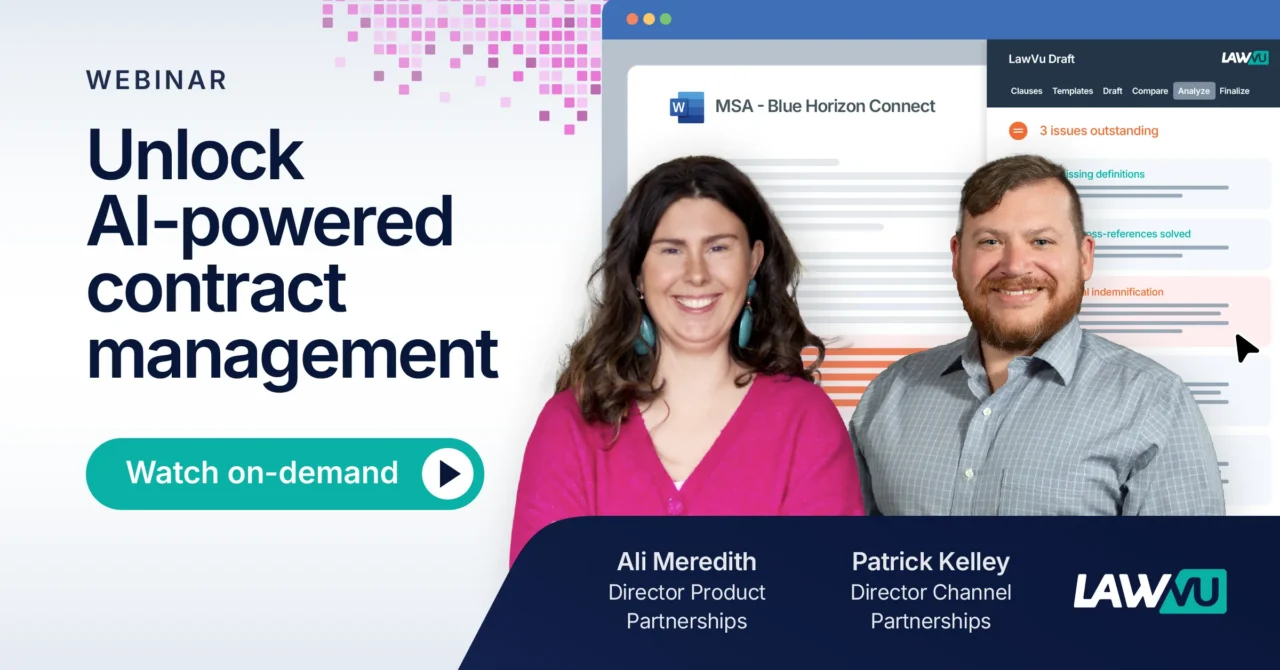
To see the spectrum of contract editing in action, check out the full “Drafting & Reviewing Contracts with AI” webinar recording.