Why document management and matter management go hand-in-hand
 Michaelle Noble

Legal departments create and manage vast amounts of information.
Contracts, correspondence, policies, litigation documents, regulatory filings, advice, approvals, and supporting materials all play a critical role in how legal work gets done. Yet many legal teams continue to manage documents separately from the matters they support.
While this approach may seem manageable at first, it often creates inefficiencies, increases risk, and makes it harder to find the information needed to make informed decisions.
This is why document management and matter management work best together.
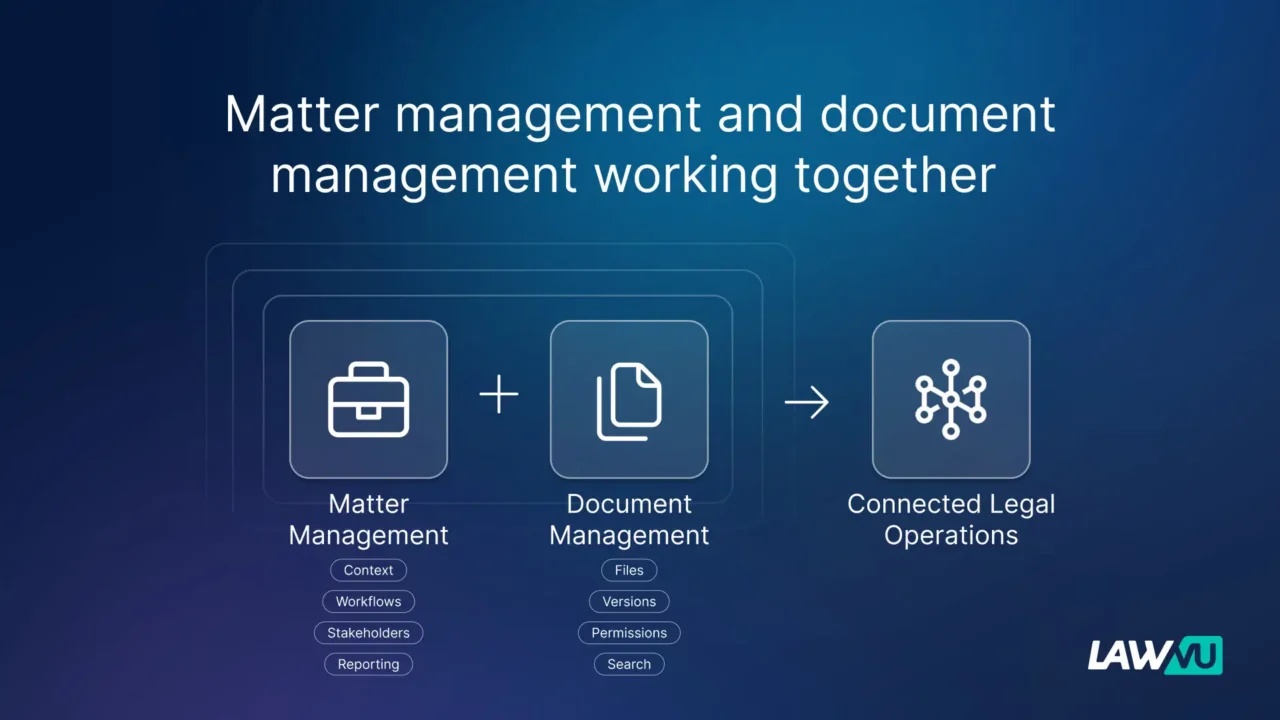
Matter management provides the context around legal work. Document management provides access to the information that supports it. When combined, they create a connected operational environment that improves visibility, collaboration, reporting, knowledge management, and AI readiness.
Why legal documents need context
Documents rarely exist in isolation.
A contract may be tied to a procurement project, a vendor dispute, a negotiation history, internal approvals, and ongoing obligations. Litigation documents may relate to multiple stakeholders, outside counsel communications, deadlines, and risk assessments.
Without context, documents become difficult to understand and even harder to locate when needed.
Matter management solves this challenge by organizing documents around the legal work they support.
When documents are connected to matters, legal teams gain a more complete understanding of:
- Why a document was created
- Who was involved
- What decisions were made
- How the matter evolved
- What risks were identified
- What outcomes were achieved
This context becomes increasingly valuable as legal workloads grow.
What is matter management? The foundation of modern legal operations
Document management and matter management serve different purposes
Although the terms are sometimes used interchangeably, document management and matter management solve different challenges.
Document management focuses on information
Document management helps legal teams:
- Store documents
- Organize files
- Control versions
- Manage permissions
- Search for content
- Retain records
Matter management focuses on legal work
Matter management helps legal teams:
- Track legal matters
- Manage workflows
- Coordinate stakeholders
- Monitor deadlines
- Capture decisions
- Report on performance
The greatest value is realized when these capabilities work together.
Why disconnected documents create operational challenges
When documents live separately from matters, legal teams often encounter common problems.
Difficulty finding information
Lawyers and legal operations professionals spend valuable time searching across shared drives, email inboxes, and disconnected systems.
Duplicate work
Without visibility into previous matters and related documents, teams may recreate work that already exists.
Limited reporting
Documents alone provide little insight into workload, risk exposure, or operational performance.
Knowledge loss
When legal work is disconnected from supporting documents, valuable institutional knowledge can become difficult to preserve and reuse.
Reduced AI effectiveness
AI depends on context. Documents without matter-related information often provide an incomplete picture of legal work.
As legal departments continue to modernize, these challenges become increasingly difficult to manage.
How matter management improves document management
Matter management creates structure around legal work.
When documents are connected to a matter, teams gain access to important contextual information such as:
- Matter type
- Business owner
- Status
- Related contracts
- Communications
- Tasks
- Approvals
- Key decisions
This creates a richer, more useful record of legal activity.
Instead of searching for individual files, legal professionals can view documents within the context of the matter they support.
Understanding the importance of legal matters for in-house counsel
How document management strengthens matter management
The relationship works both ways.
Strong document management capabilities improve the effectiveness of matter management by ensuring information remains organized, accessible, and secure throughout the matter lifecycle.
Benefits include:
- Faster document retrieval
- Better collaboration
- Improved version control
- Stronger governance
- Reduced risk
- Easier audits and compliance reviews
For legal teams evaluating legal matter management software, integrated document management capabilities should be considered a core requirement rather than an optional feature.
The role of search and knowledge management
One of the most valuable outcomes of connecting document management and matter management is improved knowledge discovery.
Every completed matter generates information that can support future work:
- Legal advice
- Negotiation history
- Internal precedent
- Templates
- Risk assessments
- Business decisions
When documents and matters are connected, legal teams can search across both work and information.
This improves:
- Efficiency
- Consistency
- Onboarding
- Decision-making
- Knowledge sharing
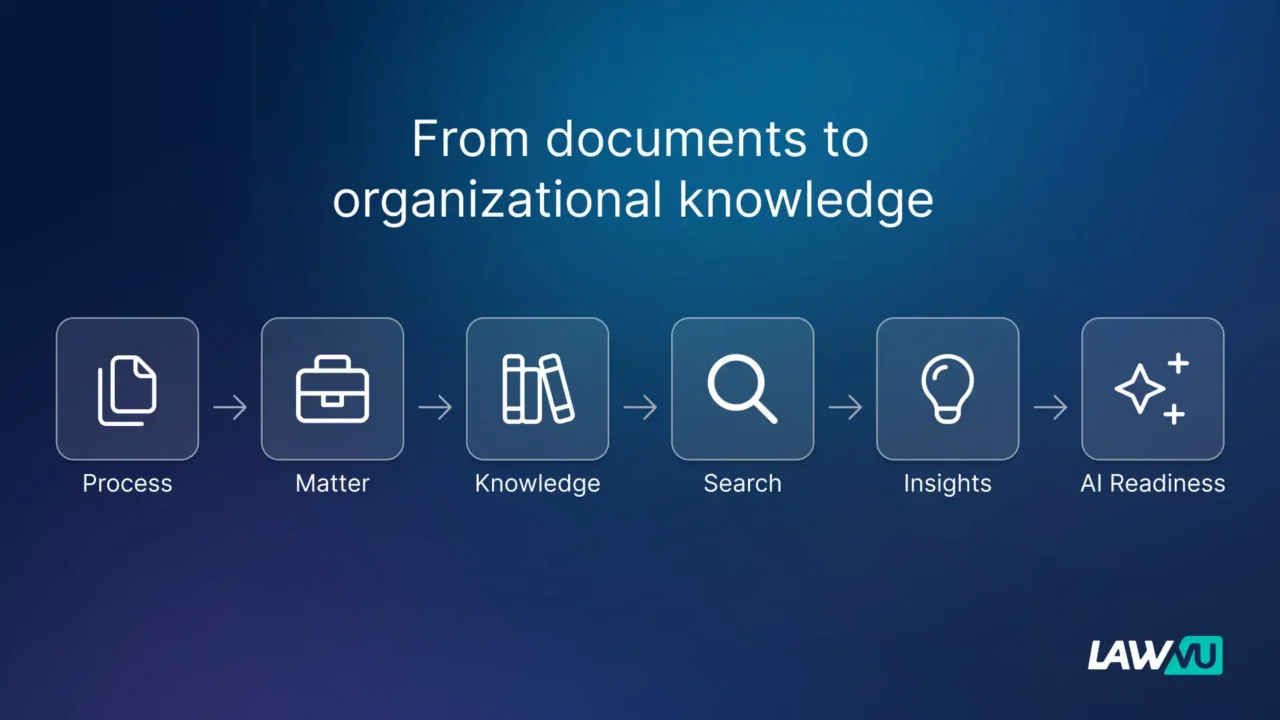
Search becomes significantly more valuable when documents and matters are connected. Rather than searching individual files in isolation, legal teams can search across documents, matters, stakeholders, decisions, and historical work. This provides faster access to information and helps teams uncover relevant knowledge that might otherwise remain hidden.
Over time, completed legal work becomes a searchable organizational asset rather than a collection of disconnected files.
Building a legal system of record
As legal departments mature, the goal extends beyond storing documents or tracking matters.
The objective becomes creating a trusted system of record.
A legal system of record brings together:
- Matters
- Documents
- Communications
- Decisions
- Workflows
- Knowledge
- Reporting
By connecting these elements, legal teams can create a more complete and trusted source of information for legal operations.
This provides:
- Better visibility
- Stronger governance
- Improved reporting
- Greater operational efficiency
- Enhanced AI readiness
Why this matters for AI
AI is rapidly changing how legal work is performed.
However, successful AI adoption depends on more than access to documents.
AI generally produces more reliable and relevant outputs when it can access both information and contextual data about the legal work being performed.
For example, a contract becomes significantly more valuable when AI can also understand:
- Related matters
- Stakeholders
- Negotiation history
- Prior decisions
- Business objectives
- Risk considerations
This is one reason why connected matter management systems are becoming increasingly important.
They provide the structure, governance, and context that support more effective AI-powered search, summarization, reporting, and knowledge discovery.
From document repositories to LegalOS
Historically, many legal departments viewed document management as a standalone capability.
Today, leading legal teams are moving toward connected operating models.
Rather than managing matters, documents, workflows, contracts, reporting, and knowledge in separate systems, they are bringing these capabilities together within a single operational environment.
This is where LegalOS comes into play.
LegalOS builds on the foundation of matter management and document management by connecting legal work, information, knowledge, reporting, and AI within a unified platform.
The result is greater visibility, stronger governance, and a more scalable approach to legal operations.
The future of legal information management
The future of legal operations is not simply about storing more documents.
It is about connecting information to legal work.
When document management and matter management work together, legal teams gain greater visibility, stronger governance, improved knowledge management, and a more complete understanding of their operations.
As legal departments continue to evolve, organizations that connect documents, matters, knowledge, reporting, and AI will be better positioned to scale legal services and support the business.
For many legal teams, that journey begins by recognizing that document management and matter management are not separate disciplines – they are complementary capabilities that are most powerful when they work together.