Implementing matter management software for in-house teams: 3 steps to success
 Aqua Delaney

Selecting a matter management platform is an important milestone for any legal department.
But implementation – not selection – is often what determines long-term success.
Many legal teams invest significant time evaluating vendors, comparing features, and building business cases. Yet even the best legal matter management software will struggle to deliver value if adoption is low, data is inconsistent, or processes remain unchanged.
Successful implementation requires more than technology. It requires a clear strategy, stakeholder alignment, and a focus on how legal work will be managed in the future.
For in-house legal teams, the most effective implementations focus on three key areas: people, process, and data.
Why matter management implementation matters
Matter management software has evolved significantly over the past decade.
Today’s platforms help legal teams:
- Centralize legal work
- Improve visibility
- Standardize processes
- Manage legal requests
- Capture institutional knowledge
- Support reporting and analytics
- Create a foundation for AI-ready legal operations
However, these benefits are only realized when the system becomes part of how legal teams work every day.
Implementation should be viewed as an operational transformation initiative rather than a software deployment project.
Step 1: Start with process, not technology
One of the most common implementation mistakes is attempting to recreate existing processes inside a new system.
If current workflows are inconsistent, manual, or difficult to manage, simply digitizing them rarely delivers meaningful improvement.
Before implementation begins, legal teams should evaluate how work currently flows through the department.
Questions to consider include:
- How are legal requests submitted?
- How are matters categorized?
- How is work assigned?
- How are priorities determined?
- What reporting is required?
- Where do bottlenecks occur?
This assessment helps identify opportunities to standardize processes before technology is introduced.
“We wanted a single place where legal work could be managed consistently across the business. By bringing matters and contracts together, we gained greater visibility and improved how requests flow through the team.”
EMAPTA legal team
Focus on legal intake first
Many successful implementations begin with intake.
Legal intake serves as the front door to the legal department. When intake is inconsistent, every downstream process becomes more difficult to manage.
Modern matter management systems can help standardize:
- Request submission
- Matter classification
- Routing and assignment
- Balancing resources and priorities
- Risk identification
- Workflow initiation
As AI-powered intake and triage become more common, establishing a structured intake process also creates the foundation for future automation and AI adoption.
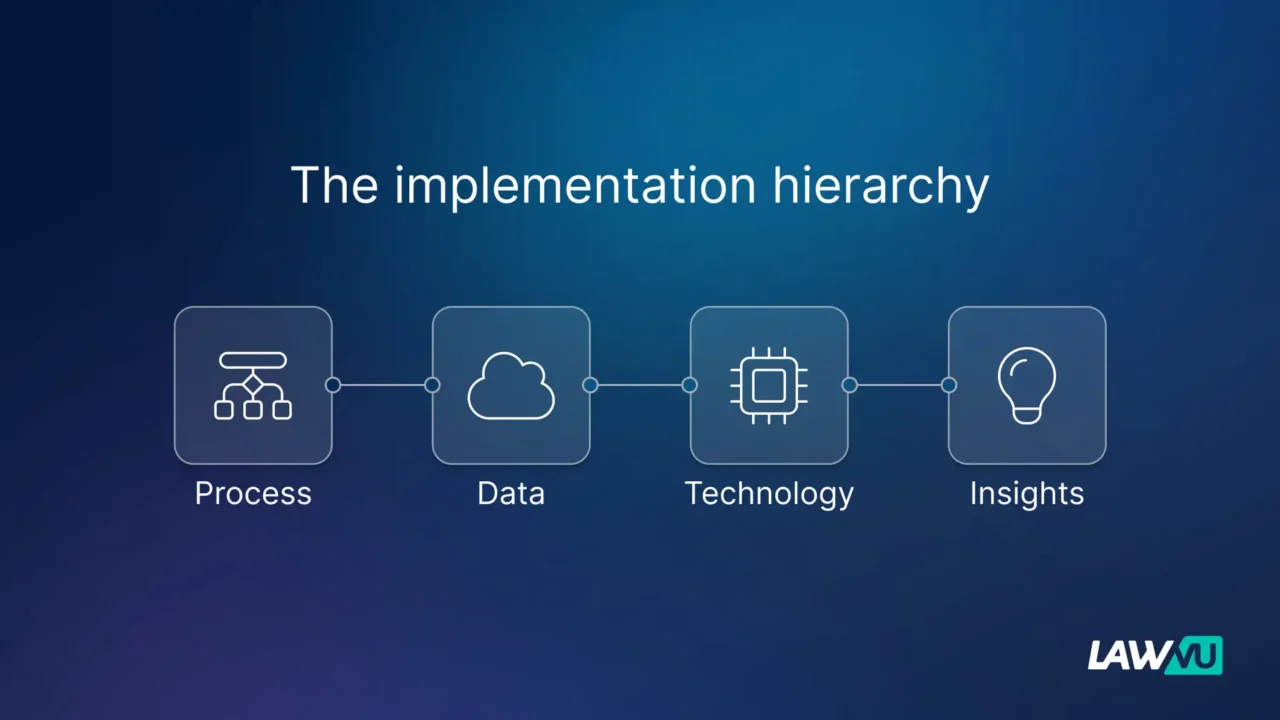
Organizations that focus on process first are often better positioned to achieve long-term adoption and value.
Step 2: Build a trusted system of record
A successful matter management implementation should create more than visibility into legal work.
It should establish a trusted system of record.
A legal system of record provides a centralized source of truth for:
- Matters
- Documents
- Decisions
- Communications
- Workflows
- Reporting
- Institutional knowledge
When information is scattered across spreadsheets, email inboxes, shared drives, and disconnected applications, reporting becomes difficult, and knowledge is often lost.
A matter management system helps solve this challenge by creating structure around legal work and ensuring information remains connected throughout the matter lifecycle.
“Before LawVu, our legal work was spread across emails, spreadsheets, and disconnected systems. Having a centralized place to manage matters and contracts has given us visibility into our work and helped us create more consistent processes across the department.”
Northern Tool + Equipment legal team
Prioritize data quality from day one
The quality of reporting, search, and future AI capabilities depends on the quality of the underlying data.
As part of implementation, legal teams should establish:
- Matter categories
- Metadata standards
- Ownership rules
- Naming conventions
- Reporting requirements
Consistent data practices create a stronger foundation for legal operations and future growth.
Related resources
Turn legal work into organizational knowledge
One of the most overlooked benefits of matter management implementation is knowledge capture.
Every completed matter contains valuable information that can help future work:
- Negotiation strategies
- Legal guidance
- Internal precedent
- Risk assessments
- Business context
Capturing this information systematically helps transform legal work into an asset that can be reused across the organization.
Step 3: Focus relentlessly on adoption
Technology creates value only when people use it.
This is often the most challenging part of implementation.
Successful legal teams focus on making adoption as easy as possible by reducing friction and clearly communicating value.
Common adoption strategies include:
- Executive sponsorship
- User training
- Clear governance
- Defined workflows
- Internal champions
- Ongoing feedback loops
Rather than measuring success solely by implementation timelines, organizations should focus on behavioral adoption.
Questions to ask include:
- Are matters being created consistently?
- Is intake being used?
- Is reporting data reliable?
- Are documents connected to matters?
- Are teams following standardized workflows?
These indicators often provide a better measure of implementation success than technical milestones alone.
Common implementation challenges
Most legal departments encounter obstacles during implementation.
Common challenges include:
Resistance to change
Team members may be comfortable with existing processes, even when those processes are inefficient.
Inconsistent data
Historical information often requires cleanup before migration.
Lack of process standardization
Undefined workflows can create confusion and reduce adoption.
Unrealistic expectations
Meaningful operational improvement takes time and ongoing refinement.
Recognizing these challenges early can help organizations plan more effectively and improve long-term outcomes.
Related resources
Why implementation is becoming more important in the AI era
As legal departments evaluate AI capabilities, implementation quality is becoming increasingly important.
AI depends on:
- Structured, complete data
- Consistent processes
- Connected information
- Reliable governance
Organizations with mature matter management practices are often better positioned to take advantage of AI-powered capabilities such as:
- Intelligent intake
- AI-assisted triage
- Knowledge discovery
- Matter summarization
- Reporting insights
In many ways, successful AI adoption begins with successful matter management implementation.
From matter management to LegalOS
The most mature legal departments use matter management for more than work tracking.
They use it as the foundation for connected legal operations.
As legal technology continues to evolve, matter management increasingly serves as the operational layer that connects intake, contracts, knowledge, reporting, workflows, and AI.
This is where LegalOS comes into play.
By bringing these capabilities together within a connected environment, LegalOS helps legal teams move beyond isolated tools and create a more scalable, data-driven operating model.
A successful implementation is often the first step on that journey.