Connecting AI tools to the legal operating system: Introducing the LawVu MCP Server
 Sam Kidd
Every core business function has experienced its operating system moment. Sales embraced CRM. Finance adopted ERP. HR standardized on HCM. Legal has been the notable exception – until now.
Most in-house teams have been forced to stitch together email, spreadsheets, shared drives, point solutions, and disconnected AI tools just to keep work moving. That model was already becoming unsustainable before AI arrived. Now, with the rise of agentic AI and rapidly evolving tools like Claude and ChatGPT, the gap has become even more obvious.
AI is powerful, but without the right operating environment, it’s still operating in fragments. Connecting AI tools like Claude with the operational reality of legal work – the matters, workflows, governance, approvals, and context managed inside the LawVu LegalOS – allows AI to become operational, specific, and centralized. It gives legal teams the ability to unlock the efficiency of AI across systems while maintaining control and visibility.
That’s why we’re announcing the LawVu MCP server.
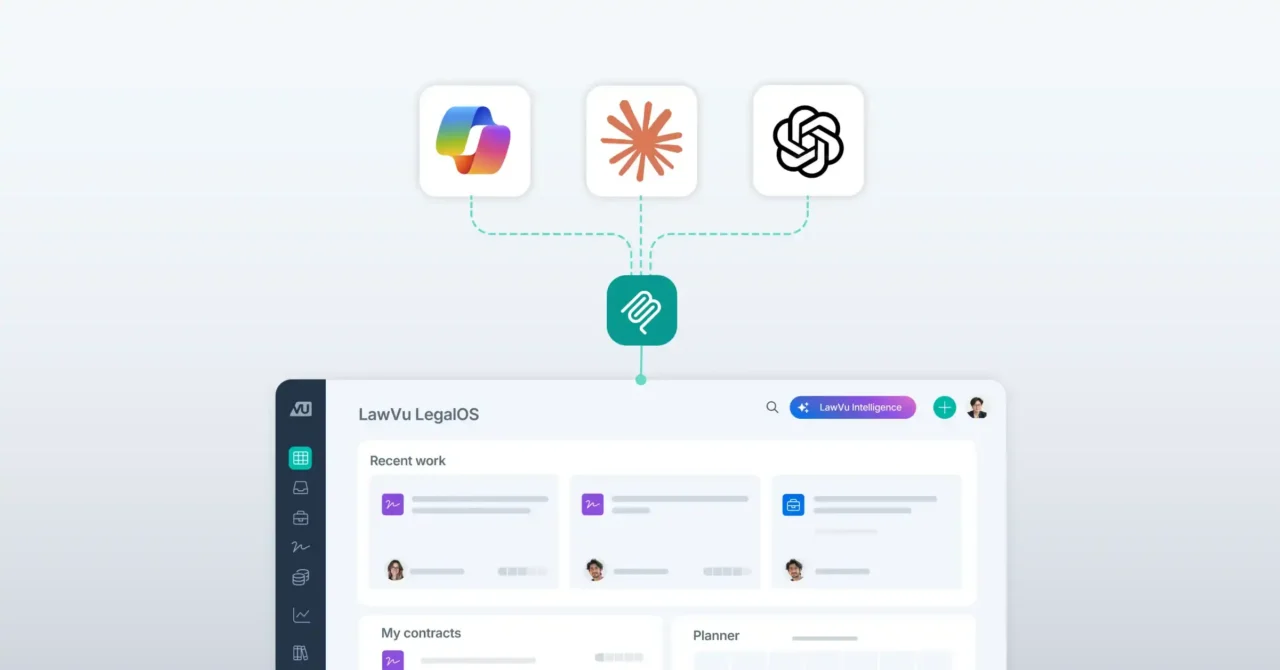
The LawVu Model Context Protocol (MCP) server allows customers to securely connect their AI tool of choice, such as Claude, ChatGPT, Microsoft Copilot, into the LawVu LegalOS, giving those tools governed access to matters, contracts, workflows, approvals, legal knowledge, spend, tasks, and other ancillary documents such as files, legal notes, and conversations linked to matters and contracts, and status updates.
This is where AI truly becomes operational.
Meeting people where they work
One of the most important principles behind LawVu is meeting people where they work.
Legal teams are already using tools like Claude to reason through documents, summarize information across systems, draft content, and interact with complex legal material. The real opportunity is to move AI beyond isolated interactions and embed it within the day-to-day operations of legal work.
Claude is strong at reasoning, natural language interaction, agent orchestration, and drafting workflows, and LawVu can enhance that.
LawVu provides the operational foundation: matters, contracts, tasks, permissions, workflows, approvals, governance, audit history, and the structured legal data that legal teams rely on every day.
The best outcomes happen when those two things work hand in glove.
Documents with operational context, specific to your legal team
A powerful example is document analysis.
Claude is excellent at interacting with documents. But legal work is rarely about a document in isolation. Value comes from understanding the broader context: the matter, related approvals, resulting obligations, applicable policies, current status, and the people responsible for what happens next.
With LawVu’s MCP server, a legal team could ask Claude to review or summarize a document while drawing on the structured context inside LawVu, the related matter, previous conversations, key dates, tasks, responsible owners, playbooks, and approvals.
That means the output is not just a generic document summary. It is grounded in the way the legal team operates. That is the difference between AI working on a file and AI working inside the legal operating system.
What the LawVu MCP server enables at launch
In the initial release, the LawVu MCP server will enable legal teams to use their AI tool of choice to:
- Search and query matters and contracts in natural language, with structured results and links back to LawVu
- Summarize and report across matters or contracts, including key details, gaps, risks, and status updates
- Retrieve policy and knowledge answers grounded in internal legal content
- Create matters or trigger contract workflows directly from an AI tool
- Update matter status, create tasks, and set deadlines from connected AI workflows
This moves AI from “ask to answer” toward “ask to act.” For example, a legal leader could use Claude to pull together information from LawVu and other business systems – like Salesforce, HR, or procurement platforms – to build a more complete picture of the business entities, projects, and operational work legal is connected to.
They could ask:
“Look across my sales contracts related to ACME Corporation in LawVu. Compare them against corresponding opportunities in Salesforce and provide a visual summary highlighting any inconsistencies in dates, contract values, or key terms.”
“Create a board-ready PowerPoint summary of high-priority active matters for this quarter. Include upcoming tasks, recent status updates, key risks, and notable conversations.”
Tools like Claude are exceptionally strong at synthesizing information and presenting it visually – whether that’s generating leadership summaries, creating polished slide decks, or surfacing insights across connected systems. When paired with the governed operational data inside LawVu LegalOS, the insights and work products generated by AI become significantly more useful, accurate, and actionable.
That is where MCP becomes more than an integration layer. It becomes a new way for enterprise systems to speak to each other.
Natural language changes integrations
Using APIs (Application Programming Interface) to create bespoke connections between the systems legal teams rely on has always been harder than it sounds. Every organization works differently. Every workflow has nuance. Moving data between systems has traditionally required technical scoping, configuration, and ongoing maintenance. MCP changes that dynamic.
It allows people to express what they want to happen in natural language – how they want systems like LawVu, Salesforce, Slack, HR platforms, or AI tools to interact – with more flexibility and control than traditional integrations have allowed.
That matters because legal teams need technology that adapts to how they work, not the other way around.
Efficiency, consumption, and guardrails
There’s also an important efficiency conversation emerging alongside all of this.
Not every workflow should happen entirely inside an external AI tool. In a lot of cases, the most efficient place for legal work is still inside LawVu, where the workflows, permissions, approvals, and operational context already exist, and legal has total control on when and what agentic workflows run.
The opportunity with MCP is not choosing between AI tools and LegalOS, but allowing each to do what it does best.
Claude can handle the reasoning, drafting, summarization, and natural language interaction layer, while LawVu handles the operational layer – workflows, governance, tasks, approvals, audit trails, and execution.
Over time, that efficiency will matter more, particularly as AI consumption pricing evolves. Legal teams will need to determine the right place for each workflow: inside LegalOS, inside AI tools, or across both through MCP-connected workflows.
That’s also why governance matters.
As AI becomes more agentic, organizations need visibility into what data is being accessed, what actions are being taken, and how workflows are operating across systems.
LawVu provides that governance and audit layer – with permissions that respect what record access is appropriate based on who is using the tool, visibility, and workflows configured around each organization’s risk appetite – from human approvals through to more autonomous execution over time.
The next phase of legal work
We are still early in the evolution of agentic AI. Every business function is learning what this means, and legal should be part of that learning. That is what makes this launch exciting.
Customers can now bring tools like Claude and ChatGPT into the way legal work runs – without leaving behind the governance, structure, and operational visibility of LawVu LegalOS.
We are especially excited to see what customers build with the MCP server: advanced reporting workflows, cross-system summaries and presentations, policy retrieval, business intelligence, and use cases we have not imagined yet.
The future of legal will not be defined by AI alone. It will be defined by how effectively AI is connected to the systems, processes, and knowledge that govern legal work. MCP is an important step toward that future, and we believe LegalOS will be the foundation that makes it possible.