
How a dedicated document management system can save time for in-house legal teams

In-house legal teams are under constant pressure to move faster, reduce costs, and deliver value to the business. Yet one of their biggest productivity drains isn’t drafting contracts or reviewing complex regulations – it’s simply searching for documents and emails.
In fact, new IDC research* reveals that 83 percent of legal teams report low-value administrative tasks keep them away from more strategic work, with 69 percent spending over an hour a day searching in emails and other systems for documents, advice and information on the work they need to complete.
Whether it’s an NDA buried in an inbox, a contract version floating on someone’s desktop, or a policy saved in three different shared drives, this wasted time adds up – and it’s a hidden tax on efficiency and risk management.

Here, we’ll unpack why legal teams struggle with search, file and email organization, collaboration, and other aspects of scattered document management; what it costs the business, and how a dedicated legal document management system can fix the problem.
Common challenges of traditional document management
Legal teams juggle contracts, policies, vendor agreements, compliance files, advice memos, and more – but without proper systems, these documents quickly become scattered across inboxes, shared drives, and point solutions. The result is wasted time searching, inconsistent processes, and higher risk of missed obligations. This lack of visibility and control makes it harder for legal to deliver the speed, accuracy, and business partnership that’s expected.
“Lack of standardized procedures and documentation causes confusion and miscommunication among [legal] team members… This uncoordinated approach hampers productivity and increases the likelihood of compliance issues and legal disputes, ultimately affecting the enterprise’s overall performance and reputation.” – IDC
Let’s unpack these challenges further:
1. Documents and emails scattered across multiple systems
Contracts, agreements, templates, policies, and advice memos often live in different places – email inboxes, shared drives, cloud folders, matter management systems, or even on individual desktops. Without a centralized repository, searching means digging through multiple systems and hoping you encounter the right one. It also creates real risk from missed obligations, version errors, and sensitive files slipping through the cracks.
2. Poor naming conventions and version control
Even when you find the document, you might not be sure it’s the right version. Inconsistent file names, duplicate uploads, and email attachments all create confusion. Legal teams waste time comparing documents just to confirm which one is final.
3. Lack of context
Most generic storage solutions (e.g. SharePoint, Google Drive) treat documents as standalone files. But in legal, documents rarely exist in isolation – they’re tied to matters, contracts, disputes, and often the email threads that accompany them. Without contextual links, teams not only struggle to find the right file quickly, but also risk losing critical information needed to make decisions, maintain consistency, and ensure continuity when team members change or leave.
4. Limited or ineffective search functionality
Basic search tools often return too many irrelevant results, forcing lawyers to sift manually through dozens of files. Worse, if a document wasn’t tagged correctly or uploaded in the right folder, it may not appear at all. And emails, which contain significant information context, are often not included at all. The real challenge isn’t just wasted time, it’s the risk of missing critical information altogether, which can undermine decision-making, delay responses, and create exposure for the business.
5. Reliance on “institutional memory”
All too often, the fastest way to find a file is to ask the colleague who “knows where everything lives”. This creates bottlenecks, knowledge silos, and major risks if that person leaves the company.
The impact of document chaos on legal teams
The inefficiencies caused by poor document management have a measurable impact on legal’s ability to support the business.
“Basic emails, chats, word processing, and spreadsheets are still the preferred mode of internal collaboration for legal departments. As one would expect, things pile up in emails and chats. With increasing workloads, it is easy for all parties to lose track of the requests and supporting documents, contributing to poor communications, visibility, and turnaround time that’s reported by the business.” – IDC
Productivity losses
Industry studies show that in-house legal professionals spend over an hour per day searching for information for in-house counsel, that’s valuable time pulled away from strategic work.
Increased risk
When teams can’t find the right version of a contract or policy, they risk acting on outdated information, missing obligations, or failing audits.
Higher costs
When documents are scattered, legal teams lose time, knowledge, and the ability to reuse past work – often leading to duplicate outside counsel spend. With outside counsel charging up to 10x the cost of in-house resources and consuming nearly US$1.8m of a median US$3.8m annual legal budget, inefficiencies quickly add up. A document management system helps free bandwidth, reduce duplication, and could save organizations over US$300,000 annually by enabling more work to be handled in-house.
Strained relationships with the business
When business stakeholders experience delays in getting answers, they often see legal as a blocker not a partner. But the issue goes deeper than speed. When documents are scattered and hard to access, collaboration breaks down: the business lacks visibility into legal work, decisions are made without the right context, and legal’s credibility erodes. Over time, this document chaos doesn’t just slow things down – it undermines trust and partnership across the organization.
See: Legal friction, the real cost to your business
The role of document management software
Modern legal document management systems (DMS) eliminate wasted time and reduce risk by making documents – and the emails tied to them – easy to find, collaborate on, and track securely in context with matters and contracts. Here’s how:
1. Centralized repository
All documents – including emails and attachments – live in one secure, cloud-based system. Legal no longer has to hunt across drives, inboxes, or point tools to find what they need.
2. Contextualized documents (integration with matters)
Documents aren’t standalone files – they’re tied directly to the matters, contracts, workflows, and even the emails that shape them. This ensures legal can always see the full story behind a document, reuse knowledge in the right context, and collaborate with the business without losing critical information.
3. Advanced search and metadata
AI-powered search and structured metadata (matter type, contract, business unit, date) make it easy to instantly retrieve the right document or email – in full context with the work it relates to.
4. Version control and audit trails
Every change is tracked, with clear version histories and permissions. No more guessing which draft is final.
5. Secure collaboration
Documents can be shared with the right stakeholders – business teams, outside counsel – with role-based access and compliance protections.
6. Workflow automation
Modern document management isn’t just about storing files – it’s about streamlining how they move through legal workflows. With automation, documents and emails can be generated from templates, routed for approvals, and filed in the right matter or contract automatically. The result is faster turnaround, fewer errors, and more time for legal teams to focus on higher-value work.
Why matter management and document management go hand-in-hand
One of the biggest breakthroughs for in-house teams is realizing that the best document management is not done in isolation. A contract, for example, isn’t just a PDF to store – it’s part of a broader matter (a deal, dispute, or compliance project), often accompanied by email chains, advice notes, and internal approvals.
By linking document management with matter management:
- Teams gain context → you know why the document exists.
- Search improves → because documents are tagged to the matter.
- Reporting becomes possible → you can measure workloads and outcomes tied to documents.
A matter management system is where in-house teams organize and track the legal work they do – from deals and disputes to compliance projects and day-to-day advice. In that context, documents and emails aren’t just files to store – they’re part of the bigger story of each matter.
That’s why document management solutions are far more powerful when built into a matter management platform. By keeping documents and emails in context with matters, contracts, and workflows:
- Teams gain clarity → you always know why a document exists and how it fits.
- Search improves → because documents and emails are tied to the work they support
- Reporting becomes meaningful → you can measure outcomes, costs, and workloads connected to documents
- Workflows get streamlined → you save even more time by managing documents alongside contracts, spend, and matters in one platform instead of jumping between tools
This is where consolidated platforms like LawVu’s legal workspace stand apart: instead of a standalone document management system, you get a connected system where documents, matters, contracts, spend, and email are managed together in one place. That means legal can control the full lifecycle of work – from intake to document drafting, contract approvals, outside counsel costs, and reporting – all in a single, integrated workspace.
The business case for fixing document chaos
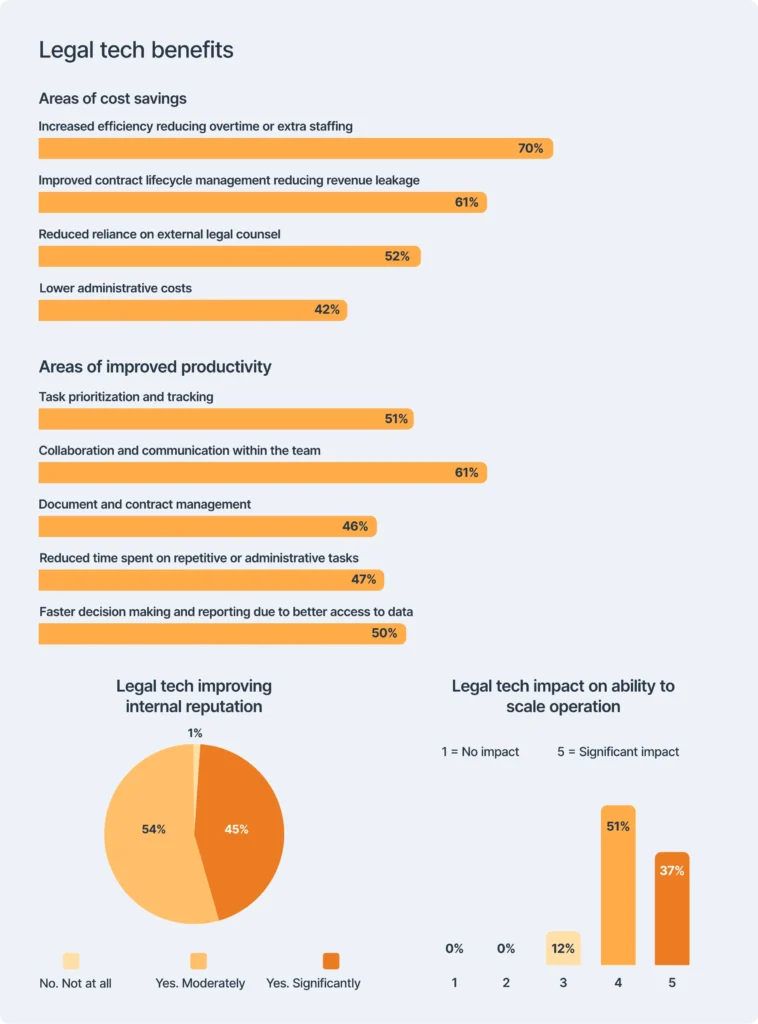
When legal teams move from ad hoc storage to modern document management, the results are tangible for both the legal team and the wider business:
- Time saved: Fewer hours wasted searching for files.
- Reduced risk: Better compliance, audit readiness, and version control.
- Cost efficiency: Less rework, lower outside counsel bills.
- Credibility: Faster response times and better transparency with the business.
In short: less time chasing documents, more time adding strategic value.
Start saving time
Searching for and managing documents and emails may feel like “just part of the job”, but it’s a major source of waste, risk and legal friction for in-house legal teams. Without centralized, contextualized, and searchable systems, lawyers spend more time hunting for files than practicing law.
“LawVu organizes our files and makes it easier for us to work on matters as a group. Sometimes, a critical issue arises, and we need to find a specific email or a document in a hurry. The search functionality on LawVu is excellent. And administering matter files is much easier on LawVu than the files based on Windows Explorer that we were using before. Another benefit to utilizing LawVu is during evenings and weekends when I am catching up on my files, I don’t have to remote into my desktop. I’m able to access the LawVu platform directly, so it is far quicker and much less laggy than the alternative. Excellent In-House File Management.” – G2 Review
A modern legal document management solution – especially one integrated with matter management – is the foundation for efficiency, compliance, and credibility. For legal teams ready to shift from firefighting to strategy, fixing document chaos is the first step.
* Businesses surveyed with mean revenue of over USD $1 billion/ GBP £750,000 per annum.
* Source: IDC White Paper, sponsored by LawVu, Legal Friction: The Real Cost to Your Business, #AP15041X, April 2025
Want to know what the benefits are (from a business perspective) when investing in an in-house legal document management system? Click here to find out!