From redlines to ROI: 7 quick AI wins for contract review
 LawVu
LawVu

Artificial intelligence may dominate conversations about the future of legal work, but many in-house legal teams are still asking a far more practical question: Can it really save time today?
Corporate legal teams are under constant pressure to move faster while maintaining oversight and managing risk. And nowhere does that pressure show up more clearly than in contract review and drafting.
From reviewing routine agreements to negotiating complex commercial contracts, contract work consumes a significant portion of in-house legal capacity. Even low-risk contracts create a steady stream of review tasks, while complex agreements add multiple negotiation rounds and internal approvals. The hidden drain isn’t just legal analysis, it’s the time spent searching for clauses, fixing formatting, and manually comparing documents.
The good news is that many of the most valuable AI use cases for contract review don’t require complex implementation. In fact, legal teams can start seeing benefits almost immediately.
As Patrick Kelley, Director of Channel Partnerships at LawVu, explained during the webinar entitled Unlock AI-powered contract management, the focus should be on practical improvements from the outset:
“We want you to think about what you can do on day one that requires not that much prep. How can you get quick time to value?”Patrick Kelley, Director of Channel Partnerships at LawVu
Rather than replacing legal judgment, today’s AI tools focus on removing the repetitive tasks that slow lawyers down. When applied to everyday drafting and review workflows, these tools can create immediate efficiency gains.
Where AI delivers immediate value in contract work
1. Instantly surface better clauses from past agreements
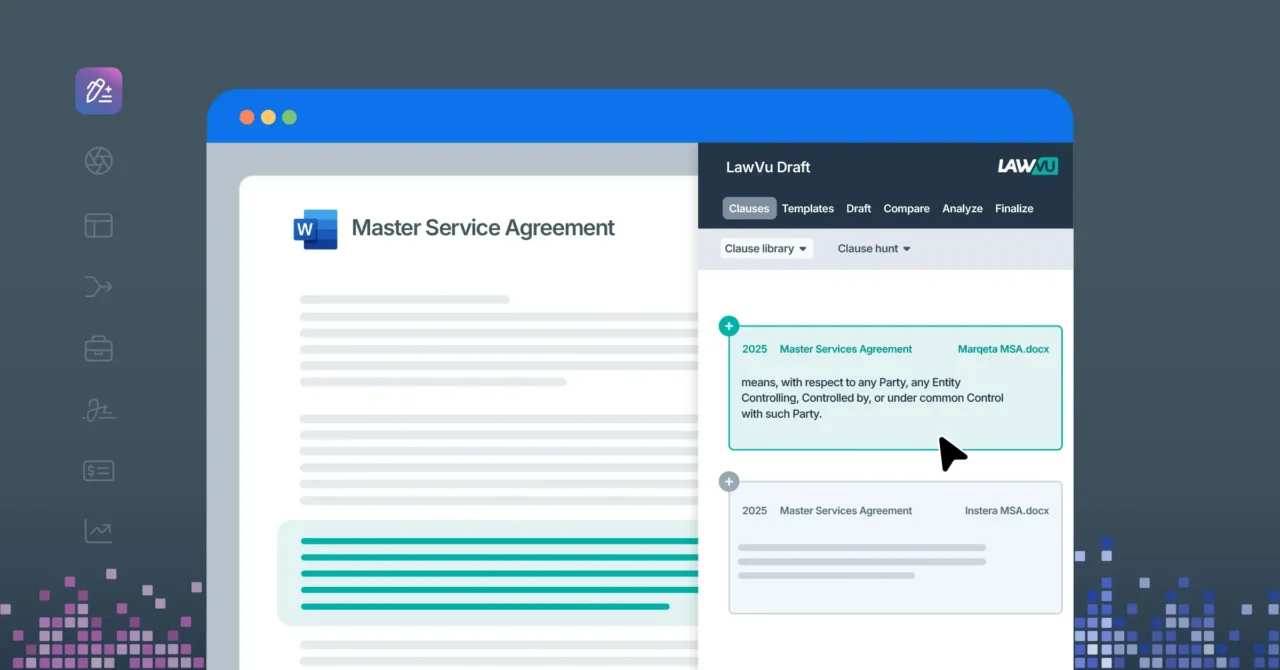
One of the fastest ways AI improves contract drafting is by making it easier to locate trusted language. Instead of digging through shared folders or past deals, lawyers can highlight a clause and instantly surface similar provisions from previous agreements. LawVu Draft’s Clause Hunt searches across an organization’s contract repository and brings back comparable language in seconds.
This allows teams to reuse clauses that have already been negotiated and approved, improving both drafting speed and consistency.
2. Merge competing clause language without formatting headaches
Contract negotiations often require blending language from multiple versions of a clause. Traditionally, lawyers copy text between documents and then spend time fixing formatting issues afterward.
AI-assisted Smart Merge functionality in LawVu Draft analyzes two clauses and allows reviewers to combine the strongest elements of each version while preserving formatting automatically.
Across dozens or hundreds of agreements, eliminating this formatting clean-up can save significant time.
3. Automatically flag clauses that deviate from your playbook
Most legal teams maintain playbooks outlining preferred contract terms. The challenge is applying those standards consistently during review.
AI-powered playbooks can analyze a document and automatically flag clauses that diverge from internal guidelines. Within LawVu Draft, reviewers see the results in a simple visual review system.
As LawVu’s Director of Product Partnerships, Ali Meredith, explained during the webinar demonstration:
“Anything that’s in red is something you want to look at… green is compliant, and orange means you may want to make some tweaks.”Ali Meredith, Director of Product Partnerships
This helps lawyers focus their attention where judgment matters most.
4. Insert consistent legal negotiation comments instantly
Contract negotiations often involve repeating the same explanations: referencing company policy, explaining risk positions, or requesting changes to familiar clauses.
AI tools allow legal teams to store these responses and insert them instantly during review. Within LawVu Draft, reviewers can apply standardized comments with a single click, ensuring consistent negotiation messaging while eliminating repetitive drafting.
Faster negotiations through smarter document insights
5. Ask the contract questions before sending it back
Generative AI also enables lawyers to interrogate a contract directly. Document chat tools allow reviewers to ask targeted questions about an agreement. For example, whether liability provisions exceed internal thresholds or whether clauses conflict with other agreements already in place.
In LawVu Draft, document chat can even compare the current agreement against other contracts stored within the LawVu workspace.
As Kelley noted, this works particularly well as a final safeguard:
“It’s that final check before you send the document back, so you don’t miss anything glaring.”Patrick Kelley, Director of Channel Partnerships at LawVu
6. Turn messy redlines into a clear summary of what changed
When a counterparty returns a heavily redlined contract, reviewing every tracked change can be time-consuming. LawVu Draft’s Summarize Changes feature automatically generates a structured departures table that categorizes edits into business, legal, or formatting changes.
Instead of scanning every edit manually, legal teams can quickly identify which revisions require attention.
7. Compare multiple contracts in minutes instead of hours
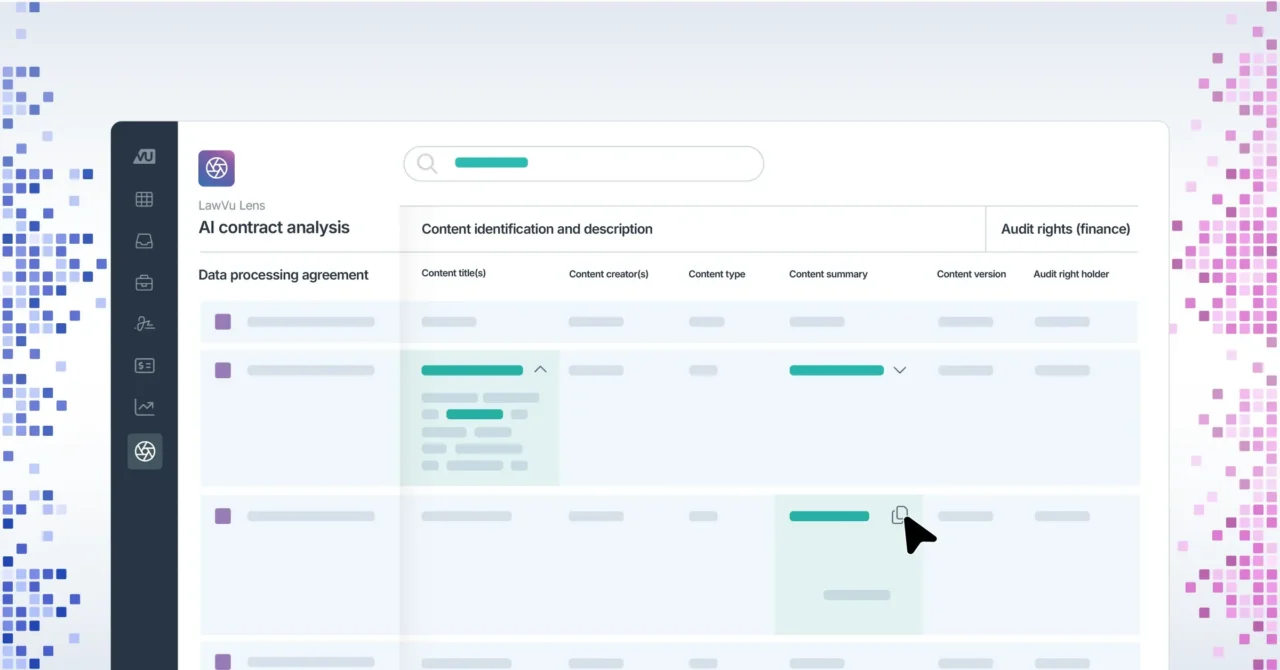
Another powerful AI capability is analyzing several agreements simultaneously. LawVu Draft’s multi-document comparison table extracts answers from multiple contracts and presents them in a structured grid. Legal teams can quickly identify patterns across agreements – such as whether termination for convenience clauses are typically accepted or how liability provisions vary between deals.
For due diligence, internal audits, or contract policy analysis, this capability can replace hours of manual document review with near-instant insights.
Moving beyond AI experiments to real ROI
Many legal teams experimenting with AI tools discover that isolated features rarely deliver the efficiency gains they hoped for. Some solutions focus solely on clause libraries. Others specialize in document chat or contract analysis.
But real contract workflows rarely involve just one task. Lawyers typically move through several stages when reviewing a contract: locating preferred clauses, reviewing against internal standards, negotiating revisions, and performing a final risk check before approval.
Tools that combine these capabilities – as LawVu Draft does within the broader LawVu legal workspace – allow legal teams to streamline these steps within a single workflow rather than switching between disconnected systems.
For teams still exploring contract management AI, the key is starting with practical use cases that deliver immediate value.
Clause search, automated playbooks, redline summaries, and cross-contract analysis may sound incremental, but together they can significantly reduce the time spent on repetitive tasks.
And when legal teams spend less time fixing formatting, rewriting comments, and manually comparing documents, they gain something far more valuable: More time to focus on the strategic work that moves the business forward.
See LawVu Draft in action to explore how AI-powered contract review can deliver practical value from day one.
You can't view the "CTA – Webinar replay – AI‑powered contract management" (#20029) item because it is in the Trash. Please restore it and try again.