AI and automation for legal operations: practical lessons from in-house teams
 LawVu
LawVu

Legal teams aren’t short on work – they’re short on time. Between contracts, internal requests, compliance demands, and ad hoc business questions, a significant chunk of every legal professional’s day is spent on tasks that frankly don’t require a law degree.
The result? Highly trained professionals doing low-value work while strategic priorities pile up.
AI is often pitched as a silver bullet. But in practice, AI in legal operations only delivers real value when it’s applied with structure, clear use cases, and strong governance controls. Without those foundations, you’re not reducing risk – you’re creating new kinds of it.
Here’s a grounded look at how in-house legal teams are using AI today: what’s working, what to watch out for, and how to adopt it in a way that actually improves efficiency.
What is AI in legal operations?
AI in legal operations refers to the use of machine learning tools to automate and augment legal workflows, including:
- Contract review and analysis
- Data extraction from agreements
- Workflow automation and intake
- Reporting and insights
Unlike traditional legal tech, AI doesn’t just store or route information – it helps interpret it.
That distinction is critical. Because while AI can accelerate work, it depends entirely on the quality of your processes and data.
What is AI in legal operations?
AI in legal operations refers to using machine learning tools to automate and augment legal workflows. In practice, that typically means:
- Contract review and clause analysis
- Structured data extraction from agreements
- Workflow automation and matter intake
- Reporting, dashboards, and operational insights
Unlike traditional legal tech, which stores or routes information, AI helps interpret it. That distinction matters. Because while AI can significantly accelerate legal work, its quality depends entirely on the processes and data underneath it.
The real problem: too much time on low-value work
Most inefficiencies in legal operations aren’t caused by one big failure. They’re the result of hundreds of small ones – reviewing documents, chasing stakeholders, updating systems, answering repeat questions.
“Administrative tasks are always death by a thousand cuts. Anywhere you can minimize the back and forth that something else could take care of is incredibly helpful.”Mike Vitko, Senior Manager, Legal Operations
Individually, these tasks seem minor. Collectively, they consume hours every week – hours pulled away from strategic advisory, risk management, and business enablement.
AI’s biggest opportunity in legal isn’t replacing lawyers. It’s removing the friction around their work so they can focus on what actually requires legal expertise.
Where legal teams actually stand on AI adoption
Despite the rapid expansion of AI tools, most in-house legal teams are still early in their journey. The pattern across the market is consistent: some teams are experimenting; few have a formalized strategy, and even fewer have scaled AI meaningfully across their operations.
One of the main reasons is data sensitivity. Legal teams, particularly in regulated industries, must carefully control how data is used, stored, and processed. That makes AI adoption as much a compliance and governance decision as a technology one.
AI governance is also increasingly appearing inside contracts themselves. Organizations are asking harder questions:
- Does this AI vendor train models on our data?
- How are confidential documents handled?
- What audit controls exist?
The takeaway: most legal teams aren’t behind on AI – they’re being deliberate. And that’s the right instinct.
AI vs automation: why legal teams need both
There’s a common misconception that AI replaces automation. It doesn’t. They serve fundamentally different roles:
- Automation creates structure: routing work, enforcing workflows, moving data between systems
- AI creates insight: interpreting text, extracting meaning, answering unstructured questions
The most effective legal operations functions use both together. Automation ensures contract data is captured consistently. AI makes that data searchable, usable, and actionable.
“It really comes down to where your source of truth is.”Mike Vitko, Senior Manager, Legal Operations
Without structured processes and clean data, AI produces unreliable outputs. Without AI, automation remains limited in scope. They’re complementary – not interchangeable.
Real use cases of AI in legal operations that deliver ROI
Successful AI adoption in legal operations tends to follow a consistent pattern: start small, focus on repeatable work, and scale only after proving reliability.
Contract review that genuinely saves time
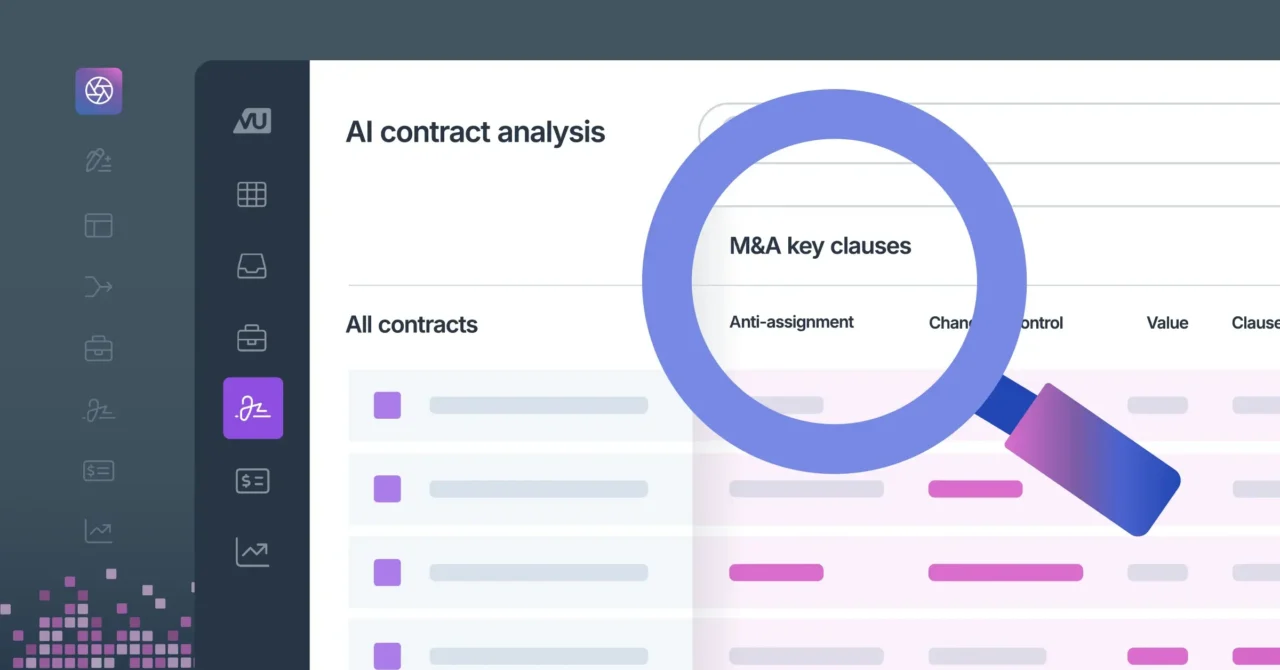
Contract review is one of the highest-impact AI use cases in legal. Instead of manually reading agreements clause by clause, teams use AI to:
- Ask targeted questions about specific contract terms
- Identify obligations, risks, or non-standard language
- Summarize key terms quickly before a call or negotiation
In practice, this can reduce review time from 10–15 minutes per contract to around 90 seconds. The shift is significant: lawyers spend less time searching for information and more time actually analyzing it.
Explore how AI can support your legal operations – without adding complexity.

Structured data extraction at scale
Contracts contain valuable structured data, but extracting it manually is slow and inconsistent.
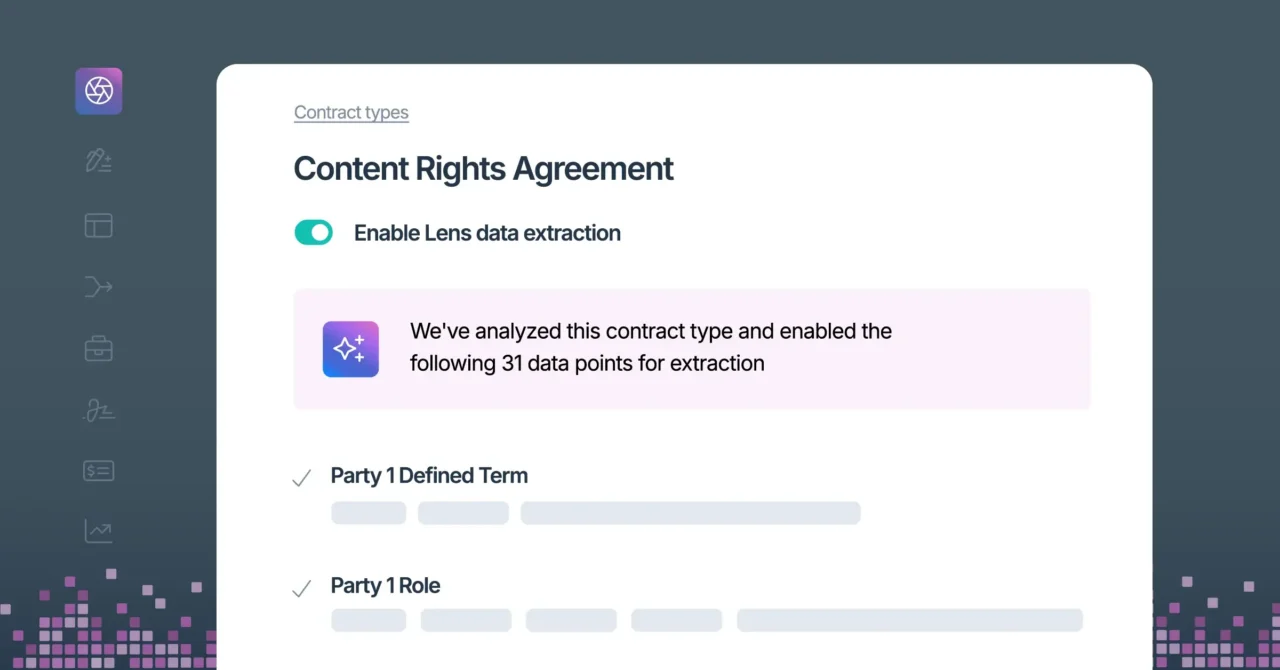
AI enables instant extraction of:
- Effective dates
- Payment terms
- Renewal conditions
This is particularly valuable for reporting, compliance tracking, and operational visibility.
Workflow automation across business systems
Legal doesn’t operate in isolation. It connects with finance, procurement, HR, and sales.
Using automation alongside AI, teams can:
- Sync contract data with financial systems
- Trigger workflows automatically
- Eliminate duplicate data entry
This ensures legal data flows across the business, not just within legal.
The pattern behind every successful use cases
Across every successful legal ops team, the same approach holds:
- Target high-volume, repeatable work first
- Start with low-risk use cases
- Build on structured, well-maintained processes
AI doesn’t create efficiency on its own; it amplifies what already works. If the underlying process is broken, AI will just accelerate the mess.
The biggest risk: over trusting AI outputs
AI is powerful, but it is not always accurate. Outputs can be inconsistent, incorrect, or subtly misleading – even when analyzing the same contract. Different tools analyzing the same document can return different answers.
That’s why the guiding principle for AI in legal operations is simple: trust but verify.
Legal teams need to:
- Validate AI outputs before acting on them
- Spot-check results regularly, especially in high-stakes work
- Maintain human oversight as a non-negotiable layer
The risk isn’t using AI. The risk is using it blindly. AI should accelerate legal work – not replace the judgment that makes legal work defensible.
How to implement AI in legal operations safely
The most effective teams treat AI implementation as a controlled process, not a big-bang rollout. Here’s a practical framework:
1. Start with a controlled dataset
Use contracts where outcomes are already known so you can measure accuracy before relying on the tool in production.
2. Test outputs against reality
Don’t assume the tool is working correctly. Measure it.
3. Define acceptable risk levels by contract type
- Low risk – vendor agreements, event contracts
- High risk – customer agreements, regulated data
4. Scale gradually
Expand AI use only after proving reliability. Build trust through demonstrated results – not assumptions.
Why your source of truth matters more than AI
As organizations adopt multiple tools, inconsistency becomes a major risk. If different systems interpret the same contract differently, which one do you trust?
The answer is to establish a single source of truth before you scale AI.
For most legal teams, this is a centralized platform – a contract lifecycle management (CLM) system or a dedicated legal workspace that manages contracts, matters, and spend data in one place.
That system should:
- Store authoritative contract data and metadata
- Define key terms consistently across the organization
- Serve as the foundation for all reporting and AI queries
AI should sit on top of your source of truth – not replace it. Without that foundation, AI will create confusion instead of clarity.
Change management: why AI projects fail
Most AI projects in legal don’t fail because of technology. They fail because of adoption.
Legal teams have to balance rigorous compliance requirements with business demand for speed and simplicity. If workflows become too complex or time-consuming, users will bypass them — and your carefully built system falls apart.
The teams that succeed tend to:
- Involve business stakeholders early in the process design
- Build intuitive, low-friction workflows that people actually want to use
- Communicate the ‘why’ clearly, not just the ‘what’
Technology doesn’t drive adoption. People do. And people adopt tools that make their lives easier, not harder.
Prompting: the overlooked skill in AI legal operations
One thing that doesn’t get enough attention: AI performance depends heavily on how it’s instructed. The quality of your prompts directly determines the quality of your outputs.
Effective prompting in a legal context requires:
- Precision: ask for exactly what you need
- Context: tell the AI what type of document it’s reviewing and what’s important
- Iteration: refine prompts over time based on what works
For example, instead of asking “What is the contract date?” – a stronger prompt specifies which date (effective, execution, expiry), where it typically appears in this contract type, and how ambiguous cases should be handled.
Over time, well-crafted prompt libraries have become a genuine competitive advantage for legal teams. Good prompting is what turns AI from a novelty into a reliable, repeatable tool.
3 key takeaways for legal teams adopting AI
1. Start with the problem, not the technology
Most legal teams don’t have an AI problem – they have a process problem.
Before evaluating tools, identify the repeatable, high-volume work where AI can reduce friction without adding risk.
- What keeps coming to your desk?
- What contract types are you reviewing over and over?
That’s where you start.
2. Define your source of truth early
Without a single, authoritative system for contract and matter data, AI will produce inconsistent, conflicting outputs. Establish your data foundation first.
3. Trust – but always verify
AI accelerates work – but human judgment ensures it’s accurate and defensible. Never skip the validation step, especially in high stakes matters.
Where LawVu fits in
To make AI in legal operations effective, teams need a strong foundation.
LawVu provides:
- A centralized legal workspace for contracts, matters, and spend
- A single source of truth across legal data
- Embedded AI across workflows
This enables legal teams to:
- Reduce manual work
- Improve turnaround times
- Increase visibility across the business
Legal teams using LawVu save 3+ hours per week per professional
Final thoughts: AI doesn’t fix broken processes
AI is genuinely transforming legal operations. But it isn’t a shortcut to efficiency, and it’s not a replacement for good process design.
The legal teams seeing the most success are not adopting AI the fastest – they’re applying it the most thoughtfully.
They focus on real specific problems. They build on strong processes first. And they scale based on proven results, not hype.
Because here’s the truth: AI doesn’t fix broken processes – it accelerates them. Get the foundation right first, and AI becomes a genuine force multiplier for your team.