AI Contract Review for MSAs: Faster, Smarter Negotiation
 Shaun Plant
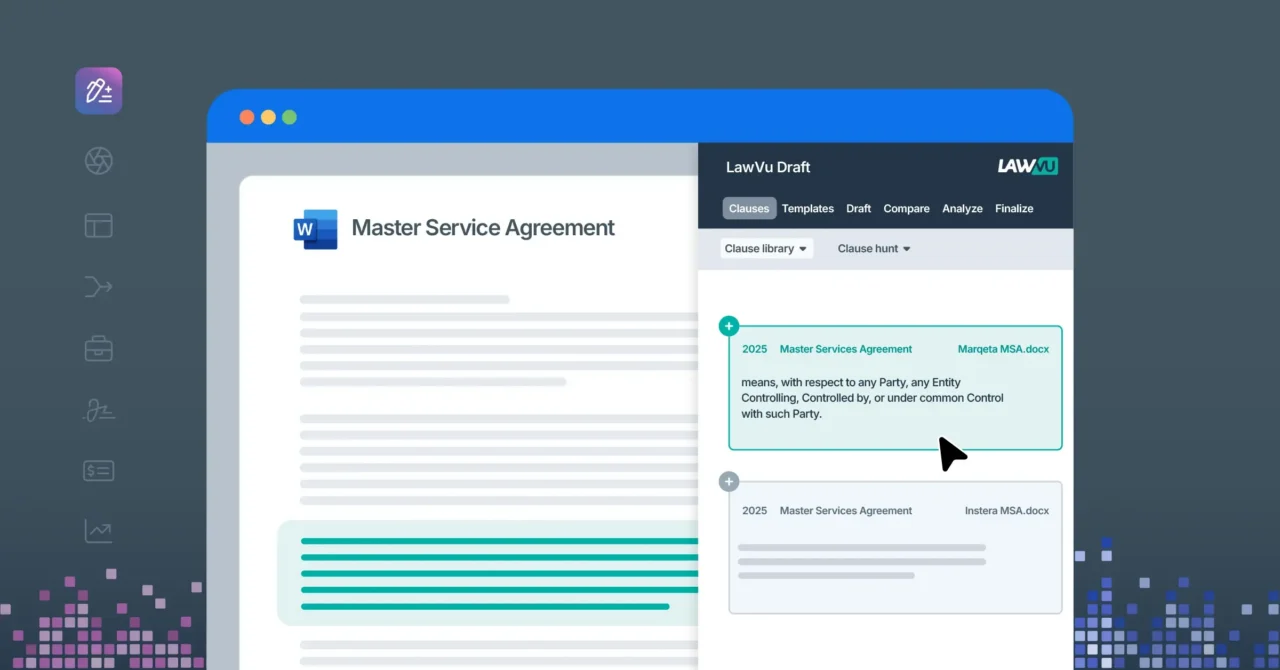
Lawyers frequently see themselves as being in the business of risk, which shapes how they think and behave, often making them meticulous as they trawl through contracts to ensure every clause is watertight. And while this way of working has its merits, when legal sees itself as a risk function it can contribute to the ‘laggard’ label legal teams often end up wearing, despite the fact that legal was never meant to simply mitigate risk, but to enable the business to move forward.
Technology has revolutionized the business world, creating data-driven, effective businesses that harness insights for efficacy. In-house legal teams are under pressure to adapt and catch up with the rest of the business, utilizing software to increase the output and value of their function.
Throughout my 30-year career, I’ve witnessed significant developments in multiple business functions: sales close deals faster than ever; finance has real-time visibility, and marketing teams harness customer and client data to their advantage.
But legal teams have been hesitant to change. Contract review and negotiation are still largely manual, absorbing time that could otherwise be spent on higher-value, strategic contributions. Why? Because the way we review contracts hasn’t really changed, even though the business around it has. In essence, it’s not the lawyers who are outdated; it’s the process and tools they are working with.
Why MSA review is slow
I’ve reviewed more contracts than I could ever begin to count, and if there’s one thing I’ve learned, it’s this: most contract reviews take far longer than they should. Sure, some contracts can be complicated, such as Master Service Agreements (MSA), which are not simple one-off agreements, but long-term framework contracts designed to govern multiple service types, Statements of Work (SOWs), pricing models, and evolving commercial arrangements over time.
The complicated nature of MSA review is fundamentally different from a standalone supply agreement or NDA. It is built to deal with complexity, not just for today’s deal but also for future SOWs and potentially different service types altogether. Because MSAs are designed to cover a broad range of service types, they can be increasingly challenging when a provider is just supplying one component of the service types. Take for instance, a SaaS provider faced with a client’s MSA that is drafted to cover custom development, hardware and software procurement, and professional services. The provider will see potential risk between the SaaS clauses and those of the custom development and professional services, having to review all sections to ensure unintended cross-application doesn’t occur. And this is precisely why MSA review often requires a structured, contextual analysis rather than a skim through.
Another root cause of the dragging contract review processes is timing. Many in-house lawyers use email to manage their work. A contract will land in your inbox, and it may sit there for a few days because inboxes are noisy environments, with notifications for important legal work competing against less important operational updates, internal chatter, and general business correspondence. Eventually, you review it, send it back to the other party, where it sits in their inbox for just as long.
I see this all the time. If it takes me three or four days to look at a contract, the other party will generally take the same approach. Before you know it, the deal has lost momentum, and no one can quite put their finger on why.
Delays in contract review are normal, not because they add value (we all know they don’t), but rather because nothing in the process pushes us to work any differently.
We focus on the wrong things
I’m a firm believer that one of the major handbrakes in the contract review process is where counsel chooses to focus on their energy, which is too often on the stylistic, rather than the contractual.
I have been guilty of taking to a contract with a red pen, obsessing over language, syntax, punctuation, and formatting. But the truth is that while redlining can give counsel a sense of control and importance, it is often based on personal preference and not on changing contractual risk.
While this type of review appears thorough and suggests work is being done, it is merely noise preventing the deal itself from progressing or any value being added to the business. Not to mention, it’s frustrating for counsel and the business, creating friction, slowing negotiation, and often resulting in escalations that could be avoided.
You can't view the "CTA – Contract Intelligence – web banner 1" (#19902) item because it is in the Trash. Please restore it and try again.
What a “good” MSA review looks like
In my opinion, a good MSA review is not about touching every clause. Rather, it’s about knowing one’s risk position thoroughly and focusing on the parts of the contract that relate to that risk. Everything else is secondary.
Not every clause deserves the same level of attention, and going through them line by line is where time gets wasted. As a lawyer, you know which areas keep you up at night, and that’s where your focus should be. High-risk clauses are often focused on liability, warranties, indemnities, or termination, as they can genuinely impact the business.
A good review is about judgment. Knowing what to push on, what to accept, and what to leave alone.
Why consistency matters more than rewriting
Clause swapping is a major culprit when it comes to slowing down MSA negotiation, particularly where consistency across multiple customer relationships matter.
Instead of working with the pre-existing language in the contract, lawyers often drop in their own preferred clauses because that language makes them feel comfortable. The result is a contract that feels disjointed and harder to read.
But inconsistency is not just a stylistic issue. If your liability language varies across customers, or your IP position subtly shifts between agreements, you are effectively managing risk differently without intending to. Over time, that creates governance issues and commercial uncertainty.
Put yourself in the opposing counsel’s shoes for a moment. When they see entire clauses replaced with no explanation, they start to wonder what’s really going on. Why has this changed? What are we missing? Are they trying to sneak something through?
Most of the time, that suspicion is completely unfounded and, more importantly, completely avoidable.
If a clause says the same thing but in slightly different language, I’d recommend keeping it, and if you are making changes, always explain them; it builds trust and makes negotiation far smoother.
Speed changes behavior and outcomes
One of the most effective ways to move a deal forward is simply to move faster. If I can turn a review around quickly, it changes how the other party responds by putting pressure on them to do the same. Let’s face it, no one wants to be the bottleneck, especially when the business is copied into the conversation.
Speed matters even more when time to market is critical. This is especially true with MSAs, where delays do not just stall a single transaction but can hold up an entire commercial relationship and the SOWs that sit beneath it. If the potential to earn revenue is there from day dot, I’m not interested in perfecting every clause. I’ll focus on the two or three things that genuinely matter and get the deal done.
I’ve seen teams spend months negotiating the most robust, watertight contract imaginable, but in doing so kill the deal or the inception of others. That’s not risk management; that’s a missed opportunity. And it’s certainly not positioning the legal function as a value-add for the organization.
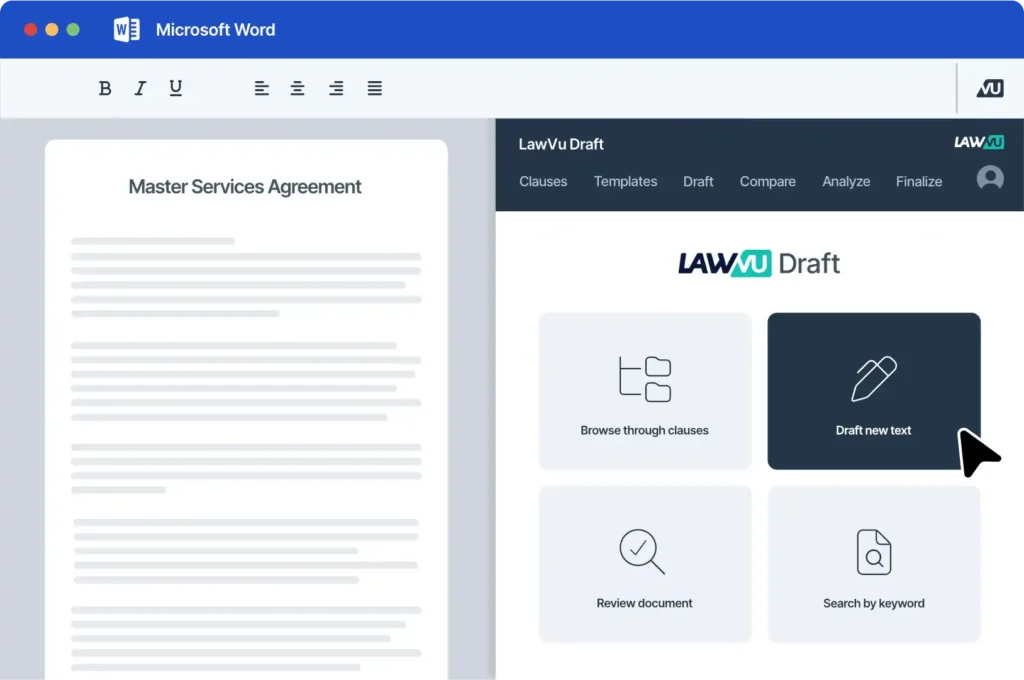
Where LawVu Draft fits – without the hype
Contract review is an area of legal work where technology can make a real difference. Not by replacing lawyers, and not by rewriting contracts for the sake of it, but by removing the repetitive work that doesn’t require human judgment.
AI tools have the power to do away with the extensive, clause-by-clause redlining that many teams still find themselves bound to. AI tools such as LawVu Draft can reduce review time, surface risks instantly, and ensure contract consistency, especially important for MSAs where risk positions must be applied consistently across complex, interdependent clauses. LawVu Draft does this by:
- Instantly surfacing relevant clauses and comparing them against approved positions
- Following guided review playbooks based on real risk
- Using approved language without breaking consistency
- Applying automated redlines with an explanation for the other party
From an in-house counsel’s perspective, it removes frustration by eliminating friction from everyday work. It helps standardize language across the team, reducing the risk that comes from inconsistent drafting. It avoids constant interruptions from colleagues asking if you have seen something similar before or time wasted hunting past contracts. It also makes it far easier for new hires to draft in line with the organization’s established approach to managing risk, so they are adding value from day one.
If you are a General Counsel, this creates consistency and confidence. Knowing the team is reviewing contracts against agreed positions rather than making judgment calls under pressure or spending time looking for non-issues. If you are an in-house lawyer, it removes a huge amount of stress because you know each review has been done thoroughly and consistently.
LawVu Draft use cases
Answering simple questions can create huge headaches and waste oodles of time for in-house lawyers reviewing contracts.
For example:
- Does this document conflict with another agreement we already have in place?
- Does it align with the MSA, the SOW, or a side letter?
- Does it take a different position than what we have agreed with this customer elsewhere, or what our policies require?
Finding answers to those questions typically involves finding and opening multiple documents, endless scrolling, searching for similar language, relying on memory or instinct, or even distracting colleagues to identify differences that may or may not be significant.
With document chat in LawVu Draft, you can ask those questions directly.
You can ask whether the current document contains any conflicting provisions, either internally or when compared to other documents in your workspace. Draft will highlight the differences, surface the relevant clauses, and let you preview them side by side.
You can ask whether the agreement aligns with related documents such as an MSA or SOW, existing agreements with the same counterparty, or internal policies and playbooks, all based on the documents you choose to save in your workspace.
Contract review stops being a memory test, and the risk of inconsistent positions across agreements is reduced as they are reviewed in context.
A better standard for MSA review
MSAs are long-term governance documents, so reviewing them in isolation or relying on memory is no longer sustainable. They require structured, playbook-driven review against established risk positions, particularly when the counterparty paper attempts to cover multiple service types in one document.
However, for most in-house teams without legal specific technology, they are left to piece together their review manually, searching old agreements, relying on personal recollection of past negotiations, and checking precedents that may or may not reflect current positions. This disconnected approach is clunky and slow, introducing delay not because the issues are complex, but because the process itself is fragmented. Each review becomes a fresh exercise in reconstruction rather than a consistent application of known risk positions.
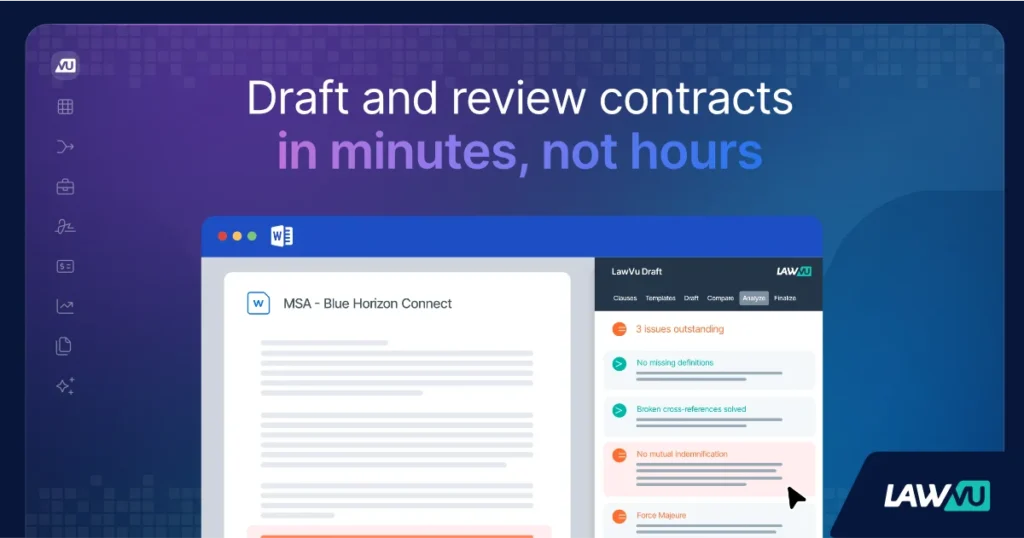
LawVu Draft solves that fragmented way of working. Once an MSA lands in your inbox, LawVu Draft reviews it against your established playbook positions within seconds and provides you with a clear, color-coded view of any issues.
- Red – clauses that are inconsistent with your position and need attention
- Amber – clauses that are not fully aligned but are worth a closer look
- Green – clauses are all good and there’s nothing to worry about
Each issue is explained in plain language, with the ability to jump straight to the relevant clause, select a suggested redraft, and insert it as a tracked change. Third-party contracts, no matter how complex, are as simple as that.
The reality is that MSAs are not slow because they are complex. They are slow because we review them manually. When you combine structured playbooks, contextual clause comparison, and cross-document analysis inside your legal workspace, even the most detailed third-party MSA becomes manageable in minutes rather than hours.
While there are plenty of tools that offer AI contract review and drafting, most cannot replicate the power of AI operating inside a legal workspace, securely leveraging your contracts, your history, and your institutional knowledge. LawVu Draft does this.
Review MSAs in minutes – not hours
Manual redlining and inconsistent clause swaps slow deals down and introduce unnecessary risk. With Contract Intelligence powered by LawVu Draft, you can apply playbooks instantly, surface real risk, and negotiate with speed and consistency.
See how LawVu helps in-house legal teams review smarter, draft faster, and move forward with confidence.
Explore Contract Intelligence for contract review and negotiation.